



What if you had a battery that could keep working for decades without ever needing a recharge? That’s the idea behind betavoltaic batteries. Instead of storing chemical energy like the batteries in your phone, these devices generate power from the steady stream of particles released as certain materials naturally decay.
How They Work
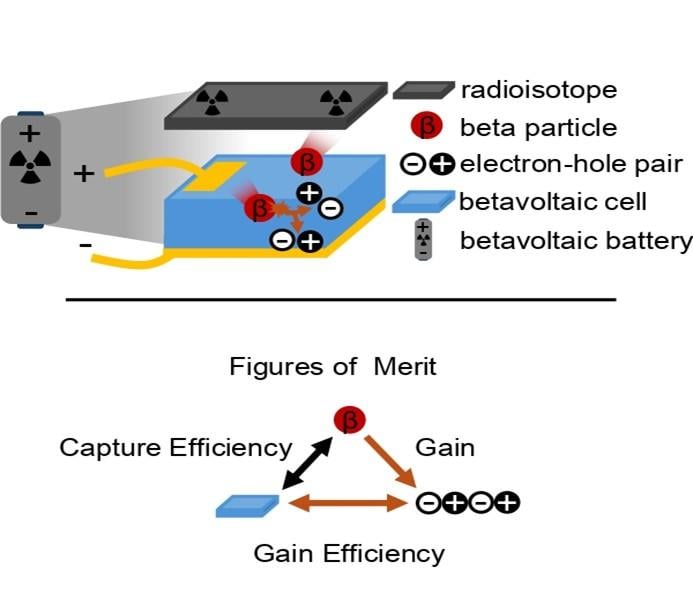
At their core, betavoltaic batteries use tiny semiconductor junctions to capture the energy from beta particles—high-speed electrons that are emitted during radioactive decay. When those particles strike the semiconductor, they knock electrons loose, creating an electrical current. It’s similar in spirit to how solar panels convert light into electricity, only here the “light” is replaced by particles from a radioactive source.
Where They Shine
These batteries don’t produce much power—nowhere near enough to run your laptop or charge an EV. But what they do offer is incredible longevity. Because radioactive decay is constant and predictable, a well-designed betavoltaic battery can last decades with almost no maintenance. That makes them a strong fit for medical implants like pacemakers, sensors in remote or harsh environments, or even space probes that need to operate far from the Sun.
The Latest News
Now, researchers at the University of Ottawa, working with Canadian Nuclear Laboratories, are pushing the technology closer to real-world use. Their team has come up with three clear performance benchmarks—capture efficiency, gain, and gain efficiency—that make it easier to measure and compare different designs. In other words, they’re giving scientists and engineers a common language to evaluate these batteries and speed up progress.
Assistant Professor Mathieu de Lafontaine, who helped lead the effort, explained that having standardized metrics will let researchers “compare betavoltaic cells simply and accurately.” It’s a step that could make the race to commercialization much faster, bringing betavoltaic batteries out of the lab and into practical applications.
Why It Matters
The University of Ottawa’s work doesn’t just represent a research milestone—it’s a bridge to the next stage of energy innovation. By removing the guesswork and giving the field a way to measure success, they’ve laid the foundation for longer-lasting power sources in places where changing a battery just isn’t an option.
Original Story: University of Ottawa joins the race for the commercialization of betavoltaic batteries | About us