
For engineers working with metal halide perovskites, humidity has always been a dealbreaker. These promising materials could power brighter LEDs, faster detectors, and more efficient lasers, but even a slight change in moisture during production can ruin them. Labs have relied on painstakingly controlled cleanroom environments and months of trial and error to coax stable films into existence. The process is slow, costly, and often unpredictable.
Now researchers at Lawrence Berkeley National Laboratory say a robot can do the job in weeks — and the films may be far more tolerant to humidity than anyone expected.
Why Perovskites Are Tricky
Metal halide perovskites are considered one of the most exciting classes of optoelectronic materials. Their performance potential is high, but their sensitivity to fabrication conditions has kept them from scaling. Small shifts in humidity, heating time, or precursor treatment can turn a good film into a failed one. Traditionally, optimizing these variables meant running thousands of experiments, one at a time, over the span of a year or more.
For engineers, this has been the barrier between promising lab science and practical device design.
A Smarter Approach
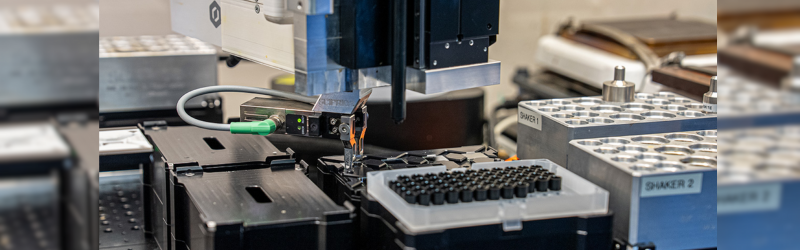
The Berkeley team built “AutoBot,” an automated platform that combines robotics, rapid material characterization, and machine learning. Instead of testing every possible recipe for making perovskite films, AutoBot runs a select batch of experiments, analyzes the results, and predicts the most promising next steps.
In practice, that means exploring more than 5,000 possible synthesis pathways while only physically testing a fraction of them. What would normally take researchers over a year of work was compressed into just a few weeks.
What the Robot Found
AutoBot uncovered something unexpected: high-quality perovskite films can be made reliably in environments with 5 to 25 percent humidity. That range is far easier and less expensive to maintain than the ultra-dry conditions many labs assumed were essential. Push humidity above 25 percent and the films degrade rapidly, but within the sweet spot the material remains stable.
For engineers, that single insight could reshape manufacturing strategies. Instead of investing heavily in ultra-low-humidity cleanrooms, production environments could be simplified and scaled at lower cost.
Why It Matters
This research does more than point to better perovskite films. It demonstrates that autonomous experimentation can attack the bottlenecks that slow material discovery and optimization. By cutting years of repetitive testing down to weeks, systems like AutoBot let scientists move faster from idea to usable technology.
While the team focused on perovskites, the same framework could be applied to semiconductors, polymers, or advanced composites — any material where small process changes make a big difference in performance.
Conclusion
Engineers know that a good material isn’t truly useful until it can be produced reliably and at scale. By teaching a robot to learn the conditions for success, the Berkeley team has turned one of the most fragile candidates for next-generation electronics into something far more practical. And in doing so, they’ve offered a glimpse of how future labs may operate: not just running experiments, but learning from them in real time.
Read the full story: Optimized Materials in a Flash – Berkeley Lab News Center