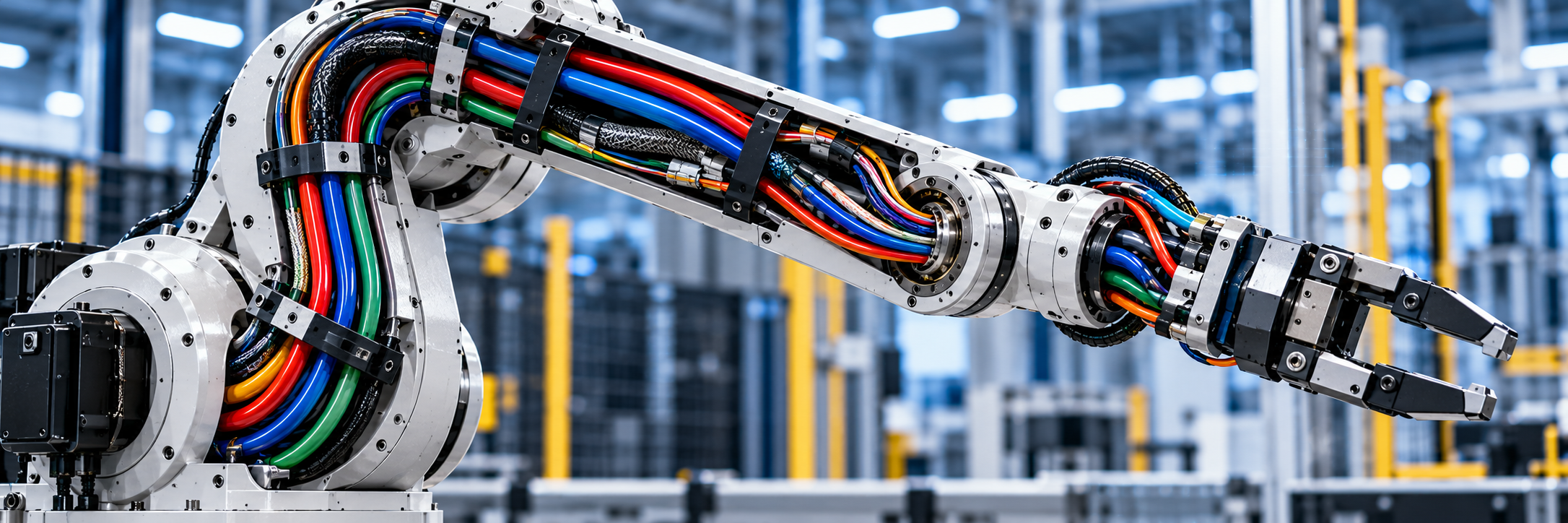
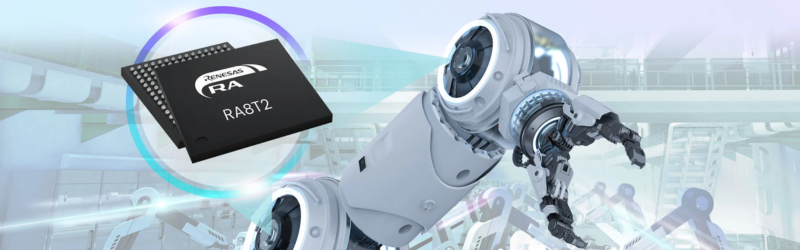
Renesas has released its RA8T2 microcontroller (MCU) series, designed for advanced motor control in robotics, factory automation, and precision industrial equipment. These devices combine high processing power, integrated networking, and motor-focused peripherals to meet the demands of next-generation motion systems.
What Sets RA8T2 Apart
-
Dual-core architecture: A 1 GHz Arm® Cortex®-M85 core with an optional 250 MHz Cortex-M33 enables real-time control and communication tasks to run on a single device, reducing system cost and complexity.
-
Helium technology for DSP and AI: Built-in support for Arm Helium accelerates digital signal processing and machine learning workloads, enabling on-device prediction, diagnostics, and optimized control.
-
High-speed networking: Dual Gigabit Ethernet MACs with DMA, a two-port EtherCAT slave, and a full range of industrial interfaces (USB, CAN FD, SPI, I²C) allow controllers to stay tightly synchronized across factory networks.
-
Memory optimized for real-time control: Up to 1 MB of MRAM provides fast writes and endurance, paired with large SRAM and TCM blocks for deterministic operation.
-
Motor-centric peripherals: Advanced PWM timers, high-speed dual ADCs for phase current sensing, comparators, and integrated safety features support precise and reliable motor operation.
Why It Matters
Motor control applications demand tighter loops, faster response, and seamless integration with networked systems. The RA8T2 series addresses these needs by delivering:
-
High compute performance with DSP/AI acceleration
-
Deterministic real-time behavior
-
Native industrial networking support
-
Integrated motor-control peripherals to reduce external components
This combination simplifies design, lowers bill of materials, and provides engineers with the headroom needed to tackle increasingly complex motion systems.
Target Applications
-
Robotics and factory automation
-
Servo drives and motion controllers
-
Multi-axis coordinated systems
-
Smart motor controllers with built-in diagnostics and predictive maintenance