

As artificial intelligence workloads continue to grow, data centers are approaching power consumption levels once reserved for industrial grids. In response, ROHM Semiconductor has released a white paper exploring next-generation 800 VDC architectures—a step toward more efficient, scalable, and sustainable power distribution for gigawatt-scale AI infrastructure.
The paper builds on ROHM’s ongoing collaborations with major industry players, including NVIDIA and Delta Electronics, to define system-level strategies that support higher-voltage operation across AI power networks. It outlines how the transition from conventional 48 V or 12 V DC systems to 800 VDC could improve overall efficiency, reduce conversion losses, and simplify rack-level power management.
Why 800 VDC Matters
AI data centers are facing dramatic increases in rack-level power consumption, often exceeding the limits of traditional low-voltage systems. The 800 VDC approach relocates AC-DC conversion from individual server racks to a centralized power rack, which then distributes high-voltage DC throughout the facility. This enables tighter integration of GPUs, smaller passive components, and improved thermal management at the IT rack level.
Wide Bandgap Devices at the Core
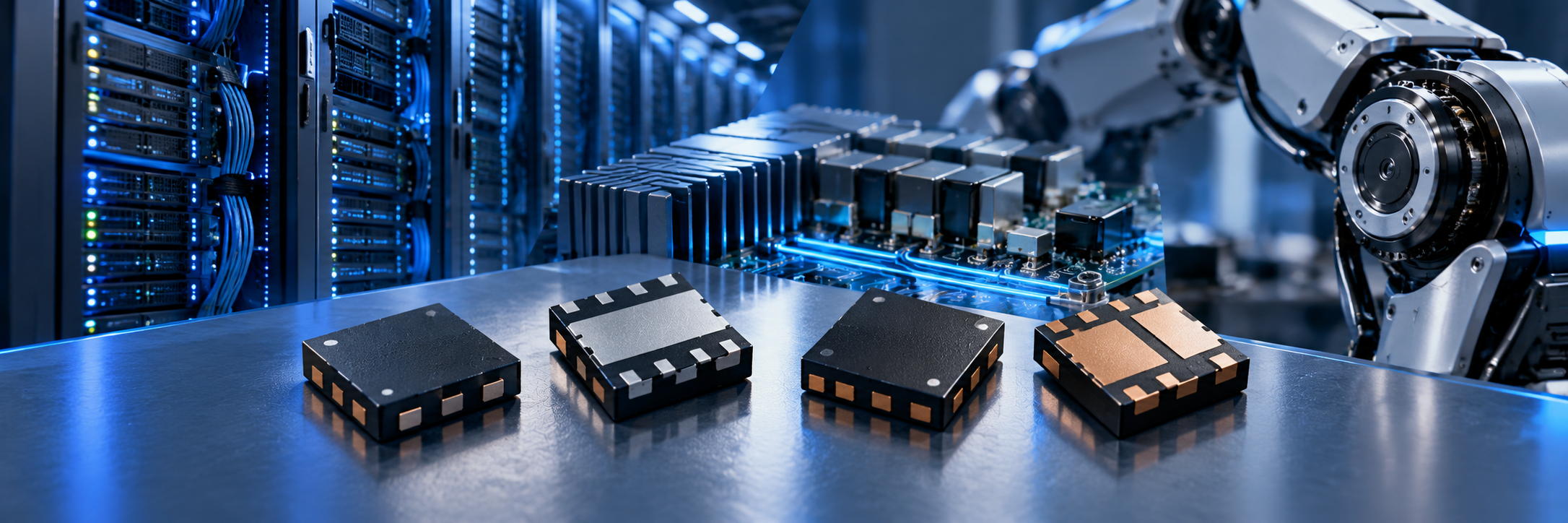
The paper highlights the essential role of silicon carbide (SiC) and gallium nitride (GaN) technologies in enabling this high-efficiency power model. ROHM’s EcoSiC™ and EcoGaN™ series are featured for their ability to operate at high switching frequencies and elevated power densities.
-
EcoSiC™ modules provide low on-resistance and support top-side cooling, improving heat dissipation for AI server environments.
-
EcoGaN™ integrates ROHM’s Nano Pulse Control™ technology, allowing for stable, ultra-fast gate drive and reduced power conversion noise.
Design Insights from the White Paper
The publication covers several key engineering considerations:
-
Thermal simulation methods for power distribution boards
-
Conversion topologies from AC to 800 VDC and from 800 VDC to point-of-load voltages
-
Practical examples of rack-level implementation and component selection
These insights provide design engineers with a realistic view of what’s required to support the next generation of AI-driven, high-density computing systems.
Collaborative Development
ROHM’s participation in the 800 VDC ecosystem is part of a broader movement to standardize power distribution at higher voltages across hyperscale data centers. By combining wide bandgap devices, analog IC expertise, and thermal modeling, the company aims to contribute to the collective shift toward more efficient AI power architectures.
The full white paper, “Power Solutions for Next-Generation 800 VDC Architecture,” is available now. Access it here.