

The year ahead is shaping up to be a major turning point for the technology world. According to TrendForce, several long-building shifts in computing, memory, storage, and device design are set to collide in 2026—pushing the industry into a new phase defined by heavier workloads, denser infrastructure, and more demanding system requirements.
The changes forecasted are tied to very real pressures: growing data center construction, new national cloud initiatives, component shortages, rising memory prices, and the increasing weight of compute-intensive tasks on hardware.
Data Centers Enter a New Growth Phase
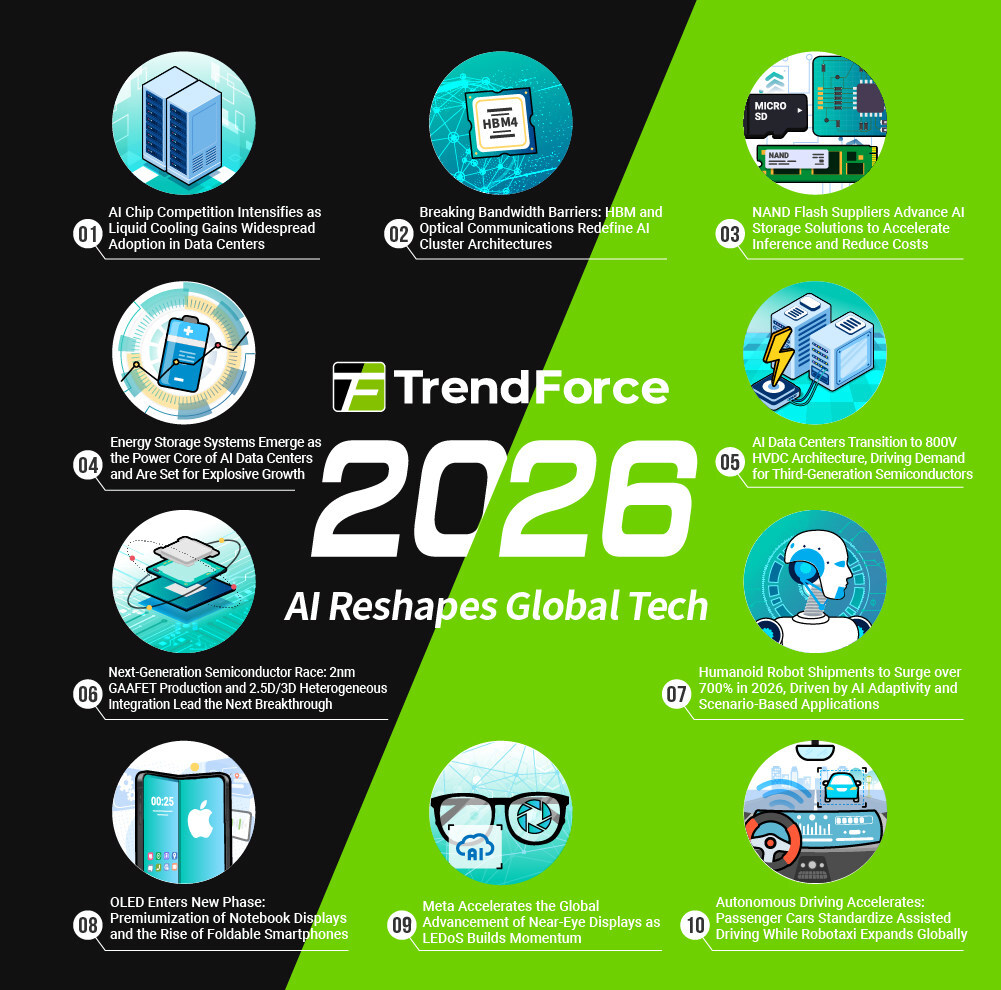
One of the biggest drivers is the rapid expansion of data centers. Cloud providers and national governments are pouring money into new facilities designed to carry far more processing and storage than previous generations. TrendForce expects AI-server shipments alone to grow more than 20% in 2026, and that expansion will cascade through nearly every part of the supply chain.
More servers mean more GPUs, more accelerators, more high-capacity power systems, and more high-speed interconnects. It also means more heat. Cooling infrastructure—which already consumes a significant share of data center operating costs—is becoming a central design constraint. Engineers will need to find ways to improve thermal performance while keeping energy consumption manageable, especially as rack densities increase.
Memory Prices and Supply Under Pressure
Memory has quietly become one of the most strained parts of the component ecosystem. Systems built for heavy workloads are pushing capacities higher, while supply remains tight. This is especially true for DDR5 and other modern DRAM types, where production hasn’t kept pace with demand.
TrendForce notes that memory prices are already trending upward—a pattern expected to continue into 2026. For designers, this means two things: careful planning around bill-of-materials cost, and a closer look at memory efficiency. Systems that use capacity intelligently—or rely on faster, higher-throughput designs rather than brute-force expansion—will have an advantage.
Storage Is Shifting Away From HDDs
Another major trend is the move to heavier storage requirements. Traditional HDDs are slowly being edged out in many enterprise environments as workloads require more sustained throughput and better durability.
High-capacity SSDs are becoming the preferred choice for nearline storage and data-rich applications. They support faster access, lower latency, and better performance under continuous load. As data centers grow in size and capability, SSD-based designs will likely dominate new deployments.
Ripple Effects Across Consumer Electronics
While much of the growth is happening in the cloud, the impact won’t stop there. Changes in supply chains and component availability will affect everything from laptops to smartphones to AR/VR headsets. Displays may shift toward more advanced panel types as manufacturers adapt production strategies. Devices that rely on high-performance memory or storage will see both benefits and constraints driven by the larger industry cycle.
2026 is also expected to bring a renewed push for efficient power management across mobile and consumer electronics. As systems become more capable, they also draw more power, and battery capacity hasn’t advanced at the same rate. Engineers will need smarter power-allocation strategies and more efficient components.
Design Considerations for Engineers in 2026
If you’re building hardware or supporting infrastructure, several practical themes emerge:
-
Plan for memory constraints. Prices are rising, and supply won’t be unlimited.
-
Design for thermal efficiency. Higher densities and more demanding workloads will make heat one of the toughest challenges.
-
Consider modular, scalable architectures. Systems that can grow without major redesigns will fare better in fast-evolving environments.
-
Pay attention to storage longevity and throughput. SSD-heavy designs will increasingly become the norm.
-
Expect display and device components to shift. Availability and pricing may influence design choices early in the cycle.
A Transition Year for the Hardware World
TrendForce’s outlook suggests that 2026 won’t just be another incremental year. It’s shaping up to be a period where long-term pressures—data growth, component supply, system complexity, and global infrastructure demands—push the industry in new directions. Companies that anticipate these shifts early, especially at the component and system-architecture level, will be better positioned to build reliable, scalable, next-generation products.
Original Release: AI to Reshape the Global Technology Landscape in 2026, Says TrendForce