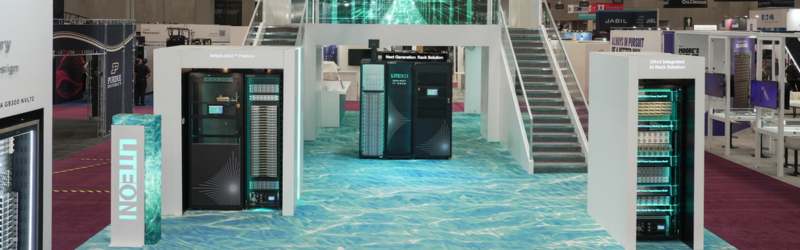
The infrastructure build-out behind high-performance and AI computing is entering a new, more integrated phase. LITEON now offers rack-level power, cooling, and mechanical infrastructure built to support full-scale AI workloads and data-center-class high-performance computing (HPC). These solutions aren’t about incremental upgrades — they’re meant to form the foundation for what modern data centers will look like once AI and HPC workloads become the norm, not the exception.
What LITEON Is Offering
-
Full-stack racks designed for large-scale AI/HPC setups. The gear includes high-voltage 800 VDC power racks, capacitor shelves, and battery backup shelves (BBUs), all optimized for high-density compute racks.
-
Liquid and hybrid cooling systems at rack and in-row level — including high-capacity in-row cooling distribution units (CDUs) and liquid-to-air sidecar modules. These are critical when racks pack dozens (or hundreds) of GPU or accelerator boards that generate heavy heat.
-
Compliance with modern data-center standards. LITEON’s design aligns with the open rack standard (ORV3) and is built around the infrastructure of NVIDIA’s MGX architecture — meaning these racks are pre-validated for the kind of hardware density and layout commonly used in cutting-edge AI and HPC environments.
In combination, this stack isn’t just a collection of components — it’s a turnkey launchpad for megawatt-scale compute, meant to collapse what used to take months of engineering into something closer to “rack-and-run.”

Why It Matters: The Rise of “AI Factory” Infrastructure
What LITEON offers is tightly aligned with the emerging idea of an “AI factory” — a purpose-built environment optimized for AI workloads from training to inference, at scale, and with predictable power, cooling, and infrastructure characteristics.
AI workloads (especially large models or high-volume inference farms) push systems far harder than traditional enterprise workloads. They require:
-
Sustained high power delivery and efficient power conversion and distribution
-
Tight thermal control and efficient cooling to prevent thermal throttling or hardware degradation
-
Dense physical arrangements to maximize compute per square meter
By providing a fully integrated rack + power + cooling + mechanical infrastructure, LITEON removes major blockers for organizations that want to deploy GPU/accelerator-heavy clusters — whether for deep learning, large-scale data analytics, simulation, or HPC-class workloads.
Moreover, because the stack is built on widely supported standards (like ORV3, NVIDIA MGX), it avoids many of the compatibility and design-validation issues that custom builds often face. That reduces engineering overhead, shortens deployment time, and lowers risk.
Who Stands to Benefit — And How
Cloud providers, AI enterprises, and service providers — companies planning to offer AI-as-a-service or run large-scale inference farms — may find this stack particularly valuable. The ability to deploy “AI-factory-grade” infrastructure with minimal custom design simplifies scaling and lowers time-to-deployment.
Research labs and HPC centers — for workloads in simulation, scientific computing, or data-intensive research where GPU/accelerator density and compute capability matter, this integrated infrastructure lays down a stable, high-efficiency foundation.
System integrators and enterprises embarking on private data center builds — especially those needing a ready-to-use platform to sidestep the complexity and risk of designing their own racks, power delivery, cooling, and layout from scratch.
What Remains to Be Proved — and What to Watch
While integrated racks simplify deployment, they don’t eliminate all challenges:
-
Operational overhead still exists. Megawatt-scale racks need careful monitoring, maintenance, and power sourcing — especially in facilities not originally built for such load.
-
Cooling and thermal design are critical. Even with liquid cooling and CDUs, dense GPU racks can push limits. Efficiency depends heavily on the ambient environment, data-center layout, and hot-aisle / cold-aisle management.
-
Scale-up still requires infrastructure readiness. Many older or smaller data centers may not have the necessary upstream power distribution or cooling infrastructure to support such high-density racks.
Finally, as “AI factories” become more common, long-term questions around energy consumption, sustainability, and resource provisioning will grow. How can large AI/HPC installations stay efficient, cost-effective, and environmentally responsible?
The Takeaway for Designers and Engineers
LITEON’s new rack-level infrastructure is not just another product launch — it’s a signal of where data-center and AI infrastructure is heading. As more workloads lean on AI, machine learning, large-scale inference, and simulation, the distinction between traditional data center and AI-ready data center is fading.
If you’re designing systems today — whether for enterprise, research, cloud, or embedded-to-cloud workflows — thinking in terms of “infrastructure as code” and “infrastructure as hardware stack” will matter more than ever. Racks, power delivery, cooling, layout, and compliance become as vital as CPU, GPU, memory, and storage.
For teams building the next generation of AI-powered products — from large-language models to real-time inference, from simulation clusters to smart factories — LITEON’s offering may well be the foundation you need to build on. And as “AI factories” edge closer to reality, infrastructure like this is what will make them work in practice.