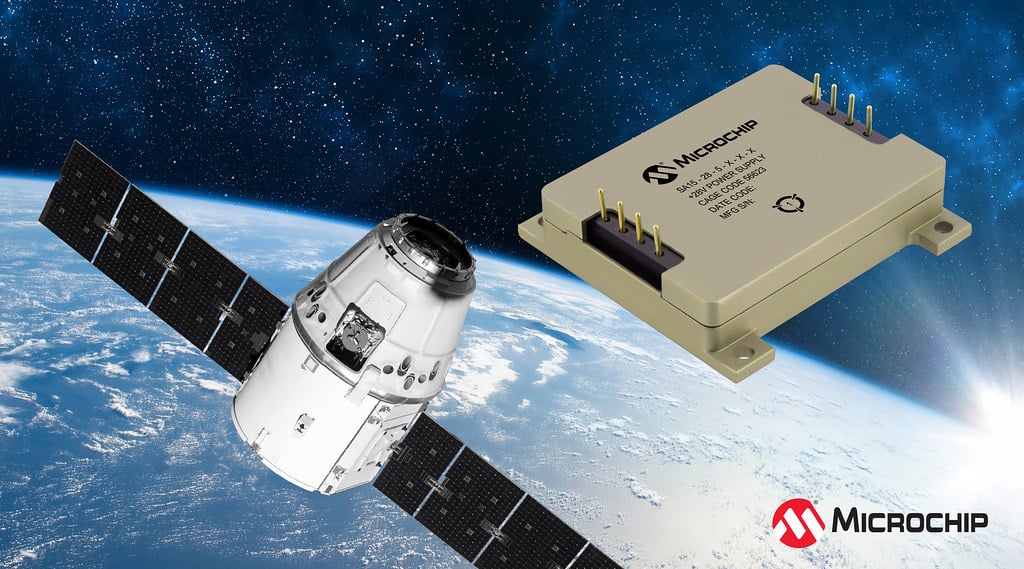




Microchip Technology has expanded its portfolio of space-grade communication solutions with the launch of the ATA6571RT, a radiation-tolerant (RT) CAN FD transceiver designed to support the growing performance demands of modern spacecraft and satellite platforms.
Communication interfaces play a central role in space system design, enabling real-time control, subsystem coordination, and robust error detection across increasingly distributed architectures. With mission environments becoming more complex — and payloads generating higher data throughput — traditional CAN interfaces operating at 1 Mbps are often a bottleneck.
Microchip’s new ATA6571RT addresses that challenge by supporting data rates up to 5 Mbps, along with payloads up to 64 bytes per frame, significantly increasing bus efficiency compared to legacy solutions. The device maintains backward compatibility with classic CAN, allowing system designers to integrate faster communication capabilities without re-engineering existing architectures.
The transceiver is targeted at a wide range of space applications, including platform data handling, propulsion control, robotics, nanosatellite onboard computers, and sensor networks. To support straightforward system migration, the RT variant remains pin-compatible with Microchip’s commercial plastic and ceramic versions.
“The ATA6571RT transceiver offers a cost-effective, size-optimized and power-efficient device designed to meet the stringent demands of space environments,” said Leon Gross, corporate vice president of Microchip’s aerospace and defense business. “As a leading supplier to the aerospace and defense market, Microchip is proud of its space heritage with products embedded in New Space and deep space missions.”
To withstand the radiation effects inherent in orbital and deep-space missions, the ATA6571RT includes mitigation for Single-Event Effects (SEE) and Total Ionizing Dose (TID) exposure. Additional features include power-saving modes with local and remote wake-up support, as well as short-circuit and over-temperature protection.
The new transceiver joins Microchip’s broader portfolio of aerospace-ready communication interfaces, which includes radiation-tolerant and radiation-hardened solutions for Ethernet, MIL-STD-1553, and SpaceWire networks.