


The U.S. power grid is operating closer to its limits than at any point in recent history. Electricity demand continues to rise as transportation, heating, and industrial systems electrify. Transmission capacity, however, has not expanded at the same pace. The result is persistent congestion that costs utilities and ratepayers billions of dollars each year, along with increasing pressure on grid operators to prevent failures before they occur.
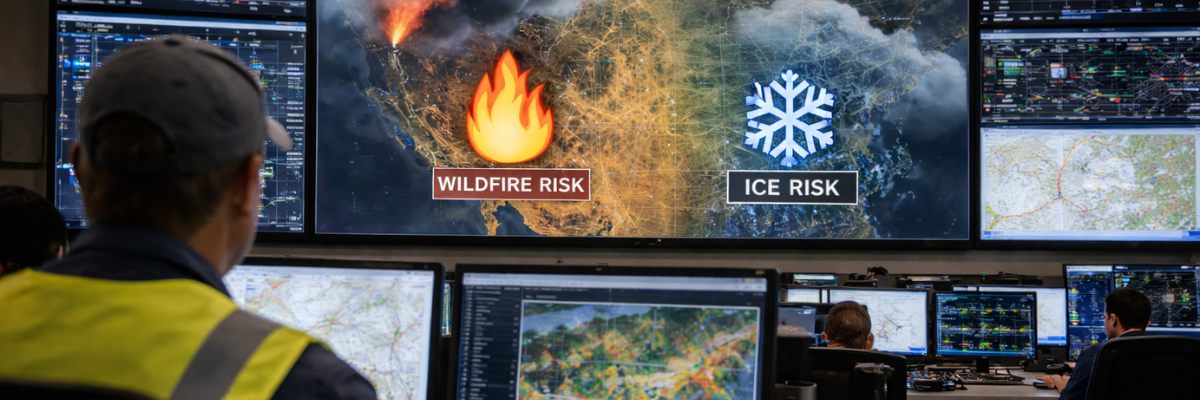
At the same time, external risks are becoming harder to manage. Wildfires in the western United States have forced utilities to de-energize lines during high-risk conditions, sometimes over large geographic areas. In colder regions, icing events can overload conductors and towers, increasing the likelihood of line damage or collapse. These threats often develop over several days, but traditional monitoring tools typically provide limited warning before conditions reach a critical point.
What is beginning to change is visibility into how risk develops across the grid.
Modern grid infrastructure already produces vast amounts of data. Sensors along transmission lines track load, temperature, and line sag. Weather models provide forecasts for wind, heat, humidity, and ice accumulation. Historical records document how past conditions translated into outages, equipment damage, or emergency shutdowns. Until recently, much of this information was analyzed in isolation or reviewed after an event occurred.
AI-based analytics are allowing utilities to connect these data sources in a more useful way. Instead of reacting to threshold violations in real time, models can evaluate how conditions are evolving and estimate the likelihood of specific outcomes several days in advance. A combination of forecast weather data, grid topology, and operating state can be used to identify transmission corridors that are trending toward unsafe conditions.
For wildfire risk, this means assessing not just wind speed or temperature, but how those variables interact with vegetation density, terrain, line loading, and historical ignition patterns. A corridor that appears safe today may become high risk within a few days as wind forecasts shift or load increases. Early visibility allows operators to reduce loading, reroute power, or schedule targeted inspections before conditions deteriorate.
In regions prone to icing, similar models can estimate ice buildup on conductors based on temperature, precipitation type, and humidity. Rather than waiting for sensors to indicate excessive mechanical stress, operators can see which assets are likely to experience dangerous accumulation and take action to rebalance loads or stage response crews.
Congestion forecasting is another area where earlier insight changes operational decisions. Transmission bottlenecks often emerge when demand spikes or generation shifts due to weather events. By predicting where congestion is likely to develop several days ahead, utilities can adjust dispatch strategies, schedule maintenance differently, or coordinate with neighboring systems to reduce cost and risk.
The value of this approach is not just in avoiding outages, but in reducing the need for overly conservative actions. When visibility is limited, utilities often err on the side of widespread shutdowns or blanket restrictions. More accurate forecasting allows for more precise interventions, which can lower economic impact while still protecting infrastructure and public safety.
These systems do not replace human operators or established grid controls. Instead, they act as an early warning layer that highlights emerging patterns that would be difficult to detect manually. Engineers and operators still make the final decisions, but they do so with a clearer picture of what the grid is likely to face in the coming days.
As the grid continues to absorb new loads and operate under tighter constraints, the ability to anticipate risk rather than react to it is becoming a requirement rather than a luxury. Seeing threats five days in advance does not eliminate uncertainty, but it provides something the grid has long lacked: time to respond before conditions become emergencies.