



Rising demand from generative AI and large-scale data processing continues to push data center power density higher. That shift is putting pressure on existing infrastructure, particularly as operators look to balance performance with energy efficiency. While approaches like smart grids and renewable integration are gaining traction, minimizing losses during power conversion remains a critical engineering challenge.
At the same time, the automotive sector is moving toward higher-performance electric platforms. Extended driving range and faster charging requirements are driving the need for more efficient traction inverters, onboard chargers, and DC-DC converters. These systems increasingly rely on wide bandgap semiconductors like SiC to reduce switching and conduction losses.
ROHM Semiconductor has introduced its 5th generation silicon carbide (SiC) MOSFETs, the latest addition to its EcoSiC lineup, aimed at improving efficiency in high-power applications. The new devices are designed for demanding environments, including electric vehicle (EV) powertrains, AI server infrastructure, and industrial power systems.
What’s New in the 5th Generation
ROHM’s latest SiC MOSFETs focus on improving performance under high-temperature conditions, where power devices often see the most stress. Compared to the company’s previous generation, the new devices reduce on-resistance by approximately 30% at a junction temperature of 175°C, under equivalent voltage and chip size conditions.
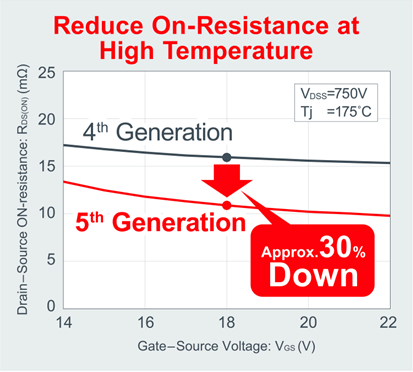
This reduction in on-resistance directly translates to lower conduction losses. In practical terms, that can enable smaller system designs or higher output power without increasing thermal constraints—both important factors in applications like EV traction inverters and high-density power supplies.
The improvements come from a combination of structural refinements and process-level optimization. While ROHM has not detailed all design changes, the focus appears to be on balancing efficiency with reliability at elevated operating temperatures.
Building on Early SiC Adoption
ROHM has been active in the SiC space for over a decade, beginning mass production of SiC MOSFETs in 2010. Its earlier devices, including 4th generation parts introduced in 2020, have seen adoption across automotive and industrial markets, supported by a broad portfolio of discrete components and modules. Many of these devices meet automotive reliability standards such as AEC-Q101.
The 5th generation continues that trajectory, targeting wider adoption as SiC transitions from niche to mainstream in high-power design.
Availability and Roadmap
ROHM began supporting bare die versions of the 5th generation devices in 2025, with development completed in March 2026. Samples of discrete devices and modules are expected to be available starting in July 2026.
The company plans to expand the lineup with additional voltage classes and package options, along with continued investment in design tools and application support.
Target Applications
The new SiC MOSFETs are positioned for a range of high-power use cases:
Automotive
- EV traction inverters
- Onboard chargers (OBCs)
- DC-DC converters
- Electric compressors
Industrial and Infrastructure
- Power supplies for AI servers and data centers
- Photovoltaic (PV) inverters
- Energy storage systems (ESS)
- Uninterruptible power supplies (UPS)
- eVTOL platforms
- AC servo drives
As power density continues to rise across both automotive and infrastructure systems, improvements in high-temperature efficiency are becoming a key differentiator. ROHM’s latest SiC devices are clearly aimed at that intersection of performance, thermal management, and system-level efficiency.