



A team at the University of Stuttgart has pulled off what was long considered nearly impossible — they managed to “teleport” the quantum state of a photon from one semiconductor source to another belonging to a different source. This isn’t science fiction; it’s a genuine step toward building a real, secure quantum internet.
What they actually did
The experiment used two different “quantum dots” — tiny semiconductor structures engineered to emit single photons or pairs of entangled photons on demand. One quantum dot generated a single photon; the other produced a pair of entangled photons.
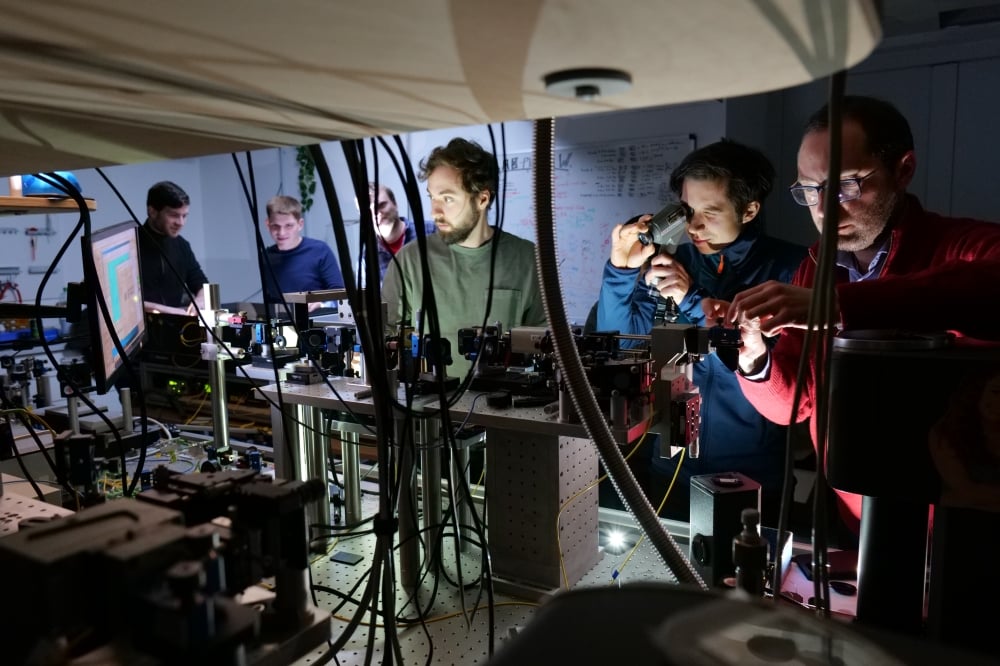
The key breakthrough was transferring the polarization state — the specific quantum “signature” — of the photon from the first dot onto one photon of the entangled pair produced by the second. In other words, quantum information was successfully handed off between two entirely distinct light sources.
To make this possible, the team used frequency-conversion techniques to erase the small wavelength differences between the photons, making them indistinguishable enough for the teleportation process to succeed.
Why this matters — and why it’s a big deal
For decades, the idea of a global quantum internet has been held back by a major engineering challenge: how do you transmit delicate quantum information across long distances without destroying the quantum state along the way?
This is where “quantum repeaters” come in — devices that can receive, preserve, and forward quantum information without collapsing it. The Stuttgart demonstration marks a major milestone toward that goal. Because the teleportation works even between photons coming from different quantum dots, it shows that future quantum networks don’t need identical hardware at every node. They can be built from diverse, scalable components.
In practical terms, this kind of quantum link could lead to ultra-secure communication networks, quantum-resistant cryptography, and distributed quantum computing architectures. It’s the early foundation of what could eventually become a quantum-enabled internet backbone.
What’s next
The current experiment was performed over a short fiber connection, serving as a proof-of-concept. To turn this into a functional quantum network, researchers now need to scale to longer distances, improve reliability, and build full quantum repeater systems capable of operating in real-world fiber-optic environments.
Still, this achievement represents an important shift. It moves quantum networking from theory into demonstrable engineering progress — a sign that the building blocks of the quantum internet are beginning to fall into place.
More Information: Milestone on the road to the ‘quantum internet’ | News | Nov 17, 2025 | University of Stuttgart