

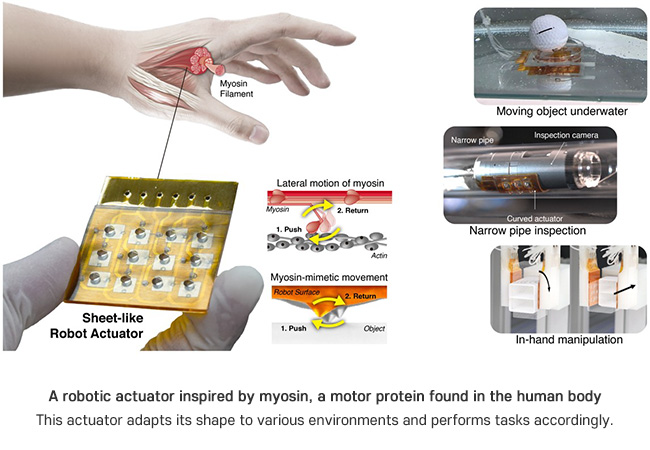
There’s a new actuator design out of POSTECH that’s worth paying attention to. It’s ultra-thin—around the thickness of a sheet of paper—but it’s capable of complex, controlled motion in multiple directions. The concept is inspired by how muscle tissue works: small, coordinated contractions that add up to smooth, forceful movement.
Here’s the key idea:
They built a soft sheet actuator with internal air chambers, each connected to independent pneumatic channels. By controlling airflow in sequence, they can create bending, curling, rotation—even crawling motion—across six degrees of freedom.
Next, they layered the design. There’s a flexible top sheet, a middle layer with cut-out cavities for air flow, and a fixed base layer. This structure allows localized deformation without requiring bulky joints or mechanical linkages.
Then, they validated the motion through real-world demos. The actuator moves reliably even when bent or folded, making it ideal for environments with limited space. Applications could include inspection robots, wearable systems, and surgical tools—anywhere you need adaptive, precise movement in a compact form factor.
From a control standpoint, it’s relatively straightforward. No motors or rigid components—just low-voltage valves managing airflow across the chambers. That simplifies the electronics and reduces the chance of mechanical failure.
Why this matters:
For engineers working in soft robotics, biomedical devices, or adaptive interfaces, this design offers a new approach to actuation. It’s light, flexible, and scalable—and the force output is impressive given its size.
If you’re interested in prototyping something similar, start with soft elastomers or TPU sheets. Use laser cutting or precision molding to create layered cavities. You’ll need basic pneumatic control and valve timing, but nothing overly complex.
Bottom line: this actuator shows that you can achieve fine, reliable motion without overengineering the hardware. It’s a clean, practical approach—and definitely one to watch.
Learn more: Muscle-Inspired Sheet-Like Robot Navigates the Tightest Spaces | POSTECH