

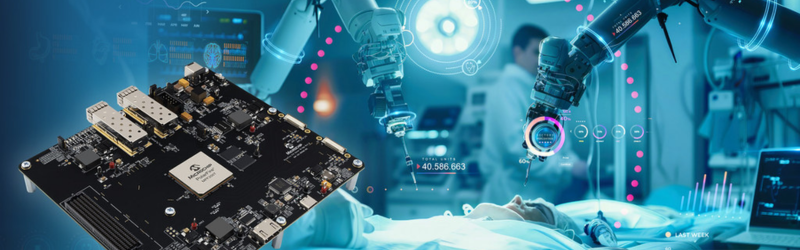
Microchip’s PolarFire FPGA Ethernet Sensor Bridge brings together cutting-edge low-power technology and multi-protocol sensor support to address the challenges of real-time data processing at the edge. As the first solution in Microchip’s platform, it supports MIPI® CSI-2®-based sensors and the MIPI D-PHY℠ physical layer, with plans to expand compatibility to other sensor interfaces like SLVS-EC™ 2.0, 12G SDI, CoaXPress® 2.0, and JESD204B.
The bridge enables developers to leverage the NVIDIA Holoscan ecosystem, which integrates the hardware and software required for AI and high-performance computing (HPC) applications. The Holoscan platform offers:
- Low-latency sensor streaming
- Optimized libraries for data processing
- AI model templates for inference pipelines
- Core microservices for real-time imaging and streaming applications
Unleashing New Edge AI Applications
With its seamless integration into the NVIDIA IGX and NVIDIA Jetson platforms, the PolarFire FPGA Ethernet Sensor Bridge enables real-time AI inferencing, bringing advanced edge AI to medical, industrial, and automotive markets. From edge-to-cloud applications to AI/ML-powered robotics, this collaboration is a game-changer for developing innovative solutions.
Key Benefits of the PolarFire FPGA Ethernet Sensor Bridge
- Power Efficiency:
- Microchip’s PolarFire FPGA technology is renowned for its power-efficient design, which is ideal for small-footprint, energy-sensitive, or cost-sensitive applications.
- Low-Latency Communication:
- Optimized for real-time, high-bandwidth sensor data processing, ensuring fast and reliable AI-driven decision-making.
- Enhanced Security:
- PolarFire FPGAs include embedded security features to protect against cyber threats, ensuring device, data, and system integrity.
- Single Event Upset (SEU) Immunity: Designed for environments exposed to radiation, such as space, high-altitude, and medical applications.
- Flexibility:
- Multi-protocol sensor support allows developers to work with a diverse range of sensors, paving the way for innovation across industries.
Empowering Developers
Bruce Weyer, vice president of Microchip’s FPGA business unit, highlights the transformative potential of this solution:
“By combining our flexible FPGA fabric with NVIDIA’s advanced AI platform and multi-protocol support, we’re empowering developers to create innovative, real-time solutions that will revolutionize sensor interfaces across a wide range of powerful AI-driven edge applications.”
Applications Across Industries
The PolarFire FPGA Ethernet Sensor Bridge enhances edge AI capabilities in applications such as:
- Medical imaging systems: Real-time AI-driven diagnostics and imaging.
- Industrial automation: Advanced robotics and process optimization.
- Automotive systems: AI-powered autonomous driving and safety features.
Conclusion
Microchip’s PolarFire FPGA Ethernet Sensor Bridge, in collaboration with NVIDIA Holoscan, is set to redefine edge AI by delivering low-power, high-performance solutions for real-time applications. Enhanced security, reliability, and flexibility empower developers to innovate across critical industries.
For more information, visit Microchip’s PolarFire FPGA Ethernet Sensor Bridge webpage.