

When disaster strikes, what if the first responders weren’t human — but a coordinated team of machines that can walk, drive, and fly their way to the scene?
That’s exactly what researchers at Caltech and the Technology Innovation Institute (TII) in Abu Dhabi have just demonstrated. Their new proof-of-concept shows how humanoids and morphing drones can combine forces to handle real-world emergencies — no single mode of movement required.
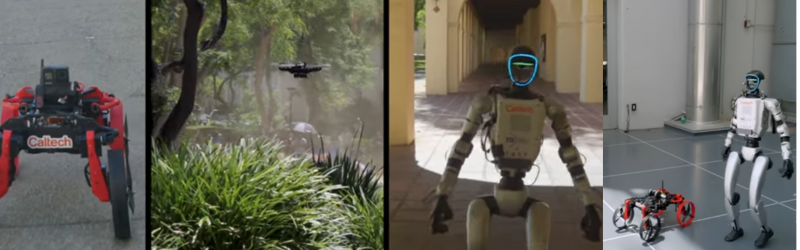
The system brings together a modified Unitree G1 humanoid and a hybrid aerial/ground robot called M4. The humanoid carries the M4 on its back, hikes across challenging terrain, then launches it into the air. Once airborne, M4 switches to wheeled mode, drives to an obstacle (a pond, in this test), and transforms back into a drone to finish the mission.
It’s a robotic relay built on precision, autonomy, and serious control engineering.
“The goal is to make multiple robot types operate as one system — each contributing what it does best,” said Aaron Ames, professor of mechanical and civil engineering and co-director of Caltech’s Center for Autonomous Systems and Technologies (CAST).
The Engineering Behind the Stunt
The challenge isn’t just the hardware — it’s getting each robot to understand its role, adapt to changing conditions, and share mission data in real time.
Caltech and TII’s joint team integrated sensor fusion, motion planning, and multi-agent autonomy so that walking, rolling, and flying all happen in sequence without human intervention.
Their next steps include expanding perception capabilities with LiDAR, vision sensors, and AI-driven decision making, giving the robots greater situational awareness and cooperative intelligence in unpredictable environments.
Why It Matters
Multi-modal robots could redefine what’s possible in disaster response, planetary exploration, logistics, and infrastructure inspection. A system that can traverse rubble, roll through debris, and take off over blocked areas eliminates the biggest limitation in robotics today — mobility silos.
By blending multiple locomotion systems into one orchestrated team, Caltech and TII are pushing robotics from isolated capabilities toward integrated autonomy — machines that don’t just move, but decide how to move.
The demo may look like a sci-fi short film, but the technology behind it is a real-world preview of the next phase in robotics: systems that work together, seamlessly switching between legs, wheels, and wings when the situation demands it.
Read the Full Story: Caltech and Technology Innovation Institute Demo Multirobot Response Team – www.caltech.edu