
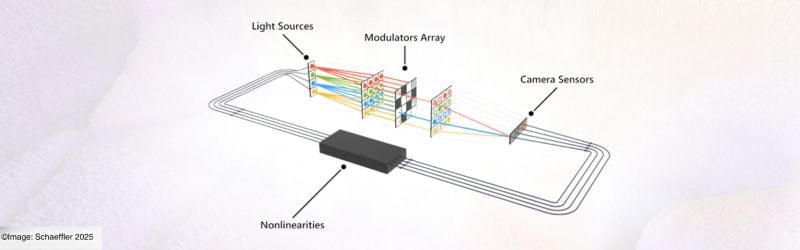
Microsoft researchers have built something that looks more like a science experiment than a supercomputer: an analog optical computer that thinks with light instead of electricity. What started as a prototype made from smartphone parts—micro-LEDs, lenses, and sensors—has now solved two problems that matter in the real world.
First came banking. Partnering with Barclays, the team tested whether their device could untangle the messy web of transactions that happen when thousands of trades need to settle at once. The computer pulled it off—faster and more efficiently than expected.
Then came healthcare. Using only sparse data, the machine reconstructed MRI images in a way that hints at shorter scan times—dropping from the usual half hour to just minutes. For patients, that could mean less time in the tunnel; for hospitals, more scans in a day.
But the story doesn’t stop there. Microsoft found that the same setup could also handle AI inference tasks, crunching through neural networks with a fraction of the energy today’s GPUs consume. That matters because AI’s energy appetite is exploding, and efficiency may become just as important as accuracy.
Researchers describe the machine as a “fixed-point” solver: it searches iteratively, nudging closer to the right answer each time. It’s not a general-purpose computer, and it won’t replace laptops or servers. Instead, it could evolve into a specialized engine—like GPUs did for deep learning—that handles optimization and reasoning tasks better than anything else.
The prototype is still small, but Microsoft says scaling it up is possible. They’ve also released a digital twin so other scientists can experiment, inviting the broader community to imagine new uses.
For now, the optical computer is a proof of concept, a flicker of light showing how future machines might solve problems faster, cheaper, and greener. If history is any guide, today’s strange lab device could be tomorrow’s indispensable tool.
Read the full story: Microsoft’s analog optical computer cracks two practical problems and shows AI promise – Source