


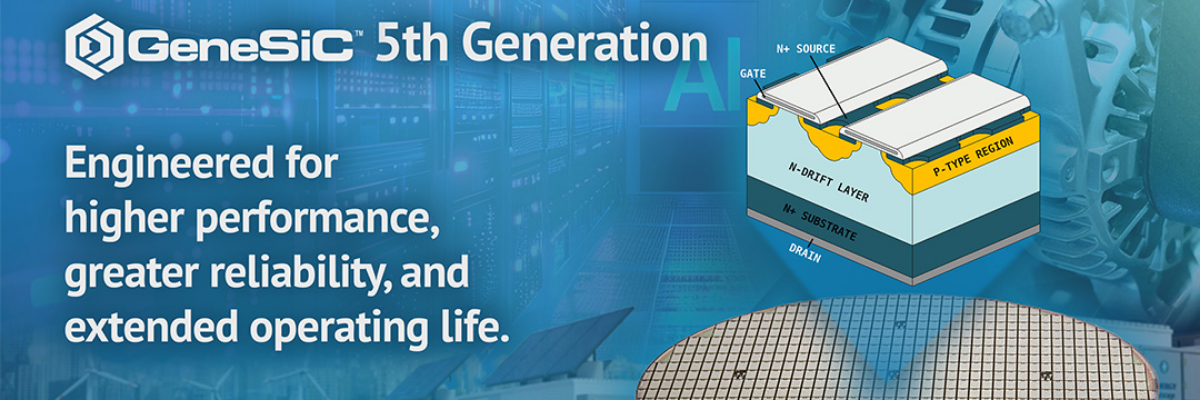
Navitas Semiconductor has announced its 5th-generation Trench-Assisted Planar (TAP) silicon carbide MOSFET technology, targeting high-voltage, high-efficiency power conversion applications including AI data centers, industrial systems, grid infrastructure, and electrified transportation.
The latest generation builds on the company’s GeneSiC platform, with updates focused on reducing switching losses while maintaining device reliability and manufacturing scalability.
Trench-Assisted Planar Architecture
Navitas’s TAP approach combines elements of planar and trench MOSFET structures. A trench is introduced near the source region to improve current flow and switching performance, while the gate structure remains planar. According to the company, this architecture avoids some of the reliability concerns traditionally associated with fully trench-based SiC devices, such as oxide stress at high electric fields.
By keeping the gate planar, Navitas aims to preserve long-term gate oxide stability while still improving key performance metrics associated with trench structures.
Improved Switching Performance
The 5th-generation TAP platform delivers approximately a 35% improvement in the RDS,ON × QGD figure of merit compared with the company’s previous 1200 V generation. This improvement is intended to reduce switching losses, particularly in high-frequency applications.
Navitas also reports a 25% improvement in the QGD/QGS ratio, which can simplify gate-drive design and reduce switching energy at higher dv/dt. In addition, the devices exhibit what the company describes as soft body-diode behavior, which can help reduce voltage overshoot and electromagnetic interference during commutation.
Reliability and Qualification
Navitas states that the 5th-generation TAP SiC MOSFETs have undergone extended qualification testing, including high-temperature reverse-bias, high-temperature gate-bias, and dynamic gate-stress testing. The devices meet AEC-Plus qualification requirements, positioning them for use in automotive and other long-lifetime applications.
The company also reports stable threshold voltage behavior and improved immunity to parasitic turn-on in high-noise environments.
Product Scope and Applications
The new TAP technology supports a range of voltage classes, including 1200 V, with higher-voltage variants already part of Navitas’s broader silicon carbide roadmap. Target applications include AI and hyperscale data-center power supplies, industrial motor drives and power converters, grid and energy-storage infrastructure, and electrified transportation platforms.
Navitas plans to incorporate the 5th-generation TAP technology across discrete and module offerings as part of its expanding silicon carbide portfolio.
Learn More: Navitas Unveils 5th Generation SiC Trench-Assisted Planar (TAP) Technology | Navitas