

Automotive camera systems continue to push data rates higher as resolution increases and sensor counts grow. Surround-view systems, driver monitoring cameras, and ADAS perception stacks all rely on high-speed image links that must operate reliably across long PCB traces, connectors, and increasingly complex cabling paths. Maintaining signal integrity across those channels has become a primary design challenge.
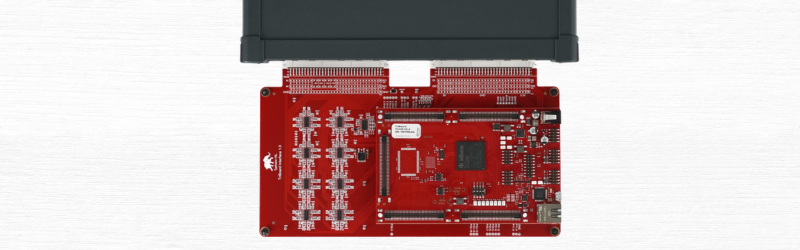
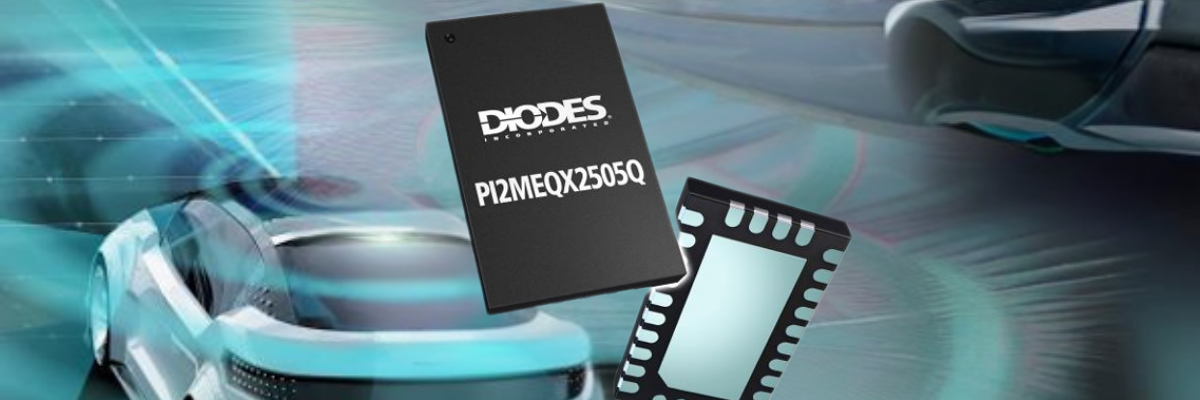
Diodes Incorporated has introduced the PI2MEQX2505Q, an automotive-qualified MIPI D-PHY ReDriver designed to address signal degradation in these environments. The device supports the MIPI D-PHY 1.2 protocol and operates at data rates up to 2.5 Gbps, targeting CSI-2 and DSI links used in automotive camera monitoring systems and ADAS platforms.
The PI2MEQX2505Q includes four differential data lanes and one clock lane, allowing it to sit directly in the signal path between an image sensor or processor and its downstream receiver. Rather than retiming the signal, the device regenerates and conditions the existing D-PHY waveform, compensating for frequency-dependent loss introduced by PCB traces, connectors, and cables. This approach helps preserve eye margin while keeping latency low, which is critical in vision systems that feed real-time decision logic.
Support for 2.5 Gbps operation differentiates the device from many existing ReDriver solutions and allows it to handle higher pixel counts without requiring architectural changes to the link. As camera resolutions increase and frame rates rise, this added bandwidth helps designers extend existing D-PHY topologies instead of migrating to more complex interfaces.
Signal conditioning parameters are programmable to accommodate different channel characteristics. The PI2MEQX2505Q provides adjustable receiver equalization, selectable pre-emphasis levels, and configurable output voltage swing. Receiver equalization can be set to 3 dB, 6 dB, or 9 dB at 1250 MHz, while transmitter pre-emphasis supports 0 dB, 1 dB, or 3 dB settings. Output voltage swing can be adjusted up to 275 mV. These controls allow engineers to tune the link for longer trace lengths or higher loss channels without excessive margining.
Configuration is handled through an I2C interface or through pin-strap options, giving designers flexibility during both development and production. This is particularly useful in automotive platforms where multiple camera variants may share a common hardware base but differ in cable length or routing.
Power consumption is an important consideration in camera systems deployed across battery electric vehicles. The PI2MEQX2505Q operates from a 1.8 V supply and supports both low-power and ultra-low-power states defined by the D-PHY specification. Integrated activity detection allows the device to transition automatically into reduced power modes when the link enters LP or ULPS states. Maximum power consumption is specified at 200 mW in active mode, dropping to 6 mW in low-power mode and 0.2 mW in standby.
The device is packaged in a compact W-QFN 3.5 mm by 5.5 mm package, supporting dense routing in space-constrained camera modules and domain controller designs. This footprint allows ReDrivers to be placed closer to connectors or cable interfaces, where signal degradation is often most pronounced.
In addition to the automotive-qualified PI2MEQX2505Q, Diodes offers standard compliance versions for non-automotive applications. The PI2MEQX2505A supports four data lanes, while the PI2MEQX2503A provides a two-lane option for designs with lower bandwidth requirements.
As automotive vision systems scale in complexity, maintaining signal integrity across high-speed image links has become a system-level concern rather than a layout afterthought. Devices like the PI2MEQX2505Q give engineers a way to extend MIPI D-PHY links with predictable performance while managing power, cost, and board space.