

For patients with slow or chronic wounds, time can mean the difference between recovery and complication. Researchers at UC Santa Cruz have built a smart patch called a-Heal that uses AI and bioelectronics to help wounds close faster — about 25% faster in early trials.
How a-Heal Works
Wound healing unfolds in stages: clotting, immune response, tissue regrowth, and repair. Each stage must progress in sequence. If one stalls, recovery slows or complications can set in.
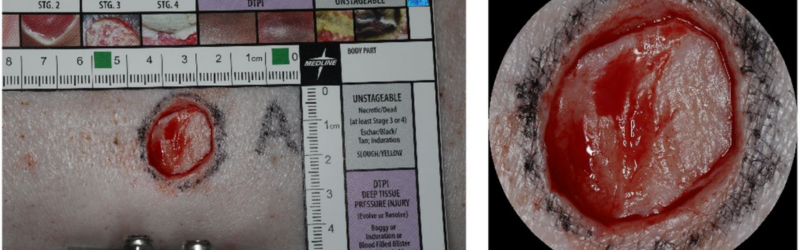
a-Heal is designed as a closed-loop system. Every two hours, its built-in camera captures an image of the wound. Those images are processed by an onboard “AI physician,” which uses reinforcement learning to decide if healing is progressing normally.
If intervention is needed, the patch can respond in two ways:
-
Medication delivery: a-Heal can release small doses of fluoxetine, a drug that reduces inflammation and speeds tissue closure.
-
Electrical stimulation: the patch can apply a controlled electric field to encourage cell migration and repair.
After each action, the camera checks the wound again, creating a feedback loop where treatment is personalized in real time. Data and images can also be streamed to a secure web interface for clinicians to monitor remotely.

The Team Behind the Technology
a-Heal was created by a collaborative team led by UC Santa Cruz professors Marco Rolandi, Marcella Gomez, and Mircea Teodorescu, with partners at UC Davis. Funding came from DARPA’s BETR program and other agencies.
Rolandi describes the device as “a body-guided optimization tool,” while Teodorescu calls it “a microscope in a bandage.” Gomez emphasizes that the AI must see the wound in context across time to make reliable decisions.
Why It Matters
Chronic and stalled wounds are a growing healthcare challenge, especially for people with diabetes, mobility limitations, or reduced access to care. By combining real-time sensing, AI-driven analysis, and targeted treatment, a-Heal offers a glimpse of how future medical devices could provide personalized, automated, and portable care.
If validated in human trials, this smart patch could shorten recovery times, lower complication risks, and bring advanced wound care to patients who need it most.
Original Story: Smart device uses AI and bioelectronics to speed up wound healing process – News