



Buildings in the U.S. consume nearly 40% of total energy, a large portion of which is wasted through inefficient operations, outdated control systems, and sub-optimal scheduling. For facility engineers and systems designers, artificial intelligence offers a suite of tools to both detect and eliminate energy waste. Below we explore key technical strategies, real-world applications, and challenges for integrating AI into building energy control, especially for commercial and institutional buildings.
Key AI-Driven Strategies to Cut Energy Waste
- Predictive & Adaptive HVAC Control
Traditional HVAC systems often operate on fixed schedules or simple reactive feedback loops (temperature/humidity thresholds). AI enables predictive control: forecasting occupancy, solar loads, external weather changes, and using those forecasts to adjust set points, airflow, or preheating/cooling in advance. This reduces unnecessary heating or cooling when spaces are unoccupied or environmental conditions shift.
- Fault Detection & Diagnostics (FDD)
Small inefficiencies (e.g. miscalibrated sensors, leaky dampers, underperforming coils) can cumulatively waste a lot of energy. Machine learning models can monitor real-time sensor data to detect anomalous behavior vs expected performance baselines and trigger maintenance before energy waste becomes large or repair costs escalate.
- Load Forecasting and Energy Management
AI models can predict short-term energy consumption (hourly/daily) using historical usage data, occupancy, weather, and other relevant signals. These forecasts enable dynamic control of equipment, demand response participation, and more strategic scheduling (e.g., shifting non-urgent loads to off-peak times).
- Reinforcement Learning & Model Predictive Control (MPC)
For complex systems with many interacting zones (multiple rooms, varying usage patterns), reinforcement learning (RL) or MPC can derive control policies that trade off between energy consumption and occupant comfort. Rather than rule-based logic, these techniques optimize dynamically over a time horizon, respecting constraints like humidity, maximum temperature deviations, etc.
- Data Fusion & Existing Infrastructure Leverage
Many U.S. buildings have partial sensor networks, legacy HVAC plants, and basic Building Management Systems (BMS). AI solutions that can integrate with existing sensors (temperature, humidity, occupancy, CO₂), meters, actuators, and historical operation logs reduce upfront cost. Also, combining external data (weather forecast, utility prices) enhances decision-making.
Case Studies & Quantified Gains in the U.S.
- C3 AI — Mission-Critical Building Optimization: In North America, C3 AI deployed ML models to forecast temperature and humidity and used optimization frameworks to adjust HVAC setpoints. They achieved over 10% reduction in total energy cost by balancing electric and gas systems, improving usage of heat recovery when possible.
- 45 Broadway, Manhattan — BrainBox AI: This case shows a retrofit to an older office building. By installing additional sensors (weather, solar angle, occupancy) and applying control algorithms that proactively adjust HVAC operations, the building’s HVAC energy usage dropped ~15.8%, yielding cost savings of over $40,000 annually and reducing CO₂ emissions.
- Verdigris Technologies: Their system monitors loads via sensors attached to building electrical panels, combined with AI analysis for load forecasting, fault detection, and actionable recommendations. In commercial environments and institutional buildings, this platform has helped facility managers reduce peak loads, detect over-usage, and optimize schedule and set-points.
Prospective Potential & Projections
Recent research modeling U.S. medium-office buildings suggests that AI adoption could reduce energy consumption and emissions by 8–19% by 2050 under realistic deployment scenarios. More aggressive scenarios (combined with policy, grid decarbonization, enabling technologies) could see energy use drops of 30–40% in certain zones. (Source)
Implementation Challenges & Technical Considerations
While the potential is large, several hurdles must be addressed by engineers and system integrators:
- Data Quality & Granularity: Models are only as good as their inputs. Many buildings have sparse sensors or noisy data. Ensuring sensors are calibrated, data streams are reliable, and there is enough history is essential.
- Model Generalization & Robustness: Buildings differ in climate zone, load profiles, architectural envelope, occupancy patterns. AI models, especially reinforcement learning or ML-based ones, must generalize or be trained/fine-tuned for each building (or zonal cluster) to avoid poor performance.
- Balancing Comfort & Energy Savings: Occupant comfort (temperature, air quality, humidity) often constrains how aggressively one can optimize. There are regulatory or contractual constraints (e.g. for hospitals, laboratories). AI approaches need constraint handling, safety margins, and feedback.
- Integration with Legacy Systems: Many existing HVAC and BMS systems are old, proprietary, or poorly documented. Integration (actuation, control) may require retrofits, upgrades, or middleware.
- Cybersecurity & Privacy: As more sensors, cloud-based controls, and remote monitoring come online, threats increase. Systems must be secure (data in transit & at rest), with robust access controls, and respect occupant privacy (e.g., when monitoring occupancy or presence).
- Upfront Cost & ROI Timelines: Sensor installation, model development, commissioning, monitoring — all have costs. Organizations need to assess payback periods (often 1-3 years), incentives (federal/state/local), and possible grant or rebate programs to offset costs.
Best Practices for Deployment
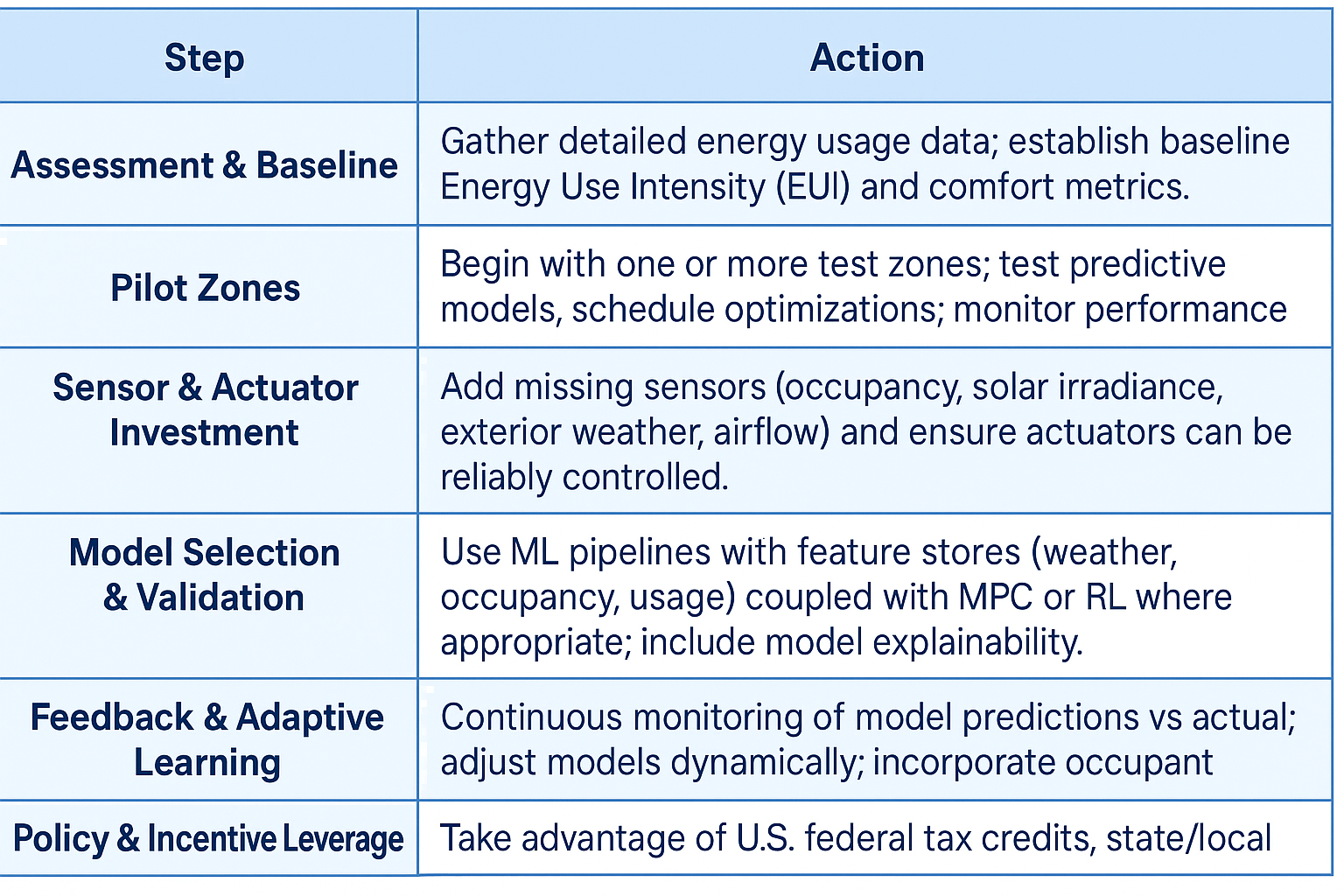
To maximize the effectiveness of AI for energy waste reduction in U.S. buildings, technical teams should consider the following guidelines:
Outlook & Emerging Trends
- Transformer-based & Meta-Learning Controllers: New research (e.g. “HVAC-DPT”) shows promise for controllers that are pre-trained on many buildings or zones and that can adapt to unseen buildings with minimal retraining. These may reduce deployment time and data requirements.
- Multi-agent Reinforcement Learning for Portfolio Control: Coordinated control over multiple buildings (or multiple zones within large campuses) using RL frameworks that optimize energy across buildings while managing shared constraints (like peak demand or utility rate structures).
- Integration with Renewable Energy & On-Site Storage: AI systems increasingly capable of coordinating HVAC loads with solar PV generation, battery storage, or EV charging, leveraging demand response and grid flexibility.
- Edge Computing: To reduce latency, bandwidth usage, and dependency on cloud, more processing is moving to the edge (on-site controllers) while retaining centralized oversight.
Conclusion
AI holds considerable promise for cutting energy waste in U.S. buildings—especially in commercial, institutional, and large multi-tenant structures. For technical audiences, understanding the interplay of forecasting, control, optimization, and data systems is critical. With realistic implementation efforts, many buildings can achieve double-digit percentage savings in energy cost, improved occupant comfort, and contributions toward sustainability goals. The challenge lies in choosing the right architecture, ensuring robustness, and aligning the deployment with financial and regulatory realities. For engineers and architects, the tools are increasingly mature; the opportunity is now.