


In many modern electronic systems, the hardest constraints are no longer computational or even electrical. They’re physical. Board outlines are shrinking, enclosure volumes are fixed earlier in the design cycle, and system functionality continues to grow. In that environment, connectors have a habit of quietly becoming the component that dictates everything else.
Engineers often encounter this problem late in layout. The circuitry fits. The power budget closes. Then the interconnects enter the picture and suddenly board dimensions expand, cable routing becomes awkward, or mechanical clearances disappear. A connector that works electrically but consumes too much space can ripple through the entire system architecture.
This tradeoff is not new, but it is becoming harder to avoid. Designs that once tolerated oversized connectors now operate with little margin, especially in industrial, aerospace, and instrumentation platforms where reliability cannot be compromised to save space.
A Common System-Level Problem
Consider a compact industrial control module used in factory automation. The system combines multiple sensor inputs, a microcontroller, isolated I/O, and a communications interface, all housed in a sealed enclosure mounted near moving equipment. The board must be small enough to fit the enclosure, but robust enough to survive vibration, temperature swings, and long service intervals.
From an electrical standpoint, the design is manageable. The challenge emerges at the interconnect level. The module requires a high pin count to support multiple sensor channels, control signals, and power rails. Traditional industrial connectors provide the necessary robustness, but their footprint forces a larger PCB, which in turn increases enclosure size and cost. Smaller, consumer-style connectors fit the space but raise concerns about contact reliability, current handling, and long-term durability.
At that point, connector selection becomes an architectural decision rather than a detail.
Density Without Giving Up Reliability
This tension has driven growing interest in miniature, high-reliability connector families designed to preserve electrical and mechanical performance at tighter pitches. One example is Harwin’s Gecko connector family, which targets applications where space is constrained but operating conditions are unforgiving.
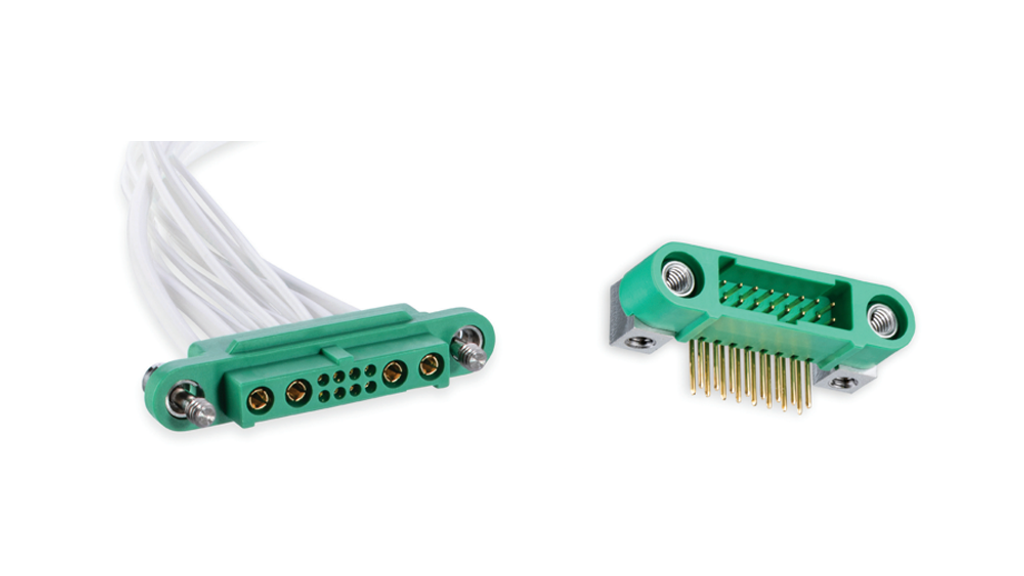
With a 1.25 mm contact pitch, Gecko connectors support high I/O density without resorting to fragile geometries. Dual-row configurations allow designers to route dozens of signals through a connector footprint small enough to materially change board layout options. In the control module example, that reduction can be the difference between a single-board design and a stacked or folded layout that complicates assembly and thermal management.
What makes this approach viable is not just pitch reduction, but how reliability is maintained at that scale.
Contact Design Becomes the Differentiator
At small pitches, contact mechanics matter more than housing size. Gecko connectors use a four-finger beryllium copper contact design that maintains multiple points of contact under vibration and thermal cycling. This approach is familiar in larger high-reliability connectors, but implementing it consistently at a 1.25 mm pitch is not trivial.
For engineers, the benefit is predictable electrical behavior over time. Stable contact resistance reduces intermittent faults, which are among the most difficult problems to diagnose once systems are deployed. Gold plating on the contacts further supports long service life, especially in applications where connectors may be mated and unmated during maintenance or reconfiguration.
In practical terms, this allows designers to treat the connector as a stable element of the system rather than a future failure point to work around.
Power, Thermal, and Layout Reality
Miniaturization often introduces thermal concerns. As pitch shrinks, resistance becomes more consequential, particularly in designs that carry both signal and power through the same interconnect. Gecko connectors are rated for up to 2 A per contact under full load, with higher current capability available on selected pins in mixed power-and-signal configurations.
In the industrial control module example, this allows low-voltage power rails to be distributed through the same connector as control and sensor signals, simplifying cabling and reducing connector count. It also keeps conduction losses manageable, limiting localized heating in dense layouts.
This matters because connector placement often dictates routing density. Smaller connectors allow traces to be kept shorter and more direct, which can help with signal integrity and EMI control in mixed-signal designs.
Assembly and Serviceability Still Matter
Connector decisions don’t stop at schematics and layout. They also affect manufacturability and field service. Mis-mating, weak retention, and fragile solder joints can turn otherwise solid designs into production headaches.
Gecko connectors address these issues with positive keying, optional latching, and PCB retention features that support both surface-mount and through-hole assembly. Tape-and-reel packaging and pick-and-place caps integrate cleanly into automated manufacturing flows, while locking options provide resistance to vibration-induced disengagement in the field.
For systems expected to remain in service for years, these details matter as much as electrical specifications.
Back to the System Level
Returning to the industrial control module, the connector choice shapes the final system in subtle but important ways. A smaller, high-reliability interconnect allows the PCB to remain compact, the enclosure to stay within target dimensions, and the internal layout to remain simple. Thermal paths are easier to manage, assembly steps are reduced, and service access remains straightforward.
None of these outcomes are visible on a datasheet, but they directly affect cost, reliability, and time to market.
Interconnects as First-Order Design Decisions
As electronic systems continue to compress, connectors are no longer passive components selected at the end of a design cycle. They increasingly influence board layout, mechanical packaging, thermal strategy, and long-term serviceability.
Connector families like Harwin’s Gecko illustrate how high-reliability design principles are being adapted to meet modern density demands. They do not eliminate tradeoffs entirely, but they shift the balance. Instead of choosing between size and robustness, engineers gain options that allow both to coexist.
In an era where millimeters matter and failures are costly, that shift can define the difference between a design that fits on paper and one that works reliably in the real world.