


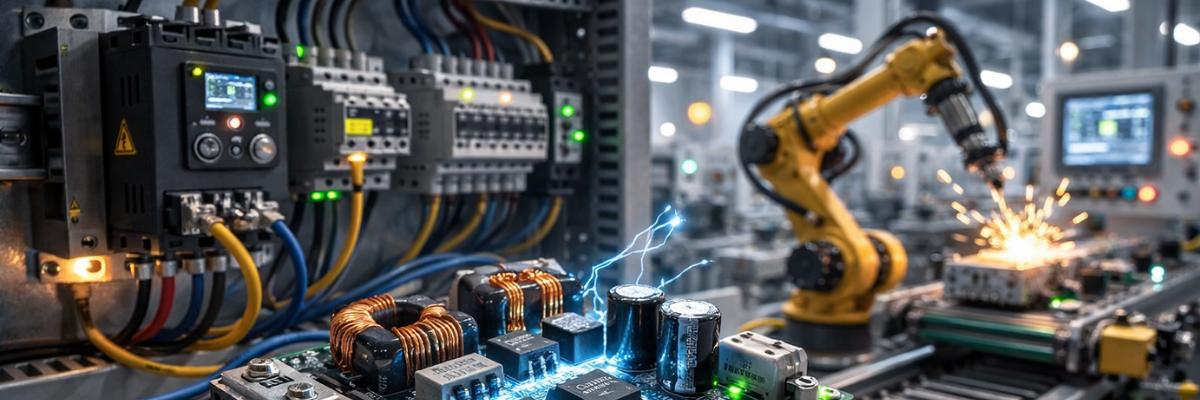
Factory automation has never been short on constraints. Power supplies are expected to shrink while delivering more output. Control systems must operate reliably amid electrical noise, temperature swings, and long duty cycles. At the same time, efficiency targets continue to tighten, driven by energy costs, sustainability goals, and regulatory pressure. For years, silicon power devices were pushed to meet these demands through clever circuit design and incremental improvements. That approach is now running into practical limits.
This is where wide-bandgap semiconductors — specifically gallium nitride (GaN) and silicon carbide (SiC) — are beginning to change the equation.
Unlike silicon, GaN and SiC devices can switch faster and operate at higher voltages and temperatures with lower losses. Those material advantages are not academic; they show up directly in the kinds of trade-offs power engineers face when designing systems for automated production lines.
Power Density as a Design Driver
One of the clearest pressures in factory automation is space. Power supplies are increasingly embedded inside compact control cabinets, drives, and distributed I/O modules. As enclosure sizes shrink, thermal headroom shrinks with them.
GaN and SiC devices help address this by enabling higher switching frequencies without the efficiency penalties that silicon incurs. Faster switching allows designers to reduce the size of magnetic components — inductors and transformers that typically dominate board real estate. The result is not just smaller power stages, but layouts with shorter current loops and improved transient response.
In practice, this makes it easier to integrate power electronics closer to the load, an increasingly common requirement in modern automated systems.
Efficiency Without Compromise
Efficiency gains from wide-bandgap devices are often described in terms of reduced switching and conduction losses, but the system-level impact is more nuanced. Lower losses translate directly into less heat generation, which reduces the burden on heatsinks, airflow, and enclosure design. That, in turn, improves long-term reliability — a critical factor in industrial environments where downtime is costly.
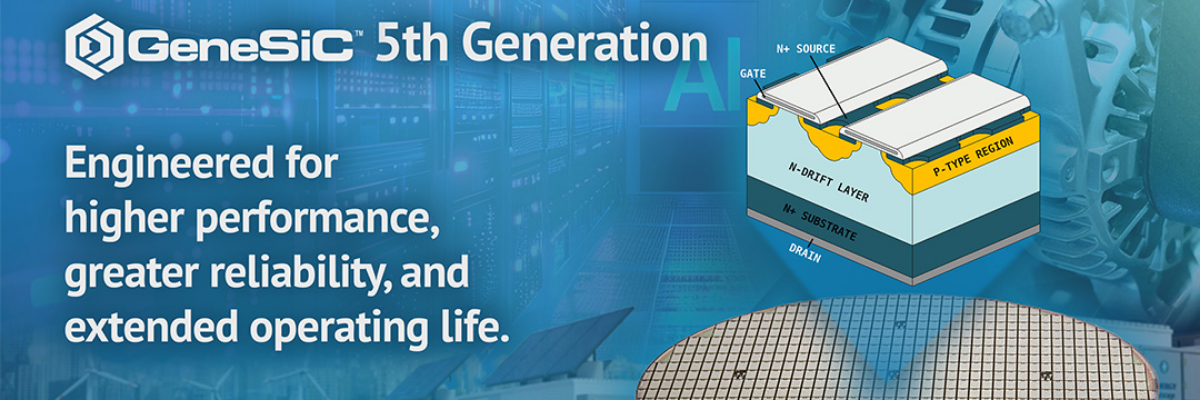
SiC devices, in particular, are well suited for higher-voltage stages commonly found in industrial drives and power conversion equipment. Their ability to handle high electric fields with stability makes them attractive in applications where robustness matters as much as efficiency.
GaN, operating efficiently at lower voltages and very high switching speeds, is increasingly used where compactness and fast transient performance are priorities.
Managing Speed in Noisy Environments
Fast switching is not without consequences. Higher dv/dt edges can exacerbate electromagnetic interference, a persistent concern on factory floors filled with motors, sensors, and communication networks. Wide-bandgap devices force designers to confront these issues directly.
Rather than simply pushing devices to their maximum speed, engineers often shape switching behavior through gate-drive tuning, layout optimization, and filtering strategies. The goal is controlled performance — extracting the efficiency benefits of GaN and SiC while keeping emissions within acceptable limits.
This balancing act is becoming a defining skill in industrial power design, and it reflects a broader shift away from brute-force solutions toward more deliberate system-level engineering.
A Shift in How Power Is Designed
The adoption of GaN and SiC in factory automation is not about replacing silicon everywhere. It is about expanding the design toolkit. Wide-bandgap devices allow engineers to rethink assumptions about size, efficiency, and thermal management — particularly in applications where conventional approaches have plateaued.
As automation systems continue to evolve toward higher integration and smarter control, power electronics must keep pace. GaN and SiC are not silver bullets, but they offer a way forward when traditional solutions can no longer stretch far enough.
On the factory floor, that translates into power systems that are smaller, cooler, and better suited to the demands of modern automation — not because they are new, but because they align more closely with the realities engineers are designing for today.