


In an interview with the co-founder and Technology Director at The Imagination Factory, Mark Hester spoke all about the journey of the Imagination Factory, from its roots to its latest project: SwimAR.
Projects: Ironman’s Heads-Up Display (HUD), SwimAR, solar powered irrigation pump for Africa, future railway technology.
The company was founded in 2010, off the back of a competition with UK Sport’s Ideas4Innovation awards scheme aimed at harnessing exceptional research concepts and proposals which, given sufficient funding and support, could boost British athletes’ performances at the Olympic and Paralympic Games in 2012.’
To enter the competition to win a £25,000 prize to invest in the development of their ideas, they had to be a limited company to register and so ‘The Imagination Factory’ was born.
Their first idea was to laser scan athlete’s faces for tailored goggles, and also a paralympic harness for table tennis players to aid with balance.
Following this competition, “the company was on ice,” said Hester. Then after his circumstances allowed, Julian Swan took the company on full time.
The Imagination Factory provides the services of their product designers, creative engineers and innovation partners to create solutions for clients, this work has enabled the team to work on internal projects such as SwimAR.
Factory Fridays
We’ve coined a phrase in our studio – Factory Fridays. Working on our own IP each week, with the same energy and expertise we bring to client projects, has given life to ideas we’ve had individually and collectively over the years.
It was during a Factory Friday session that the team started work on SwimAR.
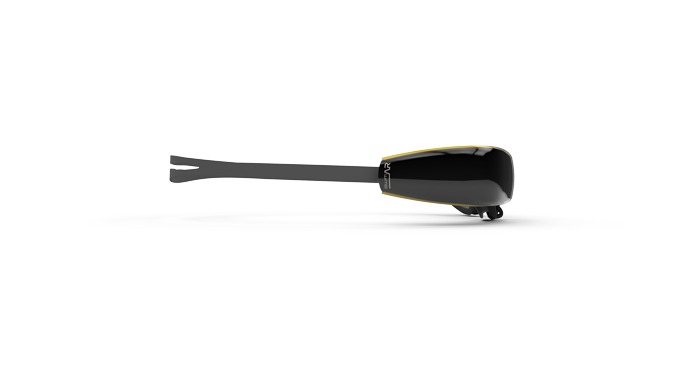
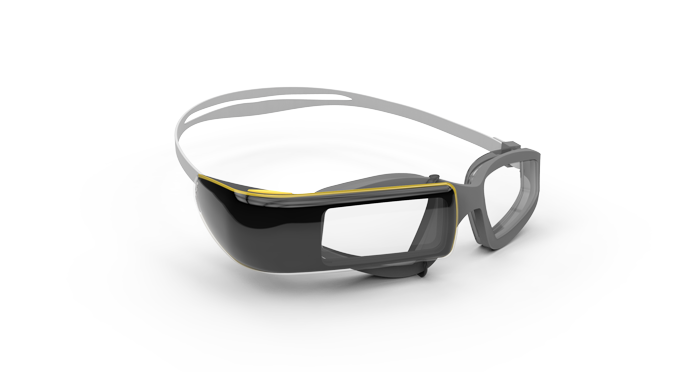
SwimAR: ‘SwimAR is a holographic Heads-Up Display (HUD) for swimmers that attaches to a regular pair of goggles’
The inspiration for SwimAR originally came whilst swim training for a triathlon in 2010. Borne out of a desperate need for real-time data in the pool, SwimAR was the idea of creative engineer, Julian Swan.
With his engineering background, it was the natural step for Swan to take when he saw an opportunity to solve a problem he encountered during his triathlon training.
Swan wanted to have a product to measure his swimming pace and provide him with real time feedback – metronomes helped with pace but are very basic. So the team began testing with “rough and ready prototyping,” said Hester. Which means that the team essentially wrapped existing electronics, such as running watches and cycling trackers, in cling film and jumped into a pool.
They tried using Google Glass, but found that its obstructed view had limitations and it also caused side effects such as eye strain.
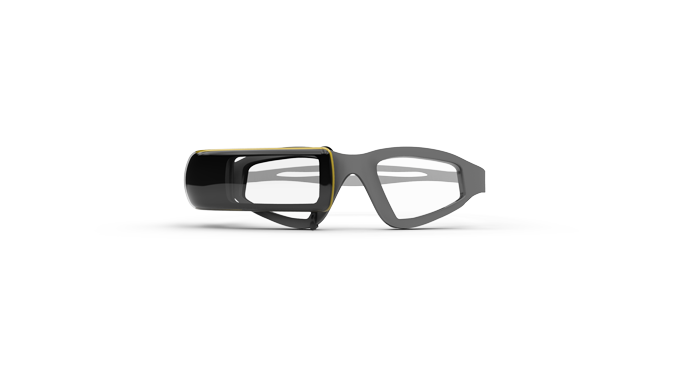
Sony SmartEyeglass
The Imagination Factory team discovered their technology solution while at the Wearable Technology Show (WTS) 2016 in London, where Sony demoed the SmartEyeglass developer tool.
It is a development kit to enable startups to create their own AR products – and they are one of the only big players doing this.
The developer kit helped to get the project started but it’s intended to be a tool rather than a consumer product which has a knock-on effect with cost. However, Sony provides the display technology as a module.
“The Sony SmartEyeglass is cutting edge tech and a cutting edge business model,” said Hester.
The Sony SmartEyeglass is augmented reality eyewear with binocular, see-through monochrome 8-bit displays with more than 85% transmittance.
The other obvious drawback with the developer kit is that it can’t be used underwater. So, the team at The Imagination Factory has built a waterproof prototype that uses a Raspberry Pi Zero to drive the AR display.
With this eyewear technology solution, the Imagination Factory team has created an eyewear solution that has a green display in the swimmer’s field of view that is natural and does not cause eye strain, the solution is called a ‘holographic waveguide’.
The next step was to then integrate this device with the physical goggles. The team created 3D printed models and jumped into the pool to test the drag.
This solution means that training plans can be implemented directly onto the goggles, eliminating poolside soggy papers and stolen phones.
It is hydrodynamically better to embed the device into the goggles, but after interviewing elite swimmers and coaches, the consensus was that they would rather be able to add the device to their existing goggles, as eyecups wear out quickly and headbands snap – they also already have their own favourite brands. In the long term, The Imagination Factory plans to embed the device into a well known brand, but as a startup the team’s design effort is focused on making the device as small and hydrodynamic as possible, which is a huge challenge but the trade-off is real time insight and a training aid.
The demo dilemma and User Experience (UX)
A benefit to the SwimAR goggles is that no one can view the information on the glass other than the user – great to safeguard any sensitive information from keen competitors. However this does present a problem from a sales perspective, as you really do have to see it to believe it.
The Imagination Factory are now testing SwimAR with elite athletes, following this interview, Mark Hester went to meet with an English Channel swimmer to get more feedback on the User Experience (UX), true to his role at the HCD lead.
The plan is for SwimAR to be compatible with other wearables, it will be ANT+ protocol compatible (a wireless protocol for monitoring sensor data, which allows multiple brands to work together). The vision for SwimAR is for it to work as a training aid alongside other devices and there is a patent pending on the design.
The market for this product is huge, and the dream for SwimAR is for it to be a tool used by Olympic-level swimmers.
SwimAR: Going for Gold
The Imagination Factory team made the decision to postpone the Kickstarter campaign while they spend more time building the ‘tribe’ and iron out some of the development costs.
They are looking at more typical Angel investment routes to finance to bring SwimAR to market, which could lead to a combination of investment and crowdfunding.
The team is confident that the outstanding development will be completed in 12 months, so that SwimAR will officially be available in 2019. Ready in time for the 2020 Olympics.
‘The impact wearables are having on the world of swimming’
The head of sports science and sports medicine at British Swimming, Karl Cooke, gave the closing keynote at the Performance Sports Conference at the Wearable Technology Show 2017 (WTS). In this keynote titled, ‘The impact wearables are having on the world of swimming’, Cooke discussed whether wearables can support high performance in Olympic swimming.
Cooke discussed the hurdles faced for wearables in the sport, as not only do they increase drag by 30%, but they are also likely to just come off at the speed the athletes swim. He admitted however that they were more accurate than a stopwatch and reduced the burden on the coach.
How would you define a ‘startup’?
“Some define being a startup based on their revenue or before a product launch, or whether they are profitable, but we are a hybrid startup – we are our own incubator.”
Tips for startups:
- Rough and ready prototyping
- Use paper to work out a user interface, it is easier to criticize
- Get market input
- Make use of online resources
Sum up your experience so far in a sentence:
“Every day you have to remind yourself where the idea came from and remain focused.”