

It starts as a practical question.
You’ve got a cable. It’s shielded. There’s metal already there. And you’re short on conductors.
So the thought comes up:
can the shield just double as ground?
That exact question came up in a recent Reddit thread, and the answers were immediate and pretty consistent.
Not really.
Or more accurately, not in the way most people are thinking about it.
Where the Idea Comes From
The confusion is understandable.
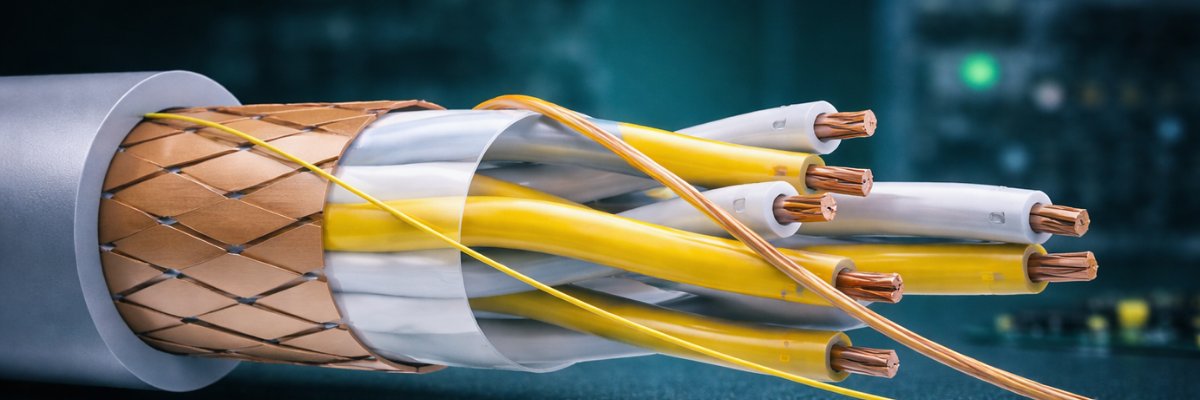
Cable shielding is already tied to ground in many systems. In coax cables, it literally acts as the return path. In other cases, it’s connected to chassis ground to reduce noise.
So, it’s not a stretch to assume it could handle grounding duties more broadly.
And in very specific cases, it actually does.
But those cases are designed that way from the start.
What Engineers Immediately Pointed Out
The first response in the thread was blunt:
“Commercially and professionally? No.”
That tone carried through most of the discussion.
The core issue isn’t whether the shield is conductive. It’s what it’s designed to do.
One comment summed it up clearly:
“Cable shielding isn’t rated to handle fault currents…”
That’s the difference.
A proper protective earth (PE) conductor has to:
-
carry fault current safely
-
survive worst-case conditions
-
meet code requirements for size and termination
Shielding is not built for that.
Another engineer in the thread explained it more simply:
shielding handles low currents from EMF, not power grounding
So even if it works under normal conditions, it’s not something you want to rely on when something goes wrong.
The Failure Mode Is the Whole Point
This is where the discussion gets more serious.
Grounding isn’t about normal operation. It’s about fault conditions.
If a fault occurs, the ground path needs to:
-
carry high current
-
trip protection devices quickly
-
prevent dangerous voltages from appearing on exposed parts
A cable shield is typically thin, inconsistent, and not guaranteed to stay intact under stress.
One comment in the thread put it in practical terms:
cables are closer to “wear items” than permanent infrastructure
That’s not something you want to depend on for safety.
Where It Can Be Done
The thread wasn’t entirely black and white.
A few engineers pointed out exceptions.
There are cases where shielding or armor is intentionally used as ground, but only when:
-
the cable is specifically rated for it
-
the cross-sectional area is sufficient
-
the installation meets code requirements
For example, armored cables in some industrial or offshore systems use the armor as a grounding path.
Even then, it’s not assumed. It’s specified.
As one commenter put it:
only if it’s explicitly designed and rated for that use
That distinction matters.
The Secondary Question That Came Up
The original poster then asked a follow-up that comes up just as often in real projects:
Can you run ground through a different cable?
In this case, a 24V control cable that had unused conductors.
Again, the answers were practical.
It depends on sizing.
Ground conductors need to match the fault current requirements of the circuit they’re protecting. If the power circuit requires a thicker conductor, you can’t just substitute a smaller unused wire.
One reply cut straight to it:
size the ground for the load, not what’s convenient
There was also another concern raised that doesn’t always get attention.
Running a high-voltage fault path through a low-voltage cable introduces risk into systems that weren’t designed for it.
That’s the kind of decision that seems fine until something fails.
The Shielding vs Grounding Mix-Up
Part of the confusion comes from how shielding is actually used.
A shield is there to control electromagnetic interference. It acts like a barrier, redirecting noise away from signal conductors.
To do that effectively, it’s usually connected to ground.
But that connection is about noise control, not safety.
In some systems, the shield is grounded at one end. In others, both ends. In coax, it carries return current.
All of those are valid, but they’re tied to signal behavior, not fault handling.
That distinction gets lost easily.
Why This Question Keeps Coming Up
This isn’t really about misunderstanding theory.
It’s about constraints.
Limited connectors. Existing cabling. Trying to make something work without running new wire.
The idea makes sense in that context.
But the answers in the thread reflect how engineers think about risk.
If something is related to safety, it doesn’t get treated as a workaround.
It gets treated as a requirement.
The Takeaway
Using cable shielding as ground isn’t automatically wrong.
It’s just rarely correct unless the system was designed for it from the beginning.
And that’s the part that matters.
Because the decision isn’t about whether it works on a good day.
It’s about what happens when something goes wrong.