
Most work in power electronics follows a familiar path. Devices get more efficient, switching improves, thermal performance is pushed a little further, and systems are redesigned to handle higher density. The underlying behavior of how energy is stored and delivered stays largely the same.
A recent research effort out of RMIT University, in collaboration with CSIRO and the University of Melbourne, is one of the few examples where that assumption starts to loosen. The group has demonstrated a working quantum battery prototype that can be charged, store energy briefly, and discharge it. That might sound incremental at first, but the way it operates is what stands out.
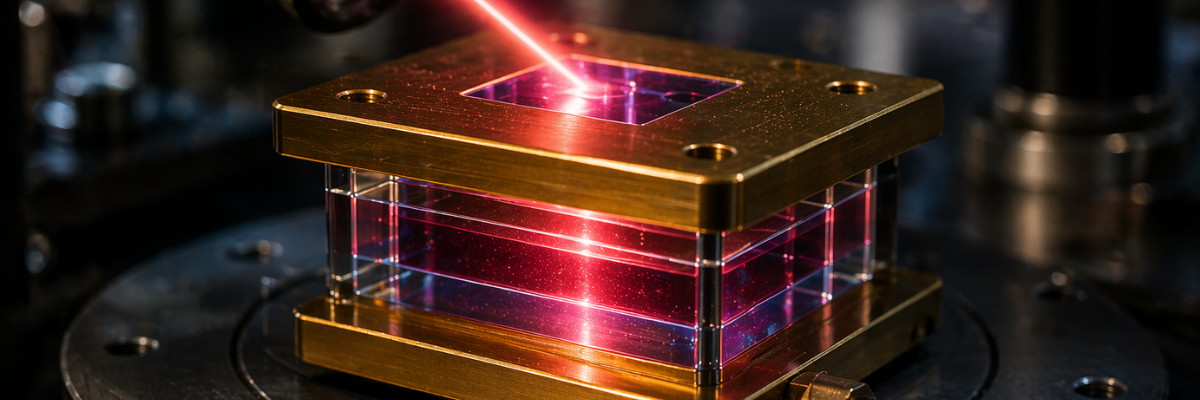
The system does not rely on electrochemical reactions. Instead, it uses a microcavity structure where light and matter interact in a controlled way. A laser is used to charge the device wirelessly, and the energy is absorbed collectively by the system rather than by individual particles acting on their own. This collective response is tied to quantum effects like superposition, which allows the system to take in energy very quickly.
What makes this especially interesting is how the charging behavior changes with size. In conventional systems, increasing capacity usually comes with longer charge times. In this prototype, the opposite trend appears. As more elements are added to the system, the charging process becomes faster due to the coordinated way energy is absorbed. Researchers often refer to this as super absorption, but the practical takeaway is that scaling does not follow the same rules engineers are used to working with.
There are still clear limitations. The amount of energy stored is small, and retention time is extremely short. The stored energy dissipates quickly, with current results measured on the order of nanoseconds. That puts it well outside the range of anything that could be used in a vehicle or grid application. At the same time, this is one of the first demonstrations where the full cycle has been shown in a physical device. Charging, storage, and release have all been validated in the same system, which moves the concept out of purely theoretical work.
From an engineering standpoint, the immediate challenge is extending how long the energy can be held without losing the behavior that enables rapid charging. That is not a trivial problem. Maintaining quantum coherence while increasing stability introduces constraints that are very different from those found in traditional energy storage design. It starts to look more like the challenges seen in high-speed memory or advanced sensing systems, where performance and retention are often at odds.
Even with those limitations, the work is relevant because it introduces a different way to think about energy systems. Current designs are built around known constraints. Charging speed, thermal limits, and conversion losses all shape how systems are architected. Advances like silicon carbide devices reduce losses and allow for higher efficiency at elevated temperatures, but they still operate within that same framework.
This prototype suggests that there are cases where the framework itself can change. If energy can be absorbed and released through collective behavior rather than independent processes, it raises questions about how systems should be designed at a higher level. It also places more emphasis on interactions across a system rather than focusing only on individual device performance.
There are some parallels to existing challenges. In high-density power systems, interactions between components already play a significant role. Current sharing between parallel devices, electromagnetic coupling, and thermal effects all influence performance in ways that go beyond the specifications of a single part. In quantum systems, those interactions are no longer something to manage around. They become the mechanism that enables performance in the first place.
Early applications, if this progresses, are unlikely to focus on large-scale energy storage. Systems that require small amounts of energy delivered very quickly are a more realistic starting point. That could include sensing, specialized electronics, or areas tied to quantum computing. The use of a laser for charging also points toward forms of wireless energy transfer that go beyond what is currently possible with inductive methods.
The longer-term outlook depends on whether storage duration can be improved without losing the collective effects that make the system useful. If that can be addressed, the range of potential applications expands quickly, especially in areas where charging time is currently a limiting factor.
For now, the value of this work is not tied to immediate adoption. It comes from demonstrating that energy storage can operate in a way that does not follow the same assumptions engineers have been working under for decades. That kind of result tends to open up new lines of thinking, even if the practical implementations take time to catch up.