

It’s a familiar sight: dust building up on a window, a solar panel, or the windshield of a car. It dulls visibility, saps energy efficiency, and demands time, water, and effort to clean. But now, a new type of glass could make those problems disappear—literally in seconds.
Scientists in China have unveiled a transparent, self-cleaning glass that can clear nearly all dust and debris in just 10 seconds. The system doesn’t require water, detergents, or moving parts—only a burst of electricity.
How It Works
The innovation relies on an electric field, not coatings or humidity, to do the heavy lifting. The glass is built from three layers:
-
A quartz glass base for strength and clarity
-
Laser-etched indium tin oxide (ITO) electrodes to generate the electric field
-
A thin polyethylene terephthalate (PET) dielectric film for insulation
When powered with a high-voltage, low-frequency square-wave signal, the electric field springs into action. Dust particles on the surface respond in two ways:
-
Reverse lateral transport, where they slide in the opposite direction of the field’s force
-
Jumping, where particles lift off entirely, breaking free from surface adhesion
These motions allow the system to remove more than 97% of dust, even in heavy accumulation conditions.
Built-In Dust Defense
The process doesn’t just clean—it prevents. Once activated, the electric field creates a subtle “shielding effect” that makes it harder for new dust particles to settle on the surface, keeping the glass cleaner for longer.
Applications That Reach Beyond the Lab
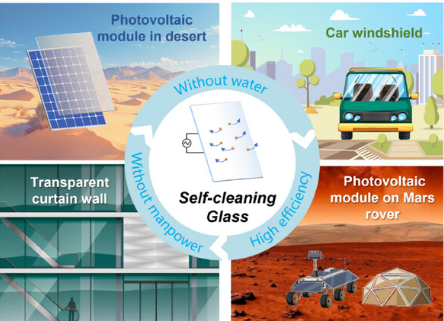
The potential uses are wide-ranging:
-
Solar panels in arid regions, where dust accumulation can slash efficiency
-
Vehicle windshields and building windows in cities prone to pollution or construction debris
-
Spacecraft and rovers, where cleaning with water or brushes isn’t an option
Why It Stands Out
Unlike traditional self-cleaning coatings, which depend on weather conditions or require regular reapplication, this electric-field approach is fast, repeatable, and unaffected by humidity or temperature extremes. Its design can be adapted to large-scale manufacturing, making it viable for commercial and industrial rollout.
Original Journal Article: Coverable Self‐Cleaning Glass via Abnormal Transport and Jump of Charged Particles – Yang – Advanced Science – Wiley Online Library