
Nearly all of the electrical energy consumed by a processor eventually ends up as heat. That heat has to go somewhere.
As processors become more powerful and more components are packed into smaller spaces, moving heat away from electronics becomes an increasingly important part of system design. Fans, pumps and compressors can do the job, but they require energy of their own. Even some emerging solid-state cooling technologies still need electrically powered components to drive the cooling process.
What if some of the heat electronics already produce could help do that work instead?
A new solid-state cooling system demonstrates one way this could happen. Rather than relying on an electrically powered actuator, the device uses heat to create mechanical movement. That movement then drives an elastocaloric cooling cycle.
The result is an unusual energy path:
Heat → mechanical movement → cooling
Researchers at Karlsruhe Institute of Technology (KIT) and the University of Tsukuba demonstrated the concept using two mechanically connected, ultrathin shape-memory alloy films. One converts heat into movement. The other uses that movement to produce cooling.
The system is still an early feasibility demonstration, but its potential applications include cooling electronics using heat they already generate. The researchers specifically point to computer processors as one possibility.
Cooling Still Takes Energy
Most cooling systems do not make heat disappear. They move it.
A conventional vapor-compression system, for example, uses a compressor to circulate refrigerant and transfer heat from one location to another. The compressor requires electricity. Fans and pumps used elsewhere in the thermal system add their own power requirements.
Elastocaloric cooling offers another approach. Instead of compressing and expanding a refrigerant, it takes advantage of materials that change temperature when mechanical stress is applied and removed.
Shape-memory alloys are particularly useful for this because their crystal structures change as the material is loaded and unloaded. Applying mechanical stress to a superelastic shape-memory alloy triggers a phase transformation that releases heat. Removing the stress reverses the transformation, causing the material to cool and absorb heat from its surroundings.
Repeated loading and unloading therefore creates a cooling cycle.
There is still a problem. Something has to provide the force.
Existing elastocaloric systems generally use an electrically powered actuator to repeatedly load and unload the material. The cooling mechanism might be solid-state, but the system still needs electrical energy to drive it.
The new approach replaces that electrically powered actuator with another shape-memory alloy.
This time, heat makes it move.
One Film Moves, the Other Cools
The prototype developed by the KIT and University of Tsukuba team uses two mechanically connected shape-memory alloy films with different jobs.
The first is a 22-µm-thick titanium-nickel (TiNi) film that acts as a thermal actuator. When heated above its transition temperature, the material undergoes a structural transformation and contracts. This converts thermal energy into mechanical movement.
That movement is transferred to a second, 26.5-µm-thick titanium-nickel-iron (TiNiFe) film. This film serves as the elastocaloric refrigerant.
As the actuator contracts, it stretches the refrigerant film. The mechanical load triggers a transformation in the refrigerant’s crystal structure, causing it to release heat. That heat can then be transferred away.
When the actuator cools, the force on the refrigerant decreases. The refrigerant returns toward its original state and undergoes the reverse transformation. Its temperature drops below ambient temperature, allowing it to absorb heat from whatever needs to be cooled.
The two films are mechanically connected but thermally isolated from one another. A 3D-printed polymer coupler transfers the movement between them while limiting direct heat transfer.
“The crucial innovation is that we combine two complementary functions of shape memory alloys, with one film converting heat into mechanical work and the other film converting this work into cold,” KIT researcher Jingyuan Xu explained when the research was announced.
In other words, instead of supplying electricity to a motor that drives the cooling material, the system gets the movement it needs from heat.
Putting Heat-Driven Cooling to the Test
The researchers first tested the device using Joule heating to control the temperature of the actuator film.
At an actuator temperature of 86°C, the refrigerant film produced a temperature change of 12.9 K. Across the complete device, the researchers measured a temperature span of 4.0 K and a specific cooling power of 4.4 W/g.
That established that the two-film architecture could produce cooling, but electricity was still being used to heat the actuator.
The team then replaced Joule heating with an external heat source at 130°C.
Under those conditions, the system maintained a device-level temperature span of 2.2 K and produced a specific cooling power of 3.3 W/g. The experiment showed that an external source of heat could provide the energy needed to drive the cooling cycle without electrically heating the actuator.
Performance was lower with the external heat source, in part because the heat had to be transferred into the actuator through conduction. With Joule heating, heat was generated directly within the film.
The researchers say changes to the actuator geometry, heat-transfer design and transformation temperature of the material could improve the system and reduce the temperature required from an external heat source.
Could a Processor Really Cool Itself?
The possibility of using waste heat makes electronics an intriguing application for the technology.
A processor generates heat as it operates. Conventional thermal management treats that heat entirely as a problem to be removed. In a heat-driven elastocaloric system, some of it could potentially serve another purpose first by providing the thermal energy needed to actuate the cooling material.
KIT specifically identifies computer processors as one possible future application. The researchers also point to automotive electronics, where heat produced elsewhere in a vehicle could potentially help cool temperature-sensitive components.
That does not mean a processor that cools itself is around the corner.
The current system is a feasibility demonstration rather than a processor cooler, and the externally heated experiment used a 130°C heat source. A practical electronics cooling system would have to operate using the temperatures and temperature differences available in the real device without allowing the electronics themselves to become too hot.
Cooling capacity is another challenge. The prototype was designed to demonstrate the concept rather than maximize the amount of heat it could remove. The researchers are now exploring ways to increase capacity, including operating multiple shape-memory films in parallel.
There is also a larger thermal-management issue that no cooling technology gets to escape. Heat ultimately still has to go somewhere.
A heat-driven elastocaloric cooler could use waste heat to help power part of the cooling process, but it would not eliminate the need to reject heat from the overall system. The potential advantage is that some of the energy already being lost as heat could do useful work before it leaves.
Rethinking Waste Heat
The idea could be particularly useful as electronics become smaller and more power dense.
The thin-film architecture gives the shape-memory alloys a high surface-area-to-volume ratio, which supports rapid heat transfer. Solid-state cooling also avoids the compressor and circulating refrigerant found in conventional vapor-compression systems.
There is still a significant distance between a laboratory device producing a few degrees of cooling and a thermal-management system integrated with a processor. The researchers need to increase cooling capacity, improve heat transfer and determine how low the driving temperature can go while maintaining useful performance.
But the prototype changes an interesting part of the energy equation.
Waste heat is normally something engineers spend additional energy trying to remove. This research shows that some of it could instead provide the mechanical work needed to drive a cooling cycle.
A future processor might not exactly cool itself. Its waste heat, however, could help power the system that does.
Additional Reading: https://www.nature.com/articles/s41560-026-02122-6
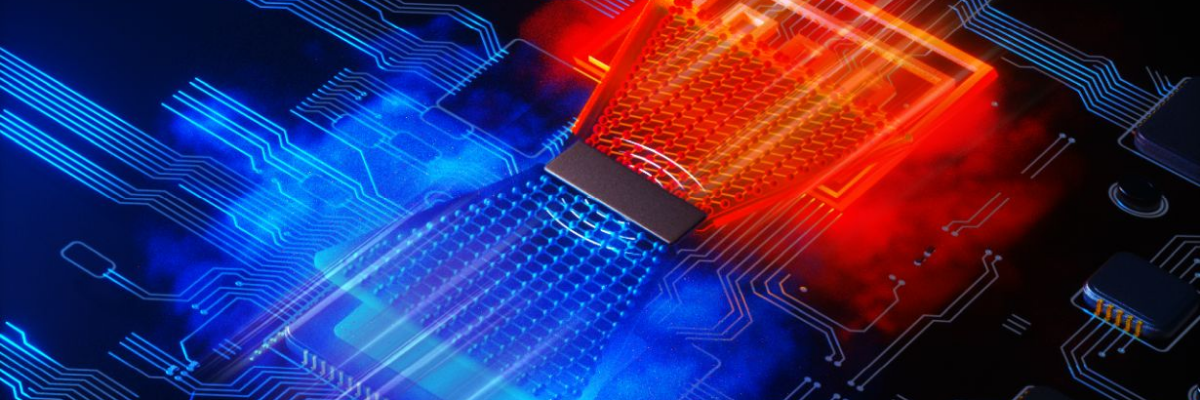
Main Image Credit: The new cooling system combines two nickel-titanium foils: a heat-responsive foil generates motion, which a second foil uses to produce cooling. (Image: Concept by Yi-Ting Hsiau and Jingyuan Xu, KIT; visual design by Ella Maru Studio)