
There are two basic ways to deliver more electrical power: increase the current or increase the voltage. For the next generation of AI data centers, electric vehicles and renewable-energy systems, pushing current higher is becoming the difficult option.
AI data centers are a clear example of how quickly power requirements are scaling. NVIDIA plans to move from the 54VDC distribution commonly used inside today’s racks to an 800VDC architecture beginning in 2027, when the company expects AI infrastructure to reach 1MW per rack and continue climbing from there.[1]
At 1MW, delivering power at 54V would theoretically require more than 18,500A. At 800V, the same power corresponds to 1,250A. Actual systems are more complicated than that simple calculation, but it illustrates the problem engineers face. Higher current requires more conductor capacity and increases resistive losses, which means more copper, more heat and more space devoted to moving power rather than computing.
Raising the distribution voltage helps shift that equation. But it also introduces a new challenge: the semiconductor switches that convert that power now have to withstand it.
The Voltage Margin Problem
Power semiconductors are not selected simply to match the nominal voltage printed on the bus.
Switching transients, parasitic inductance and other circuit conditions can push voltage above its nominal value. Designers therefore need devices with sufficient voltage margin to survive those events without pushing the switch close to its breakdown limit.
That becomes harder as the bus voltage rises.
Gallium nitride has become attractive in power conversion because GaN switches can operate efficiently at high switching frequencies. Higher switching frequency can reduce the size of magnetic components and other passives, helping designers build smaller, denser power converters.
Historically, however, voltage has limited where GaN could be used. Higher-voltage conversion has been an important territory for silicon carbide (SiC), while lower-voltage GaN devices can be stacked when the required blocking voltage exceeds that of an individual switch.
Stacking solves one problem but introduces others. Multiple switches have to share voltage properly, and the design requires additional components and control. Parasitics also become more difficult to manage when the goal is to switch quickly.
Power Integrations is taking a different approach by pushing the voltage capability of GaN itself.
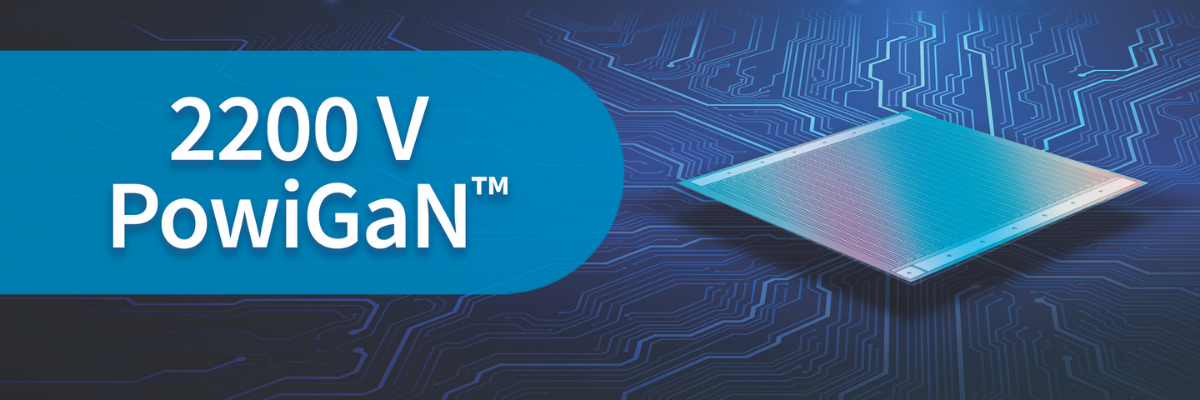
The company’s PowiGaN technology is now rated to 2200V, extending a progression that has already produced 1250V and 1700V GaN devices.[2] At 2200V, GaN moves into voltage territory that gives designers considerably more headroom around emerging high-voltage DC buses.
Why 2200V GaN Matters to an 800V Bus
A 2200V device on an 800V system might initially sound excessive. The extra voltage capability is part of the point.
Power Integrations has already demonstrated 1250V PowiGaN for the main power path of 800VDC data-center architectures. Its 1700V devices are being used for auxiliary supplies that must operate directly from the high-voltage bus.[3]
The higher rating opens another possibility: maintaining a single-switch approach as system voltages continue upward.
That matters because 800V is not necessarily the endpoint.
Power architectures around 1500VDC are being explored for future data centers and already appear elsewhere in high-voltage energy systems. Solar installations, battery-energy-storage systems and HVDC infrastructure all create applications where converters must operate from increasingly high DC voltages.
At those levels, a semiconductor’s voltage rating begins to influence the architecture itself.
If one device can withstand the required voltage with sufficient design margin, engineers can avoid series-stacking lower-voltage switches in some topologies. Fewer switches can mean fewer gate-drive circuits, fewer opportunities for unequal voltage sharing and a simpler power stage.
The high switching frequency available with GaN then becomes useful for another reason: density.
Power Density Is Becoming a System Problem
In an AI data center, every cubic inch occupied by power equipment competes with computing, cooling and other infrastructure.
NVIDIA says its move to 800VDC is intended in part to reduce conversion and routing volume inside the compute space while reducing distribution losses and the number of conversion stages.[1] Its published architecture is intended to support megawatt-scale racks without the copper requirements associated with distributing the same amount of power at 54V.
Changing the bus voltage does not eliminate conversion. Power still has to move from facility-level electrical infrastructure down to the voltages required by processors, memory and other electronics.
Efficiency at each conversion stage therefore has consequences beyond the converter itself.
Power lost during conversion becomes heat. That heat then has to be removed by the cooling system. Improving converter efficiency can therefore reduce both electrical loss and some of the thermal burden associated with it.
This is where wide-bandgap semiconductors have become important. SiC has established itself in high-voltage power conversion, while GaN has been particularly attractive where high switching frequency and power density are priorities.
A 2200V GaN device begins to blur that division.
Beyond the Data Center
The same voltage-versus-current problem appears wherever power levels are climbing.
EV architectures have already moved from roughly 400V batteries toward 800V systems in some vehicles to support higher charging power and reduce current for a given power level. Photovoltaic installations have moved toward higher DC string voltages. Battery-storage systems have to convert increasingly large blocks of energy between batteries, local DC buses and the grid.
Power Integrations is positioning 2200V PowiGaN for these high-voltage systems as well as future HVDC infrastructure.[2]
The significance is not that GaN suddenly replaces SiC everywhere. Device selection still depends on switching frequency, topology, thermal requirements, cost, power level and the operating conditions of the converter.
The more interesting development is that engineers now have another option in a voltage range where GaN previously had little room to compete.
Power Integrations’ 2200V PowiGaN technology combines that higher blocking-voltage capability with the fast switching characteristics that made GaN useful at lower voltages. The company says the technology is intended to provide the voltage margin needed for emerging high-voltage buses without requiring designers to give up the switching frequencies used to achieve high power density.[2]
For years, one of the dividing lines between GaN and SiC has been voltage. As buses move from hundreds of volts toward a kilovolt and beyond, that line is becoming less distinct.
And that could prove important because higher voltage is no longer simply a semiconductor specification. In systems moving megawatts of power through limited space, it is becoming one of the tools engineers have left to keep current, copper and losses under control.
Endnotes
- NVIDIA, “800 VDC Architecture Will Power the Next Generation of AI Factories,” May 20, 2025.
- Power Integrations, “Power Integrations Demonstrates World’s First 2200 V GaN Technology for Next-Era High-Voltage Power Systems”
- Power Integrations, “1250 V / 1700 V PowiGaN for 800 VDC AI Data Center Architecture,” 2025.