It is easy to treat a real-time clock as one of the least interesting parts of an embedded design. It keeps time, wakes the system when needed, and quietly does its job in the background.
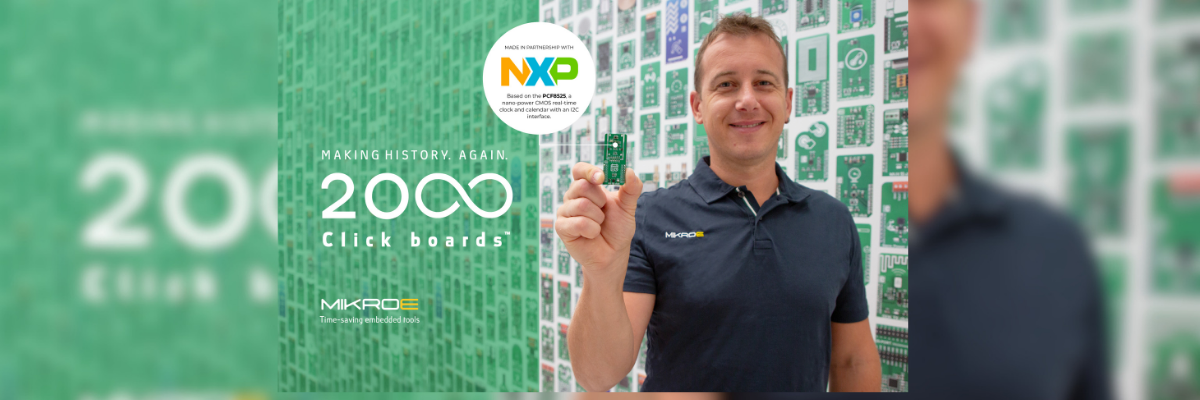
But accurate, low-power timekeeping becomes much more important when a product has to operate for long periods from a small battery, maintain timestamps during power interruptions, or wake itself for an event without leaving the rest of the system running. That is the design space behind MIKROE’s RTC 27 Click, its 2,000th Click board.
The compact add-on board is built around NXP’s PCF8525 real-time clock and calendar IC. It brings together the functions many embedded designs need for time-aware operation: calendar data, alarms, watchdog timing, timestamp capture, battery backup, and configurable interrupts.
Why an RTC Matters in an Always-On World
A real-time clock, or RTC, is a dedicated device that maintains time even when the main processor is asleep or the primary power source is unavailable. In a battery-powered sensor, for example, the microcontroller may wake only every few minutes to collect and transmit data. The RTC can track the schedule and issue the wake-up interrupt, allowing the rest of the system to remain in a low-power state.
That same capability matters in wearables, portable instruments, industrial controllers, and Internet of Things devices. Accurate timestamps can help establish when an event occurred. Alarms can trigger scheduled activity. A watchdog timer can help recover a system that has stopped responding. And battery backup can preserve timekeeping through a power loss, so the device does not have to start from scratch when power returns.
The PCF8525 is designed for this type of low-power work. In timekeeping mode at 3.3 V, it typically consumes just 64 nA. That makes it practical for designs where a small amount of always-on functionality needs to continue running while the larger system conserves energy.
More Than a Clock
RTC 27 Click supports the usual year, month, date, weekday, hour, minute, second, and hundredth-of-a-second information, but the useful design details go further.
Its programmable alarm function can generate an interrupt at a scheduled time. The watchdog timer can monitor whether a system is operating as expected. Timestamp capture can record when an external event occurred, which could be useful in monitoring equipment, security devices, or data loggers. The board also includes automatic battery switchover circuitry, helping maintain the clock when the primary supply is interrupted.
Two configurable interrupt outputs give designers flexibility in how they handle those events. Instead of constantly polling the RTC for an update, a host processor can wait for the board to signal that an alarm has occurred, a timestamp has been captured, or another programmed condition has been met.
That approach can reduce unnecessary processor activity and help support a lower overall power budget.
The Value of a Standardized Add-On Board
The milestone itself is part of the larger story. MIKROE’s Click board ecosystem was created around the mikroBUS socket, a 16-pin interface intended to make peripheral boards easier to move between development platforms.
For an engineer, the appeal is not that every project can be solved with an add-on board. Production hardware will often require a custom implementation. The value is speed during the earlier stages of development.
An RTC board such as RTC 27 Click can help a designer test a timing strategy, build a proof of concept, verify firmware behavior, or evaluate how backup power and interrupt handling should work before committing those functions to a custom PCB. Because the board uses I²C and supports MIKROE’s software libraries, it can also reduce the amount of basic interface work needed to get started.
That is especially useful when timekeeping is only one part of a more complex embedded system. Engineers can focus on the application behavior first, then decide how the RTC function should be integrated into the final design.
Small Building Blocks, Bigger Systems
Two thousand Click boards is a large catalog, but it reflects a familiar reality of embedded development: the hardest part of a design is rarely just selecting a microcontroller. Systems need sensors, displays, communications interfaces, power monitoring, memory, timing devices, and many other supporting functions.
The RTC 27 Click is a small example of how those supporting functions can shape the finished product. A low-power clock can determine how long a device sleeps, how reliably it records data, how it recovers from a power interruption, and whether it can stay useful when the rest of the system is conserving every possible microamp.
For an add-on board that is centered on keeping time, that is a pretty important job.