
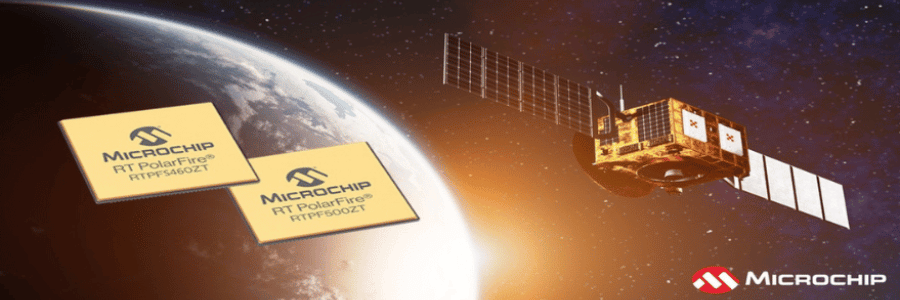

Microchip Technology has expanded the spaceflight qualifications of its radiation-tolerant (RT) PolarFire FPGA and SoC families, giving aerospace developers additional options for onboard processing systems that must operate reliably in radiation-intensive environments.
The company’s RTPF500ZT RT PolarFire FPGA has achieved Defense Logistics Agency (DLA) Qualified Manufacturers List (QML) Class V qualification, the highest qualification level for space microelectronics. Meanwhile, the RTPFS460ZT RT PolarFire SoC FPGA has completed QML Class Q and MIL-STD-883 Class B qualifications.
The new qualifications address the demanding reliability requirements of satellite payloads, spacecraft, and other aerospace systems where component failure can be difficult or impossible to correct after deployment.
Radiation tolerance is an important consideration when selecting programmable logic for space applications. Many SRAM-based FPGAs require configuration scrubbing to identify and correct radiation-induced configuration errors. Microchip’s RT PolarFire devices use configuration technology designed to eliminate configuration single-event upset (SEU) concerns, reducing the need for corrective configuration operations.
The devices also emphasize power efficiency, an important consideration for spacecraft with limited power budgets and restricted heat-dissipation capabilities.
The QML Class V-qualified RTPF500ZT provides in-flight programmability and radiation performance intended for high-reliability space applications, including protection against single-event latch-up (SEL). The RTPFS460ZT combines programmable logic with an integrated microprocessor subsystem featuring 64-bit RISC-V processor cores, allowing processing and configurable hardware functions to be implemented within a single device.
These capabilities can help developers consolidate onboard electronics while maintaining the flexibility to implement custom processing and control functions.
Microchip supports the RT PolarFire family with its Libero SoC Design Suite and Mi-V development ecosystem. The RTPFS460ZT development kit also provides a platform for evaluating the SoC architecture and prototyping applications before transitioning to flight hardware.
The company’s common RT PolarFire architecture and development tools allow engineering teams to reuse portions of their design and verification work across supported devices.
The newly qualified devices target applications ranging from satellite constellations and scientific payloads to human-rated spacecraft and deep-space missions.
Additional information is available through Microchip’s RT PolarFire FPGA and SoC portfolio. Pricing and ordering information is available through Microchip’s sales representatives and authorized distributors.