Artificial intelligence can identify a defective product on a manufacturing line, recognize an obstacle in a robot’s path, or determine when a machine needs adjustment. Recognizing a problem is only part of the job because then the system also needs to respond, sometimes within milliseconds.
That creates a challenge for embedded designers. AI workloads require substantial processing power, and physical control systems depend on predictable timing. Bringing these capabilities together is becoming much more important as AI moves beyond analyzing information and begins influencing how machines operate.
Why AI Processing and Real-Time Control Have Different Requirements
Traditional embedded systems are often built around microcontrollers designed to perform specific tasks with predictable timing. They read sensors, manage communication interfaces, and control motors or other connected equipment.
AI applications introduce a different set of requirements. Computer vision, speech recognition, and machine learning models can involve large amounts of data and complex calculations. These workloads typically benefit from application processors, substantial memory, and dedicated hardware acceleration.
Linux-based platforms are well suited to many of these processing tasks because they support sophisticated software environments and development tools. However, a general-purpose Linux system does not inherently guarantee that a particular operation will execute within a fixed deadline.
This becomes important when software decisions have physical consequences.
Think of an autonomous mobile robot navigating a warehouse, for example. Its vision system might identify an obstruction and determine that the robot needs to change direction. However, controlling the motors requires a separate sequence of operations, including updating drive signals and monitoring feedback.
The AI system determines what the robot should do, but the control system must execute that decision with the timing and precision required by the equipment.
Bringing Two Processing Environments Together
One approach is to divide these responsibilities between an application processor and a dedicated microcontroller.
The application processor handles computationally demanding workloads such as neural network inference, image processing, and higher-level decision-making. The microcontroller manages time-sensitive operations, including motor control, sensor sampling, and industrial communication.
This arrangement allows engineers to use Linux and AI development frameworks without placing every control function under the same operating system.
The two processors must still exchange information efficiently. Communication latency, synchronization, and fault handling become important design considerations, particularly when control decisions depend on information generated by an AI model.
For example, a machine vision application might identify an object and calculate its position. That information can be passed to the microcontroller, which determines how and when to move an actuator within the system’s programmed operating limits.
Keeping these functions separate also allows the microcontroller to maintain basic control operations when the AI workload is delayed or temporarily unavailable. That behavior must be deliberately designed, however, rather than assumed from the presence of two processors.
What This Means for Embedded Development Platforms
As edge AI applications become more sophisticated, development hardware is beginning to reflect this division between intelligence and control.
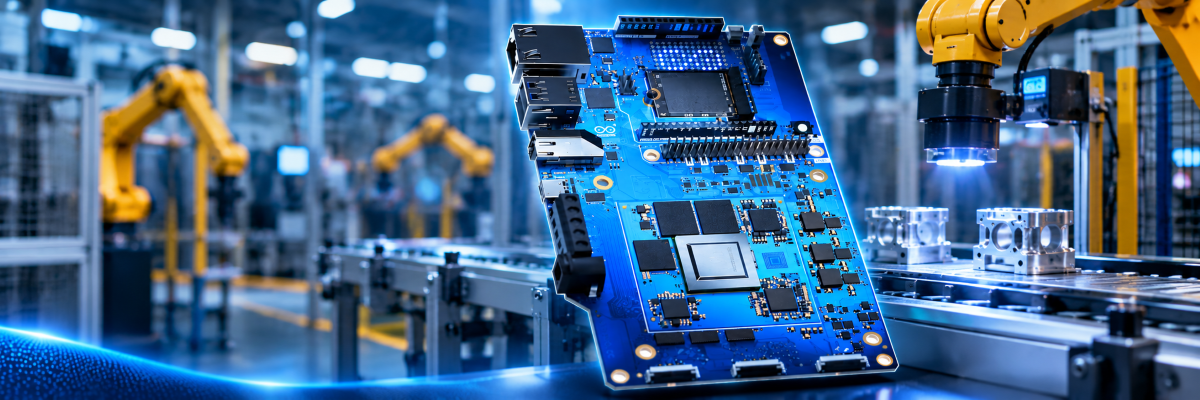
The Arduino VENTUNO Q is one example. Its dual-processor architecture combines a Qualcomm Dragonwing IQ8 application processor with an STMicroelectronics STM32H5F5 microcontroller.
The Qualcomm processor runs Linux applications and AI models, supported by a neural processing unit (NPU) capable of up to 40 dense TOPS. The STM32H5F5, built around a 250MHz Arm Cortex-M33 core, handles real-time control functions.
The processors communicate through a remote procedure call (RPC) mechanism, allowing applications running in the two environments to exchange information.
The board also includes 16GB of LPDDR5 memory and 64GB of eMMC storage, with NVMe expansion available for applications requiring additional storage capacity.
Of particular interest for vision-based systems is its support for three MIPI CSI camera connections. Multiple cameras can provide different views of an object or environment, which may be useful for robotic navigation, object tracking, or automated inspection.
For engineers working with both AI and traditional embedded control, the platform illustrates how these previously separate computing requirements can be brought together on a single board.
Making Edge AI Development More Accessible
Hardware integration addresses only part of the challenge. Engineers also need software tools that make it practical to develop and coordinate applications across different processing environments.
A typical edge AI project might involve Python for model execution, C or C++ for embedded control, and additional frameworks for vision processing or robotics. Managing these components across separate development tools can complicate integration and debugging.
Arduino’s App Lab addresses this issue by allowing Arduino sketches, Python applications, and AI models to be organized within a common project environment.
This approach can simplify experimentation with applications that combine sensing, inference, and physical control. It also gives engineers access to familiar Arduino hardware extensions while retaining the flexibility of Linux development.
Still, an integrated development environment does not eliminate the need for careful system design. Engineers must account for communication delays, processor resource limitations, power consumption, and the behavior of connected equipment when AI predictions are incorrect.
Safety-critical functions also require appropriate independent safeguards. An AI model’s output should not be treated as a substitute for verified safety controls.
From AI Decisions to Physical Responses
The next step for many edge AI systems is not necessarily running larger models. It is making the information those models produce useful to the equipment around them.
A vision model that identifies a manufacturing defect becomes more valuable when its output can trigger a precisely timed inspection or rejection operation. A robot that recognizes an obstacle needs control hardware capable of responding predictably. Even relatively simple AI applications can benefit from a clear separation between computational processing and time-sensitive device control.
Combining application processors with real-time microcontrollers gives engineers a practical way to address both requirements. As more embedded platforms adopt this architecture, the challenge will increasingly shift toward integrating the software, managing the exchange of data, and ensuring that AI-driven decisions translate into reliable physical actions.
See the Technology at electronica 2026
TME (Transfer Multisort Elektronik) will showcase the Arduino VENTUNO Q at electronica 2026 in Munich. Engineers interested in learning more about the platform can visit TME at Booth 361, Hall B5.