

The chipmaker’s latest earnings beat Wall Street expectations, while a stronger revenue forecast points to sustained demand for AI computing hardware. But export controls and a leadership transition raise questions about how that growth will unfold.
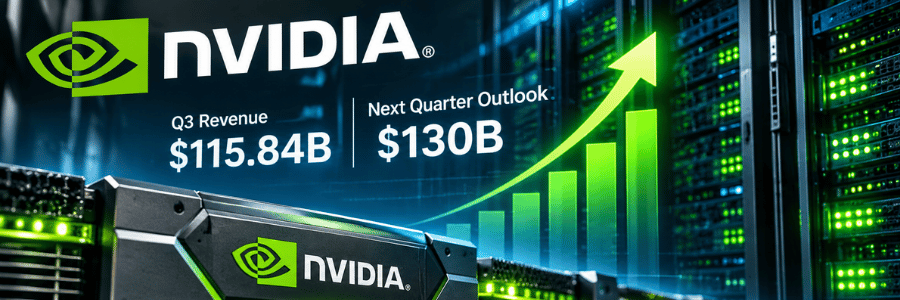
Nvidia reported quarterly revenue of $115.84 billion on November 17, exceeding Wall Street expectations and reinforcing the strength of demand for AI computing infrastructure. The results marked the company’s first earnings announcement since the departure of longtime CEO Jensen Huang, adding another layer of uncertainty to an otherwise strong financial performance.
Revenue for Nvidia’s third quarter of fiscal 2027, which ended October 25, increased 103% from a year earlier and 20% from the previous quarter. The results exceeded analysts’ expectations of approximately $109.1 billion, according to market estimates reported ahead of the announcement.
In its official earnings release, Nvidia projected fourth-quarter revenue of $130 billion, plus or minus 3%. The outlook was particularly notable because it assumes no data center compute revenue from China, where U.S. export restrictions continue to limit access to advanced AI chips.
Interim CEO and Chief Financial Officer Colette Kress also raised Nvidia’s expected revenue growth for fiscal 2028 to 75%, up from an earlier projection of 70%, according to earnings-call coverage from Reuters.
The combination of record revenue and higher growth expectations suggests that demand for accelerated computing remains strong despite geopolitical restrictions and growing questions about the sustainability of AI infrastructure spending.
Data Center Revenue Continues to Drive Growth
Nvidia’s data center business accounted for the overwhelming majority of quarterly revenue, generating $107.6 billion, an increase of 110% year over year.
That growth reflects continued investment in the computing systems required to train and operate increasingly complex AI models. Hyperscale cloud providers, specialized AI infrastructure companies and enterprise customers are expanding accelerated computing capacity to support workloads ranging from large language models to industrial AI applications.
The company’s latest results also coincide with the rollout of its Vera Rubin computing platform. According to Nvidia, production of the Vera Rubin NVL72 system has begun ramping, with installations at cloud infrastructure providers including Microsoft Azure, Google Cloud, CoreWeave and Oracle Cloud Infrastructure.
These developments are important because AI infrastructure is increasingly designed around complete computing systems rather than individual graphics processing units (GPUs).
High-performance AI installations require processors, high-bandwidth memory and networking hardware to operate together across large numbers of interconnected devices. As systems scale, memory bandwidth, interconnect performance and power delivery become increasingly important to overall computing efficiency.
For semiconductor manufacturers and component suppliers, Nvidia’s growth suggests continued opportunities across the supporting hardware ecosystem. Advanced packaging technologies, optical interconnects, power semiconductors and thermal management equipment all play a role in bringing higher-density AI systems into operation.
China Restrictions Reshape Nvidia’s Revenue Outlook
Perhaps the most significant detail in Nvidia’s earnings outlook is what the company has excluded from its projections.
Nvidia stated that its fourth-quarter forecast assumes no data center compute revenue from China. This reflects the continuing effects of U.S. export controls restricting shipments of advanced semiconductor technologies.
These restrictions have created uncertainty for companies supplying AI hardware to Chinese customers, particularly when products must meet increasingly specific performance and licensing requirements.
Yet Nvidia’s ability to project $130 billion in quarterly revenue without including Chinese data center compute sales suggests that demand from other markets remains substantial.
The implications extend beyond Nvidia’s immediate financial results. Export restrictions are influencing where advanced AI computing infrastructure can be deployed and how manufacturers develop products for different geographic markets.
Companies serving the Chinese market may face pressure to develop alternative AI accelerators and supporting software ecosystems, potentially accelerating investment in domestic semiconductor technologies.
For multinational suppliers, the restrictions complicate long-term product planning. Engineers developing AI hardware must increasingly consider regulatory requirements alongside traditional decisions involving processing performance, memory capacity and system architecture.
The restrictions also raise questions about how global AI infrastructure could evolve if access to advanced computing hardware remains uneven across markets.
Nvidia Faces Its First Major Test Without Jensen Huang
Nvidia’s financial performance comes during an unusual leadership transition.
On November 12, the company announced Huang’s resignation, naming Kress interim CEO while its board searches for a permanent successor. Kress, who joined Nvidia in 2013, will continue serving as chief financial officer during the transition.
Huang’s departure has raised questions about the company’s future direction after more than three decades under its co-founder.
During the November 17 earnings call, Nvidia’s leadership emphasized continuity in its technology roadmap and customer commitments. However, Reuters reported that investors remain focused on how the company will manage its leadership transition while maintaining relationships with major cloud customers and manufacturing partners.
Nvidia’s position in the AI market depends partly on those relationships. Developing advanced computing platforms requires coordination with semiconductor foundries, memory manufacturers and system integration partners, often years before products reach customers.
Maintaining that coordination will be important as Nvidia continues expanding beyond GPUs into CPUs, networking equipment and integrated AI computing platforms.
What the Results Mean for the Semiconductor Industry
Nvidia’s latest earnings offer another indication that AI infrastructure investment is supporting demand throughout the semiconductor supply chain.
The company’s rapid growth has implications for manufacturers of high-bandwidth memory, advanced interconnects and the power electronics used in large-scale computing installations.
As AI systems become denser, electrical and thermal requirements are becoming increasingly difficult to manage. Higher computing performance can increase rack-level power consumption, placing additional demands on voltage regulation, power conversion and cooling infrastructure.
Networking is another important consideration. Large AI clusters must move enormous quantities of data among processors, making high-speed electrical and optical connections essential to overall system performance.
Nvidia’s continued expansion may encourage additional investment in these technologies, particularly as cloud providers deploy more complex systems capable of supporting both AI training and inference.
However, strong demand for Nvidia’s products does not necessarily guarantee equal growth for every supplier. Component availability, manufacturing capacity and changing system architectures will influence which companies benefit most from AI infrastructure spending.
There are also questions about whether cloud providers can sustain current investment levels. Although Nvidia’s financial results indicate substantial near-term demand, future orders will depend partly on whether customers generate sufficient returns from their expanding AI infrastructure.
Strong Demand, but New Questions Ahead
Nvidia’s record quarter demonstrates that demand for advanced AI computing hardware remains substantial, even as export restrictions limit access to one of the world’s largest technology markets.
Its $130 billion fourth-quarter forecast and higher fiscal 2028 growth expectations suggest that the company sees continued expansion ahead. At the same time, Huang’s departure introduces uncertainty as Nvidia navigates increasingly complex relationships with customers, suppliers and regulators.
For the electronics industry, the results reinforce the growing importance of the hardware supporting AI development. Continued investment in accelerated computing is creating demand for increasingly capable processors, higher-bandwidth connections and more efficient power and thermal management systems.
The larger question is how long that expansion can continue at its current pace, particularly as companies face rising infrastructure costs and pressure to demonstrate returns on AI investment.
Nvidia’s latest results suggest that demand has yet to slow significantly. Whether that momentum continues will have consequences well beyond the chipmaker itself, influencing semiconductor development and the design of future data centers.