
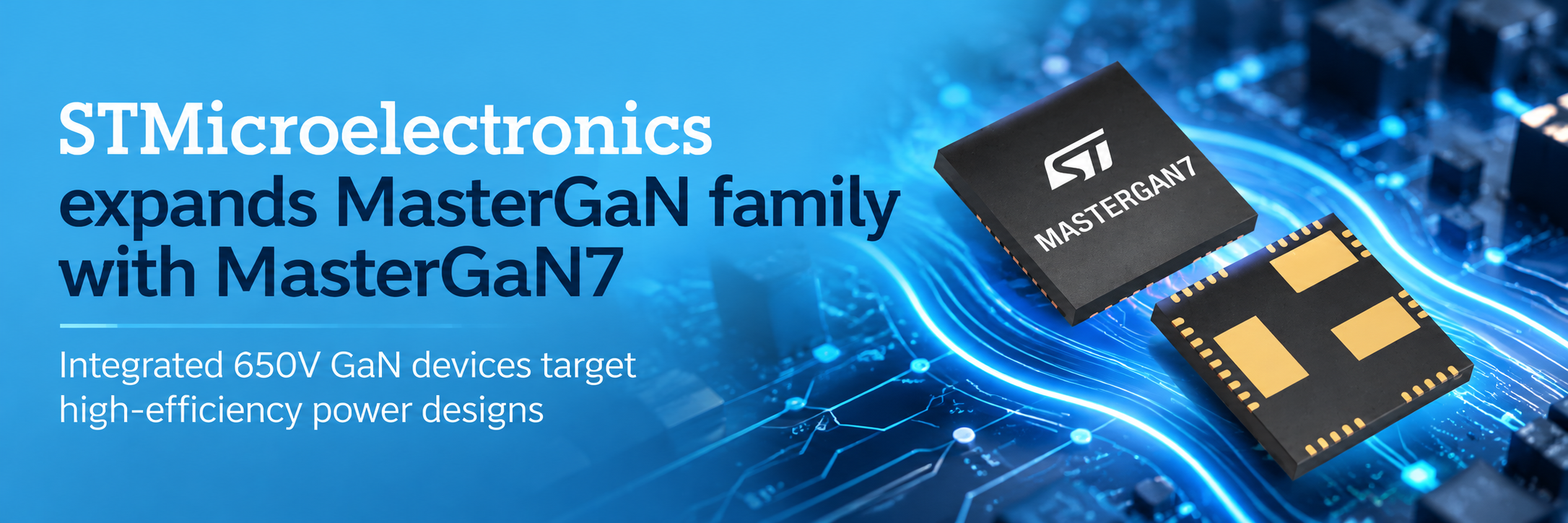

STMicroelectronics has expanded its MasterGaN power device family with the introduction of MasterGaN7, a series of integrated half-bridge devices designed to improve efficiency and power density in applications such as power adapters, chargers, industrial lighting systems, and solar microinverters.
The new devices combine two 650V enhancement-mode gallium nitride (GaN) transistors, rated for a maximum current of 6A, with a high-voltage gate driver in a single 9mm × 9mm QFN package. The package shares its pinout and footprint with other MasterGaN devices, allowing designers to work within existing board layouts.
MasterGaN7 introduces integrated low-dropout (LDO) regulators to stabilize gate-drive voltage and support consistent switching performance. A pin-controlled shutdown mode with fast wake-up helps reduce power consumption during idle periods.
With a propagation delay of 45ns and switching frequencies up to 2MHz, the devices can operate with smaller external magnetic and passive components, helping reduce circuit size and bill-of-materials costs. An integrated bootstrap diode supplies the high-side driver, while built-in protections include undervoltage lockout, thermal shutdown, and interlocking to prevent cross-conduction.
The MasterGaN7 series supports several power conversion topologies, including active-clamp flyback, resonant LLC, power factor correction (PFC), and DC-to-AC inverter designs. The devices operate across a temperature range of -40°C to 125°C.
MasterGaN7 is now in production, with pricing starting at $3.83 each in quantities of 1,000. STMicroelectronics also offers the EVLMG7 evaluation board to support initial development and testing.