

Most drones try to blend in by changing their appearance. They may use camouflage colors, transparent materials, or shapes designed to resemble birds or insects. A new experimental drone from Northwestern University takes a very different approach: instead of changing what the drone looks like, it changes how the human eye sees it in motion.
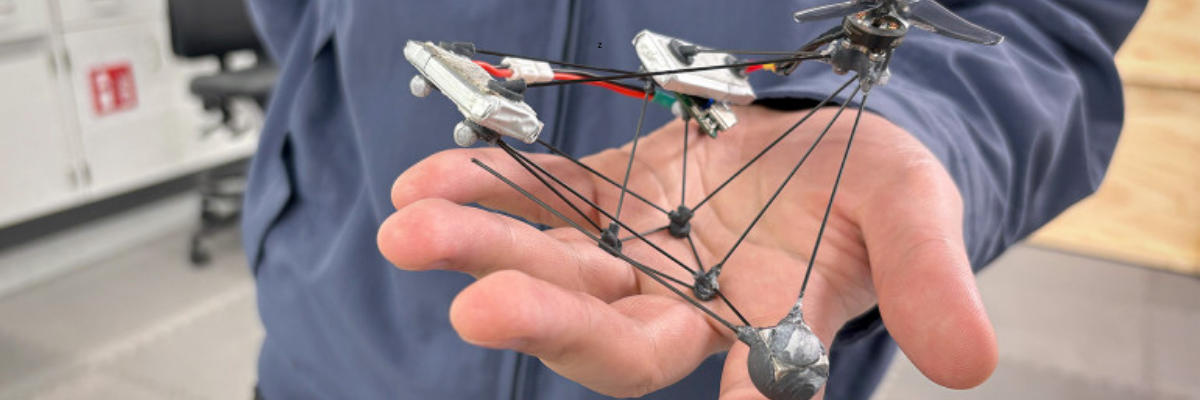
Called Phantom Twist, the drone uses a single propeller and spins its entire body while flying. The result is not invisibility in the science-fiction sense. At high speed, however, the individual components become difficult to distinguish, leaving behind a faint blur that can blend into a busy background.
It is a clever demonstration of how mechanical design, controls, and human perception can be designed together.
The Parts That Normally Give a Drone Away
A conventional quadcopter is easy to spot because its body remains relatively stationary even while its propellers spin. The arms, battery, camera, wiring, and central frame still create a familiar silhouette. Movement makes the propellers blurry, but it does not remove the body from view.
Phantom Twist eliminates that stationary center. Its propeller rotates in one direction while the rest of the UAV rotates in the opposite direction, allowing the overall system to remain stable enough for flight. With the drone’s functional components constantly moving, there is no clearly defined body for the eye to lock onto.
The concept is similar to looking through a fast-spinning ceiling fan. The blades are still there, but the eye integrates their motion over time instead of resolving each blade individually. The drone uses that same motion-blur effect to soften the visual boundaries of its battery, control board, motor, counterweight, and supporting structure.
Designing for Perception, Not Just Flight
The interesting engineering challenge is that spinning the whole platform is not enough. A drone still needs to maintain the mass distribution, inertia, thrust, and aerodynamic behavior required for controllable flight.
Northwestern’s researchers used a computational design process to explore roughly 20,000 possible configurations. The process adjusted the placement of major components and evaluated each arrangement against two competing requirements:
- The drone needed to meet the mechanical and aerodynamic constraints for stable flight.
- Its components needed to be positioned so they would not overlap into a recognizable form when spinning.
The final arrangement spreads components across different heights and angles. Rather than creating one dense, opaque shape, the geometry produces a more diffuse visual cloud during rotation. The researchers simulated these designs against a range of real-world backgrounds and used a perception model to estimate how noticeable each configuration would be to a human observer.
That approach is notable because it treats visual detectability as an engineering parameter. In most UAV design work, visibility might be considered late in the process as a matter of color, finish, or external housing. Here, it helped determine the physical layout of the system from the start.
Why Low Visibility Could Matter
A drone does not need to be invisible to be useful. It simply needs to create less disruption in the environment where it is operating.
Wildlife monitoring is one obvious application. A conventional UAV can alter animal behavior before it captures meaningful observations. A drone that is less visually noticeable could potentially observe nesting birds, wetlands, or other sensitive environments with less interference.
Infrastructure inspection is another possible use. In certain settings, a lower-visibility drone could inspect bridges, buildings, or industrial equipment without becoming an unnecessary distraction for nearby workers or the public.
The work also points to a broader robotics question: should robots always be designed to stand out? In public spaces, the answer is often yes. High-visibility colors, lights, and predictable movement help people recognize that a machine is present. But in research, environmental observation, and certain inspection tasks, reducing visual disruption may be just as important as making a system easy to notice.
The Tradeoffs Are Still There
The Phantom Twist is a research prototype, not a finished replacement for conventional drones. It still produces propeller noise, and its support rods and wires remain somewhat visible. Continuous body rotation also introduces practical questions about sensors, cameras, onboard electronics, payload mounting, and control-system design.
A camera or sensor mounted to a rapidly rotating platform would need its own stabilization strategy, or the drone would need another way to gather useful data. The electrical system also has to tolerate the mechanical demands of continuous rotation. Batteries, circuit boards, connectors, wire routing, and structural elements all become part of the balancing problem.
Those challenges are what make the project more than a visual trick. The drone’s reduced visibility comes from a tightly connected system-level design problem involving mechanical balance, propulsion, electronics placement, control, and perception.
A Different Way to Think About Robot Design
Phantom Twist shows that a robot’s appearance is not limited to its enclosure or surface finish. Motion itself can become a design material.
As robotic systems move into more shared, sensitive, and visually crowded environments, engineers may need to think beyond performance specifications such as flight time, payload, speed, and accuracy. How a machine is perceived by people and animals may become another meaningful constraint, shaped by the physical architecture of the system.
For this drone, the path to hiding in plain sight was not camouflage. It was engineering the blur.