

For most smartphone users, tapping a phone to pay for coffee, unlocking a car, or storing a digital driver’s license feels routine. Behind those everyday interactions, however, is a growing challenge that device manufacturers are already preparing for: how to secure digital credentials in a world where quantum computers may eventually be capable of breaking many of today’s encryption methods.
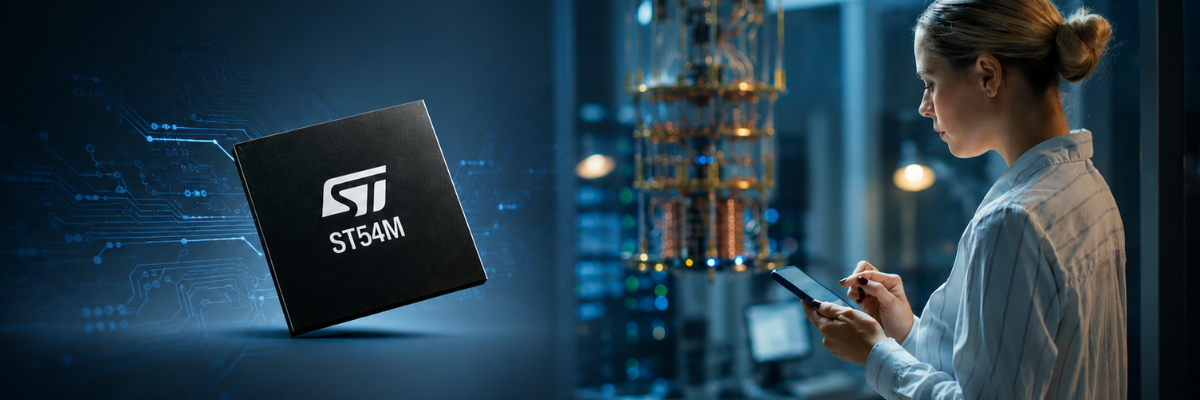
To address that challenge, STMicroelectronics has introduced the ST54M, a secure mobile chip that combines near-field communication (NFC), secure element, eSIM functionality, and a dedicated hardware accelerator for post-quantum cryptography (PQC) into a single device.
According to ST, the ST54M is the first secure mobile chip to integrate a hardware-based PQC accelerator alongside these mobile connectivity functions, giving smartphone and personal electronics manufacturers a way to begin preparing for future security requirements without changing how consumers interact with their devices.
Why Quantum Security Matters Today
Large-scale quantum computers capable of breaking widely used public-key encryption schemes do not yet exist. However, governments, financial institutions, and technology companies have increasingly warned that sensitive information encrypted today could potentially be stored and decrypted in the future once quantum computing capabilities mature.
This “harvest now, decrypt later” concern has accelerated efforts to develop and deploy post-quantum cryptographic algorithms designed to resist attacks from both classical and quantum computers.
For mobile-device manufacturers, the challenge is particularly complex. Smartphones have evolved into trusted platforms that store payment credentials, digital identities, transit passes, enterprise access credentials, and vehicle keys. Any future migration to quantum-resistant security standards must occur without disrupting these services or degrading the user experience.
The ST54M is designed to help bridge that transition.
Multiple Security Functions on a Single Chip
Rather than requiring separate components, ST’s new device combines several technologies already common in modern smartphones.
The chip integrates:
- NFC functionality for contactless interactions
- A secure element for protecting sensitive credentials
- Embedded SIM (eSIM) capabilities
- A dedicated post-quantum cryptography hardware accelerator
Bringing these functions together on a single die can help reduce complexity while allowing device manufacturers to support multiple secure services from one platform.
Potential applications include:
- Contactless payments
- Transit ticketing
- Digital identity programs
- Mobile driver’s licenses
- Secure building access
- Mobile network operator services
- Digital car keys
As more of these services move onto smartphones, device makers face increasing pressure to provide stronger security while maintaining convenience for users.
Hardware Acceleration for Post-Quantum Cryptography
One of the most notable features of the ST54M is its dedicated hardware engine for post-quantum cryptographic algorithms.
The accelerator supports algorithms including ML-KEM (Module Lattice-Based Key Encapsulation Mechanism) and ML-DSA (Module Lattice-Based Digital Signature Algorithm), both of which are among the cryptographic approaches being adopted as part of the industry’s transition toward quantum-resistant security.
Implementing these algorithms efficiently presents challenges because post-quantum cryptography often requires larger keys, additional memory, and more computational resources than traditional public-key systems.
By handling these operations in dedicated hardware rather than software alone, the device can provide improved performance while helping protect against side-channel and fault-injection attacks that target cryptographic implementations.
The hardware accelerator builds upon ST’s broader post-quantum security efforts, which already include certified software libraries for STM32 microcontrollers.
Supporting the Next Generation of Digital Services
As digital wallets, identity programs, transportation systems, and connected vehicles become more integrated with smartphones, secure mobile chips must also deliver reliable wireless performance.
ST says the ST54M incorporates an enhanced RF front end and expanded memory resources to support multiple applications simultaneously. The company also notes that the platform can improve operation with smaller antennas and single-ended configurations while supporting more demanding use cases such as mobile point-of-sale (mPOS) systems and wireless charging applications.
These improvements reflect a broader trend across the mobile industry. Smartphones are increasingly expected to serve as a universal credential that can authenticate users across banking, transportation, government services, workplaces, and vehicles.
That expanding role places greater demands on both security and connectivity technologies.
Preparing for Security Requirements Years Ahead
Although many industry experts expect post-quantum security requirements to become more widespread closer to 2030, device manufacturers typically need years to design, qualify, and deploy new hardware platforms.
That means the transition has already begun.
By introducing a mobile platform with built-in post-quantum cryptography support today, ST is giving OEMs, mobile operators, financial institutions, and ecosystem partners an opportunity to begin testing and deploying quantum-ready solutions well before regulatory requirements arrive.
The company reports that the platform has completed certification testing under Common Criteria 2022 EUCC and EMVCo standards, with production and certification targeted for July 2026.
While quantum computing’s full impact on cybersecurity remains several years away, the mobile industry is increasingly treating post-quantum readiness as a current design consideration rather than a future problem. The ST54M represents one of the latest examples of how semiconductor manufacturers are beginning to build that transition directly into the hardware powering next-generation connected devices.