


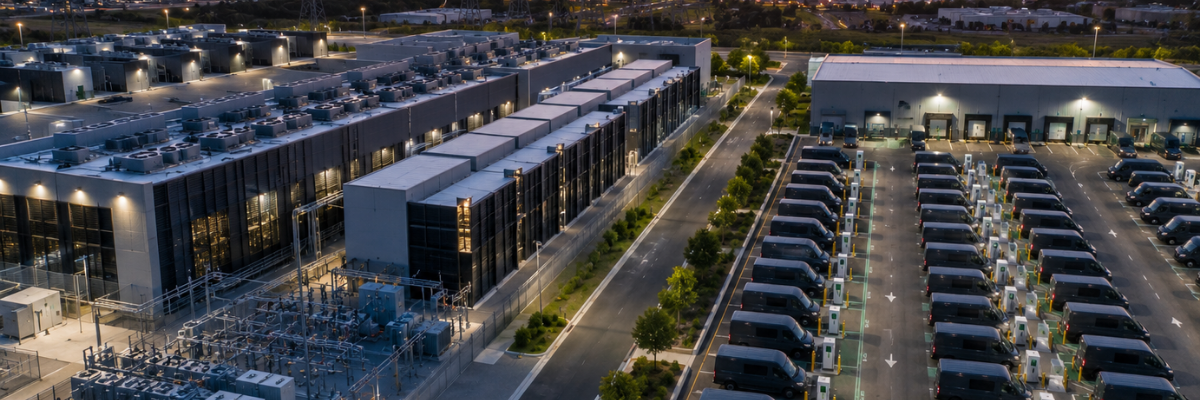
Over the past year, AI stories have become more about power stories than AI itself. Utilities from Texas to Virginia are receiving requests from data center developers looking for amounts of electricity that could change utility forecasts. Texas grid operator ERCOT, for example, has been dealing with hundreds of gigawatts of proposed new load, and much of it is tied to data centers. In June 2026, federal regulators directed regional grid operators to review how large energy users connect to the grid.
Clearly, the attention is beyond processors and computing hardware, and now the question is whether the electrical infrastructure needed to support the next generation of AI can be built quickly enough.
AI data centers put the question in plain view: What happens when growth depends on power that the grid wasn’t ready to deliver quickly?
Commercial EV fleet operators have known a smaller version of the same problem.
A delivery depot is not asking for the same amount of power as a hyperscale data center. The numbers are smaller, and even the public attention is smaller, but the planning questions often sound familiar.
How much capacity is available at this site? How long will a utility upgrade take? What happens if the vehicles arrive before the power does?
Amazon says more than 30,000 custom Rivian electric delivery vans now operate across the United States. Globally, Amazon’s electric delivery fleet has passed 50,000 vehicles. UPS, DHL, FedEx, utilities, municipalities, school districts, and service companies are also moving vehicles into electric programs.
Electrification of fleets appears straightforward when the numbers are small. A company adds a handful of vans and installs a few chargers. The project feels similar to adding EVs to a corporate parking lot.
But when we’re talking about fleets with dozens or hundreds of vehicles, the conversation begins to change. A depot that serves 200 electric vans requires very different infrastructure needs than if it were just serving 20. At that scale, charging is more of a facility issue instead of just a transportation issue.
The comparison to AI starts to make sense at this point. Both industries are forcing utilities to plan for new sources of electrical demand that didn’t exist a decade ago.
AI Gets the Headlines. Fleets Feel the Same Utility Math.
The International Energy Agency expects global data center electricity demand to more than double by 2030. AI is a major reason. In the United States, the agency expects data centers to account for nearly half of electricity demand growth through the end of the decade.
Those numbers explain why utilities are paying attention. Data center developers are asking for service at a scale once associated with factories, mines, and large industrial sites. Some requests reach hundreds of megawatts. Texas regulators recently approved a new ERCOT process for large load interconnection after the grid operator faced more than 438,000 megawatts of load requests, with most tied to data centers.
Fleet depots are smaller, but they land on the same utility desks.
A depot electrification project might ask for 2MW, 5MW, or 10MW instead of 200MW. For the fleet operator, though, the problem has the same shape. The business wants to grow. The site needs more power. The utility must study the request, find available capacity, plan upgrades, and decide who pays for which pieces of the work.
A gas or diesel depot never had to think this way. Fuel arrived by truck. The site needed tanks, pumps, and safety systems. The local electric service mattered for the building, not the vehicles.
Electric fleets move the energy problem onto the property.
A Fleet Depot Becomes an Electrical Project
Early fleet electrification projects were often measured in dozens of vehicles. A city might replace part of its maintenance fleet with electric vans, or a delivery company might test some routes before committing to a larger rollout.
The infrastructure requirements were usually manageable, and the process included installing chargers, working with the utility, and getting the vehicles on the road. But as the fleets grew, the lessons changed.
For example, a depot with 200 electric delivery vans could require 10MWh to 20MWh of energy overnight, depending on route length, vehicle size, weather conditions, and charging strategy.
The challenge is not just about the amount of energy, though. Most of those vehicles return within a relatively short period of time. Drivers finish their routes, park, and plug. After everyone does this, the charging demand across the site looks a lot different than it did during the day. So, fleet operators are discovering that the question is not whether enough energy is available over a 24-hour period, but whether enough power is available when hundreds of vehicles need it at about the same time.
That creates changes to the facility.
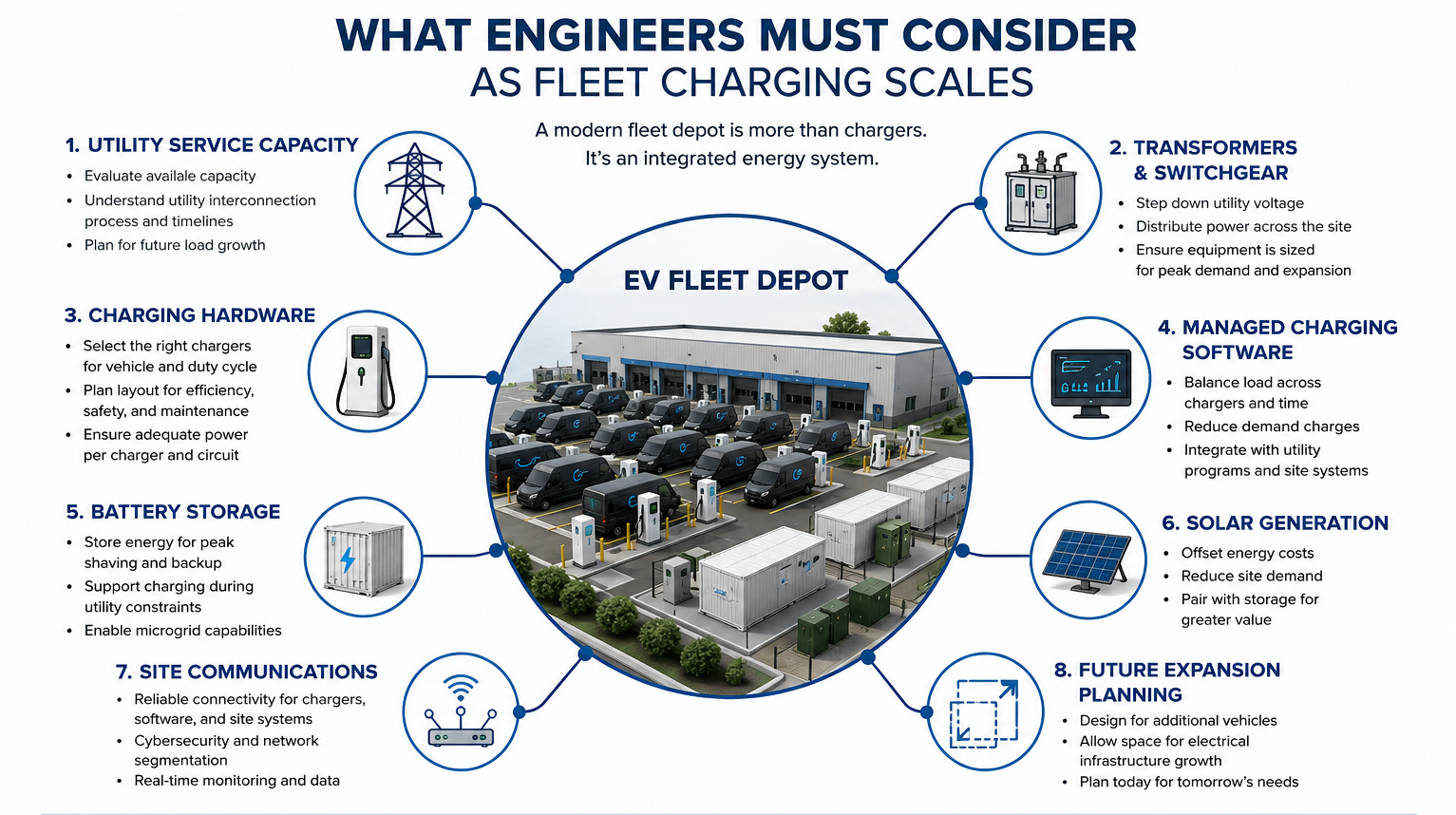
Engineers have to look past the charger pedestal. They need to look at service entrance capacity, transformers, switchgear, panel capacity, conduit runs, trenching, communications, parking layout, charger placement, cable reach, maintenance access, and future expansion.
Many fleet operators begin by thinking about vehicles and chargers, but utilities tend to look at the project differently.
Before the first charger is installed, someone has to determine whether the site has enough electrical capacity to support the fleet being planned. If additional capacity is needed, then the conversation must expand.
The U.S. Department of Transportation’s EV Fleet Transition Toolkit recommends evaluating utility service, facility infrastructure, charging requirements, and fleet operations together rather than treating charging as a standalone project.
The reason for that advice is that vehicles and infrastructure often move on different timelines. A fleet manager might finalize vehicle purchases months before a utility completes an infrastructure study. New transformers, switchgear, service upgrades, permits, and construction all take time, and in some cases, the vehicles are ready before the site is.
The vehicle program then depends on the power project.
The Problem Is Not Always Charger Count
Fleet electrification often starts with a simple question: How many chargers do we need? The better question is: How should the site use the power already available?
A depot with 100 vehicles does not always need 100 vehicles charging at full output at 6 p.m. Some vehicles return with half a battery. Some need a full charge. Some leave before sunrise. Others sit until mid-morning.
This is where fleet charging starts to look less like fueling and more like scheduling.
Managed charging software looks at state of charge, departure time, charger availability, site capacity, and utility rates. Then the system decides when each vehicle charges and how much power each vehicle receives.
The goal is to keep operations practical and prepare every vehicle for its next route without driving demand peaks to their maximum.
For a small fleet, a dispatcher might handle those decisions manually. For a large fleet, software becomes part of the infrastructure. The system decides whether a van leaving at 4 a.m. should charge before a van leaving at 9 a.m. The system also lowers charging power when the building load rises or when utility rates make peak demand expensive.
This is not a futuristic idea. SEPA has identified managed charging as one of the tools for fleet electrification, especially where grid limits slow charging deployment. The World Economic Forum has also pointed to smart charging and microgrids as a combined approach for scheduling charging in response to building loads and grid signals.
More chargers do not always solve the problem. Better use of power often comes first.
Batteries Move From Vehicles to the Depot
AI developers have drawn attention for looking at new power strategies, including fuel cells and dedicated generation. Fleet operators are not copying that model at the same scale. They are looking harder at battery storage.
A stationary battery does not replace the grid. It changes how the site uses the grid.
The depot charges the battery when demand is lower. Later, when vehicles return and charging demand rises, the battery helps serve the load. This reduces the site’s peak draw from the utility.
For fleet operators, peak demand is not a small issue. Many commercial electric bills include demand charges based on the highest power draw during a billing period. A single evening of unmanaged charging raises costs for the whole month.
Battery storage is also finding a role in projects where utility upgrades are still months or years away. A fleet operator might have enough electrical service to support normal facility operations but not enough capacity to charge every vehicle at the same time. Added storage gives the site another source of energy during periods of heavy charging demand.
While it’s not a substitute for long-term infrastructure upgrades, it does offer some flexibility while those projects move through the other stages.
Some good examples are emerging in heavy-duty charging.
Projects like WattEV’s Bakersfield depot show how much fleet charging infrastructure has changed. The site combines charging equipment, battery storage, solar generation, and energy management systems in a single location.
Most delivery fleets are operating at a smaller scale than heavy-duty trucking, but they are starting to confront many of the same questions. How much power should come from the grid? How much should come from stored energy? How should charging be scheduled across dozens or hundreds of vehicles?
The fleet charging conversation doesn’t stop at the charger anymore. When fleet sizes start growing, the discussion must expand to battery storage, solar generation, energy management software, and other ways to make better use of available power.
Utilities Need Better Forecasts From Fleets
The utility side also changes.
A utility cannot plan around vague electrification goals. It needs numbers. How many vehicles? What type? What route lengths? What charger power levels? What hours? What growth plan?
A fleet might start with 25 vans, then move to 100, then 400. Each step changes the load forecast. If the utility only sees the first phase, the site might need another upgrade later. If the operator overstates future growth, infrastructure might sit underused for years.
AI data centers face a similar credibility problem.
ERCOT’s large-load queue became so large that Texas regulators approved a process meant to screen and study qualified projects more carefully. The same issue appears in a different form with fleets. Utilities need early information, but they also need realistic information.
That puts more pressure on fleet operators to treat charging plans as engineering inputs, not rough guesses.
A route plan becomes a load forecast. A vehicle schedule becomes a charging schedule. A parking lot layout becomes an electrical design constraint.
This is one reason fleet charging projects now involve more people than many operators expect. Fleet managers, facility engineers, utility account teams, electrical contractors, software vendors, charger suppliers, and finance teams all have a role.
A depot electrification project is not a vehicle purchase with some chargers attached. It is a site redevelopment project with vehicles at the center.
The Next Fleet Is Already Part of the Design
The hardest decision is not always what to build for the first electric vehicles. The harder decision is what to reserve for the next ones.
A depot might start with 30 vans, but might need to support 200 later. Another site might add box trucks or heavy-duty vehicles after the first delivery vans arrive. Charging standards also continue to move. Megawatt Charging System development targets larger commercial vehicles with charging needs far beyond light-duty vans.
Designing only for the first deployment lowers near-term cost, but risks a second round of trenching, electrical upgrades, and construction. And while designing for the final fleet raises the upfront cost, it also reduces future disruption.
There is no universal answer.
A dense urban depot faces different limits than a suburban warehouse. A utility fleet with predictable routes has different needs than a parcel delivery site with seasonal demand spikes. A depot with room for solar and storage has different options than a site with no spare land.
Those differences make early planning important and raise many initial questions, including:
Where will the next chargers go? Where will the transformer sit? Does the parking layout leave room for larger vehicles? Will cables reach safely without blocking traffic? Will the site need battery storage later? Will the utility service support the full buildout?
Those are practical questions that also bring a focus back to the product layer. Charging infrastructure depends on the physical connection between the vehicle and charger. Cables, connectors, charging inlets, contact systems, and safety features become part of a larger site design. As fleets scale, those choices affect reliability, ergonomics, maintenance, and uptime.
A failed charging session at home is inconvenient. A failed charging session at a depot affects tomorrow’s routes.
The Grid Story Comes Back to Vehicles
AI data centers and EV fleet depots are not the same customer.
Data centers run around the clock. Fleet charging often peaks around operating schedules. Data centers concentrate power in computing halls. Fleet depots spread power across parking rows, chargers, cables, vehicles, and route plans.
But both are part of the same larger change happening.
Electricity is moving from a background utility cost to a planning constraint. Companies that grow through computing need more power. Companies that grow through electric transportation need more power. Utilities must serve both while maintaining reliability and controlling costs for other customers.
For fleets, the answer is not to wait for the grid to become perfect.
The answer is to plan earlier, share better load forecasts, manage charging, and build sites with room to grow. Some depots will add battery storage. Some will add solar. Others will use microgrids. Many will rely on software to spread charging across the hours available.
The electric vehicle is still the most visible symbol of fleet electrification. But the harder story now sits behind the vehicle, at the depot, where parking spaces are turning into electrical loads, and delivery schedules are becoming part of the power plan.