

When a lithium-ion battery cell enters thermal runaway, engineers have plenty of ways to observe what happens on the outside.
They can measure changes in voltage and temperature. They can monitor pressure and gases leaving the cell. After the test, they can take the battery apart to examine the damage. Simulations help reconstruct what likely happened along the way.
What has been much harder to see is what happens inside the cell while it is failing.
Those internal events happen quickly. Materials shift. Cracks form. Gases develop. A failure that begins in one location can spread through the cell and, in a battery pack, potentially into neighboring cells.
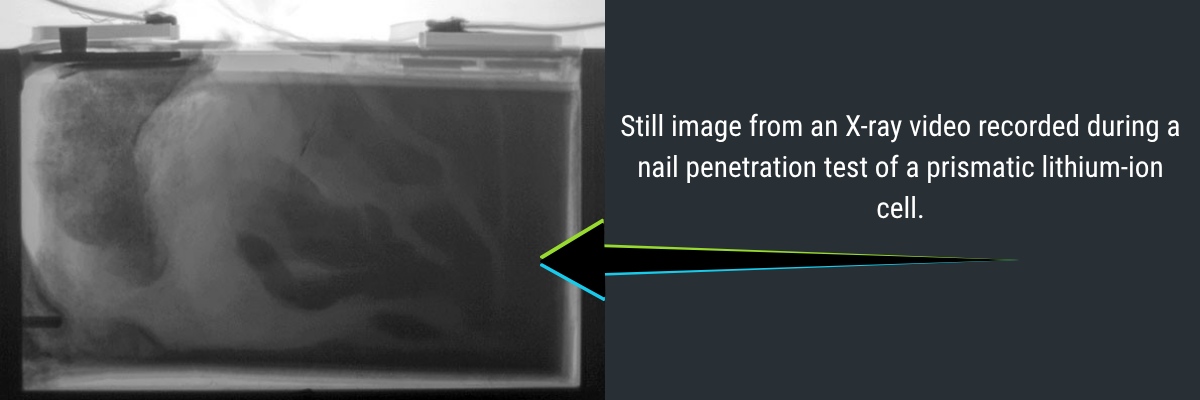
A new high-speed X-ray system is giving battery engineers a way to watch some of those processes as they happen. The technology records the inside of large-format prismatic lithium-ion cells at up to 1,000 images per second while other sensors simultaneously measure temperature, pressure, voltage and gas flow.
Developed by the Fraunhofer Institute for High-Speed Dynamics, Ernst-Mach-Institut (EMI), the system is now being moved toward industrial use through a collaboration with PowerCo, Volkswagen Group’s battery company. Volkswagen and Audi have already used the technology in battery research, and PowerCo plans to install the system at its Salzgitter facility in 2028.

For battery developers, being able to see a failure unfold could provide something measurements and post-test analysis cannot: a direct look at when and where critical events happen inside the cell.
What Happens During Thermal Runaway?
A lithium-ion cell stores a large amount of energy in a relatively small space. Under normal operating conditions, its electrodes, separator and electrolyte work together to keep electrochemical reactions controlled.
Problems arise when that internal structure is damaged or the cell is pushed outside safe operating conditions.
An internal short circuit, mechanical damage, overheating or another failure can cause the cell temperature to rise. As temperatures increase, materials inside the battery begin to break down and trigger additional reactions that release more heat.
If the cell begins generating heat faster than it can release it, the result can become self-sustaining. This is thermal runaway.
Once underway, the process can produce rapidly rising temperatures, pressure and flammable gases. In a battery containing many cells, heat from one failing cell can also trigger thermal runaway in neighboring cells, creating a propagation problem.
Understanding that sequence is essential to designing safer cells and battery packs. The difficulty is that some of the most important events are happening behind a metal enclosure.
Looking Beyond the Outside of the Cell
Battery safety testing already gives engineers substantial information about a failure.
Voltage measurements can show when electrical behavior changes. Temperature sensors reveal how quickly different areas of a cell or pack heat up. Pressure and gas measurements provide information about venting and the products released as the battery breaks down.
But those measurements are indirect.
They do not necessarily show how materials inside the cell are moving at the moment the measurements change.
Manufacturers and vehicle developers have therefore relied on a combination of simulations, destructive tests and indirect measurements to understand the internal behavior of a failing cell.
Post-test analysis adds another piece of the picture, but by then the failure has already happened. Engineers are examining the result rather than watching the sequence that produced it.
High-speed X-ray imaging changes the type of information available during the test.
Fraunhofer EMI’s system captures up to 1,000 X-ray images every second. At the same time, synchronized sensors collect temperature, pressure, voltage and gas-flow data. Engineers can then compare what they see happening inside the cell with the measurements being recorded outside it.
The images reveal processes including gas formation, material displacement and crack propagation as the cell fails.
That combination matters. A sudden pressure change, for example, becomes more useful when engineers can compare it with an image showing what shifted inside the cell at approximately the same moment.
Building a Camera for an Explosion
Seeing through a battery cell at 1,000 frames per second presents one set of engineering challenges.
Doing it while the battery is undergoing thermal runaway presents another.
The X-ray equipment has to remain close enough to capture useful images while being protected from the event it is recording. A failing lithium-ion cell can generate intense heat, pressure, gases and material ejected from the cell.
Fraunhofer EMI therefore had to develop a specialized test chamber that protects the sensitive X-ray components from those conditions while still allowing the system to observe what is happening inside the battery. The institute describes development of the protective chamber as one of the central engineering achievements behind the system.
The X-ray technology itself grew out of Fraunhofer EMI’s work studying other extremely fast events.
The institute has previously used high-speed X-ray imaging during automotive crash testing. Its system uses a linear accelerator as the X-ray source and has captured internal structural deformation during a crash at the same rate of up to 1,000 images per second.
Applying that capability to batteries creates a different problem. Instead of looking through a vehicle structure as it deforms, engineers need to resolve changes occurring inside a compact electrochemical cell while safely containing the consequences of failure.
From Seeing Failure to Designing Around It
The goal is not simply to produce dramatic footage of a battery failing.
The value comes from connecting what happens inside the cell with the other data collected during the test.
A simulation of thermal runaway is only as useful as the physical behavior it represents. Direct observations give engineers another source of experimental data for validating those models and improving their understanding of how a particular cell design behaves under abuse conditions.
The system could also help engineers examine how changes to cell construction affect failure.
Fraunhofer EMI says the test setup is modular and is designed to accommodate different cell formats and cell chemistries. That makes it possible to compare how different designs respond under similar test conditions rather than limiting the system to one particular battery architecture.
The technology has already moved beyond an experimental demonstration.
Fraunhofer EMI has used high-speed X-ray testing for several German automakers. Work for Volkswagen and Audi has included studying material ejection during thermal runaway and examining how failures propagate through configurations containing multiple cells.
The next step brings the equipment closer to battery manufacturing itself. PowerCo plans to install the technology at its Salzgitter site in 2028, where the company is ramping production and development of battery cells.
Seeing What the Sensors Miss
Battery engineers already collect enormous amounts of data during safety testing. High-speed X-ray imaging does not replace those measurements.
It gives them context.
A temperature spike shows that something inside a cell has changed. A pressure increase indicates that gases are forming or moving. A voltage drop tells engineers something has happened electrically.
Now those measurements can potentially be matched to images showing where materials moved, when cracks developed or how the internal structure changed as the failure progressed.
There are still limits. X-ray testing requires specialized equipment and controlled test facilities, making it a development and validation tool rather than something that follows a battery into normal operation.
But batteries do not have to carry the X-ray system for the information to matter.
If engineers can see precisely how a cell comes apart during failure, they have a better chance of changing the materials, internal structure or surrounding battery system before the next one does.
For a process as fast and destructive as thermal runaway, seeing the failure while it happens fills in a part of the story that has largely remained hidden inside the cell.
Original Story: https://www.emi.fraunhofer.de/en/news/news-press/X-raying-batteries-under-load.html