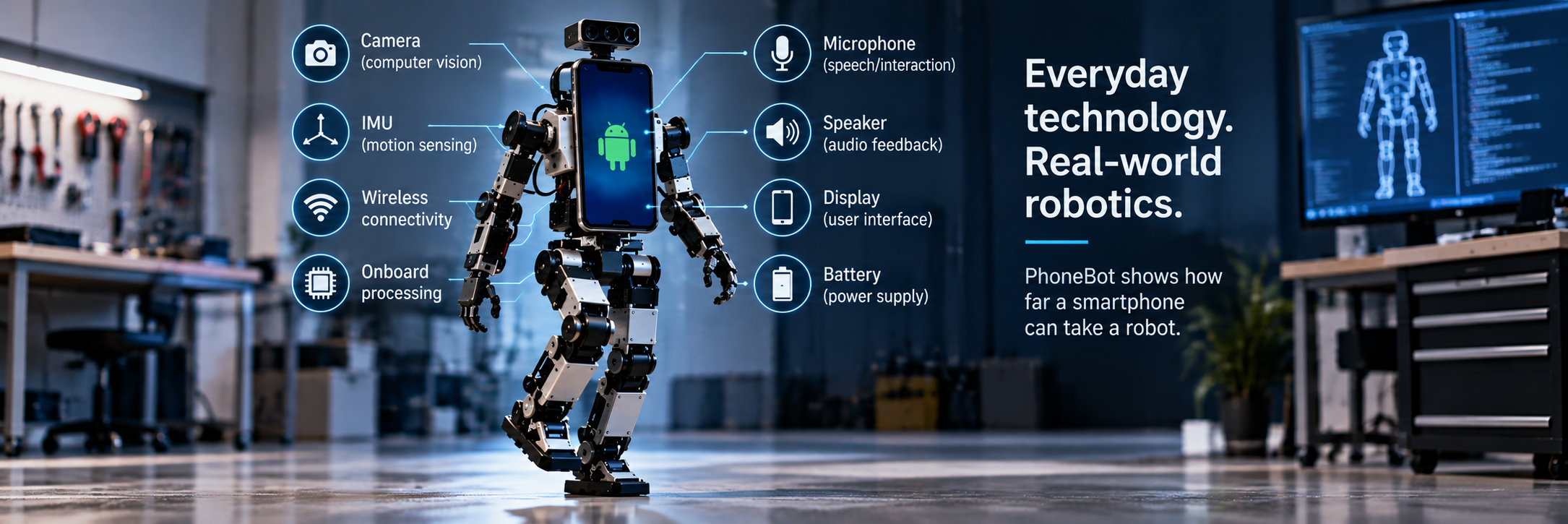

PhoneBot puts an old Android handset at the center of a walking humanoid. The larger lesson is not that a phone replaces every piece of robot electronics. It is that engineers now have a mature, tightly integrated module for perception, compute, communications, and human interaction sitting in a drawer.
The newest humanoid robot worth watching does not arrive in a crate from a well-funded startup. It walks with an Android phone bolted to its torso.
PhoneBot, an open-source project from researchers at UCLA, uses a commodity smartphone as its primary sensing and computing unit. Thirteen low-cost actuators make up the lower body. The phone supplies the camera, inertial sensing, wireless connection, local processing, display, speaker, and user interface. The team reports stable walking, person following, filming, telepresence, and conversational interaction from a machine built around ordinary consumer hardware.
The point is not that a $75 handset turns into a humanoid controller by force of optimism. It does not. A phone has real limits, and a robot that moves around people still needs dedicated electronics where timing, motor control, and safety leave no room for improvisation. But PhoneBot puts a useful question on the table: how much of a robot still needs to be designed from scratch?
For years, engineers have bought separate boards and modules to assemble the same basic collection of functions: a processor, camera interfaces, inertial measurement, radios, audio, display, power management, storage, and a software environment. A phone arrives with those pieces already integrated, tested at enormous scale, and supported by a development ecosystem most robotics platforms would envy.
The idea is older than the current humanoid rush
PhoneBot is new. Smartphone robotics is not.
In 2020, Intel Labs introduced OpenBot, a small wheeled robot body intended to work with a standard Android phone. The group put the chassis cost at about $50 and showed person following and real-time autonomous navigation in unstructured environments. The design had a refreshingly plain premise: let the phone do the work it already does well and keep the purpose-built hardware focused on movement.
The idea came around before that. Romo, a small iPhone-powered robot from the early 2010s, offered a glimpse of the concept to consumers. It was charming, limited, and ultimately tied too closely to a short list of compatible iPhones. That last point matters. Robotics moves on a far longer product cycle than consumer electronics, and a robot platform built around a particular phone model risks becoming an orphan as soon as the connector or operating system changes.
Still, the ingredients improved. Cameras became better. Mobile processors acquired dedicated image processing and neural acceleration. Wireless links became more capable. The phone stopped looking like a toy controller and started looking like a compact edge-computing module with a battery and a screen attached.
OpenBot’s later fleet work made the argument more interesting. Researchers deployed 72 smartphone-based robots in people’s homes and reported navigation policies that generalized to unseen homes with more than 80% success. That is not a claim that a phone belongs in every autonomous mobile robot. It does show what becomes possible when building and deploying a large robot fleet stops requiring a matching fleet of expensive custom compute stacks.
A phone bundles more than processing power
It is easy to reduce this story to cheap compute. That misses the engineering advantage.
A modern smartphone is a concentrated collection of subsystems that a robot designer otherwise has to select, connect, power, enclose, characterize, and support. The camera feeds vision software. The IMU supplies acceleration and angular-rate data. The radios handle Wi-Fi, Bluetooth, and often cellular service. The microphone, speaker, and touch screen turn a machine into something a person can configure or talk to without a separate panel.
Android’s sensor framework exposes motion, position, and environmental sensors through a standard software interface. Accelerometers and gyroscopes are hardware devices; rotation, gravity, and linear-acceleration readings can be derived through sensor fusion. A developer still has to check what exists on a particular phone, along with resolution, range, power draw, and sampling behavior. But the wiring and low-level device access are no longer a custom project.
That changes the early architecture discussion. The question shifts from “Which camera board, IMU, radio, display, and compute module do we need?” to “Which of those functions truly needs a dedicated robot-grade component?”
For education and prototype work, that shift is enormous. It lowers the cost of a failed experiment, shortens the path to a mobile demonstration, and removes a pile of integration work before the team knows whether the robotic behavior itself is worthwhile. For a company building a non-safety-critical service robot, a phone also offers a ready-made human-facing terminal. Technicians already understand its interface. Users know where to look.
The same design instinct shows up in professional robotics hardware, even when no phone is visible. Robotics platforms built around mobile-class systems-on-chip combine heterogeneous processors, camera support, machine-learning acceleration, and high-bandwidth wireless connectivity on one compute board. The handset and the industrial module differ in packaging, lifecycle, connectors, thermal design, and software control. Their shared lesson is that robots increasingly benefit from a dense, integrated edge-compute architecture instead of a collection of disconnected boards.
The phone should not sit in every control loop
This is where the story becomes useful for design engineers. Reusing a phone does not remove the need to divide work properly.
A walking machine has at least two jobs happening at different speeds. The high-level system decides where the robot should go, recognizes a person, manages a conversation, and sends broad motion goals. The low-level system reads encoders, controls current, manages motor commutation, watches joint limits, and reacts to faults. Those latter jobs belong near the drives, on electronics whose timing and failure behavior the designer controls.
PhoneBot follows that logic rather than trying to make the handset do everything. The smartphone acts as the torso-mounted hub for perception, computation, and interaction, while the rest of the architecture handles the robot’s actuation and real-time communication. That split is the story, more than the clever reuse of a retired phone.
The operating system adds another reason for restraint. Android supports sensor access, but sensor hardware varies among devices. Its documentation also notes that apps targeting Android 12 or later face a 200-Hz limit on several motion and position sensors through the ordinary listener interface unless they request the higher-sampling-rate permission. A product team needs to treat those details as architecture constraints, not surprises found during field testing.
Then there is the physical side. A phone is not rated by default for joint vibration, dust, washdown, temperature extremes, or a decade of service. Battery swelling, software updates, supply continuity, repair access, and thermal throttling belong in the requirements discussion from day one. If a phone becomes part of the bill of materials, it needs a mechanical home, a charging strategy, a replacement policy, and a defined software image.
That is why the most promising use is not “replace the robot controller with a phone.” It is “use the phone where its integration density helps, and leave deterministic or safety-critical work to purpose-built hardware.”
Old phones offer a different kind of reuse
There is another appeal here. The world has a mountain of aging smartphones with working cameras, processors, displays, inertial sensors, radios, and batteries. Their resale value falls faster than their useful engineering life.
PhoneBot turns that mismatch into an asset. A used phone does not need to outperform the newest edge AI module to be valuable. It needs to handle the perception and interaction workload assigned to it. That opens a more practical route to robotics education, distributed research, and rapid prototyping than treating every project as a miniature version of a commercial humanoid program.
There is a lesson for product teams as well. Integrated consumer hardware creates a baseline that a custom robot architecture has to beat. If a proposed stack replaces a phone, it should deliver a reason: deterministic timing, environmental qualification, longer availability, security control, better I/O, or a defined functional-safety path. “Built for robotics” by itself is not a reason.
Humanoids tend to attract attention because they look like science fiction finally got organized. PhoneBot is more useful than that. It shows the less glamorous work of bringing cost, sensing, computation, and user interaction into the same design conversation.
The smartphone is not the robot’s brain in any complete sense. It is something more practical: a mature front end, an edge computer, and a human interface that already arrived as one well-integrated package. For the right robot, that is a good place to start.