

Automated test systems have a sizing problem. Engineers need enough switching capacity to connect instruments to every required test point, but those requirements often change as products evolve, test coverage expands, or additional devices are added to a system.
Building extra matrix capacity into a test rack from the beginning provides room to grow, but it also means paying for hardware that might sit unused. Expanding later can create another problem if it requires replacing the original matrix or adding separate switching hardware that must then be managed independently.
Pickering Interfaces is addressing that problem with its new 65-217 modular 2A Ethernet-controlled LXI matrix, which allows engineers to add switching capacity to an existing system as test requirements grow.
Building a Matrix One Module at a Time
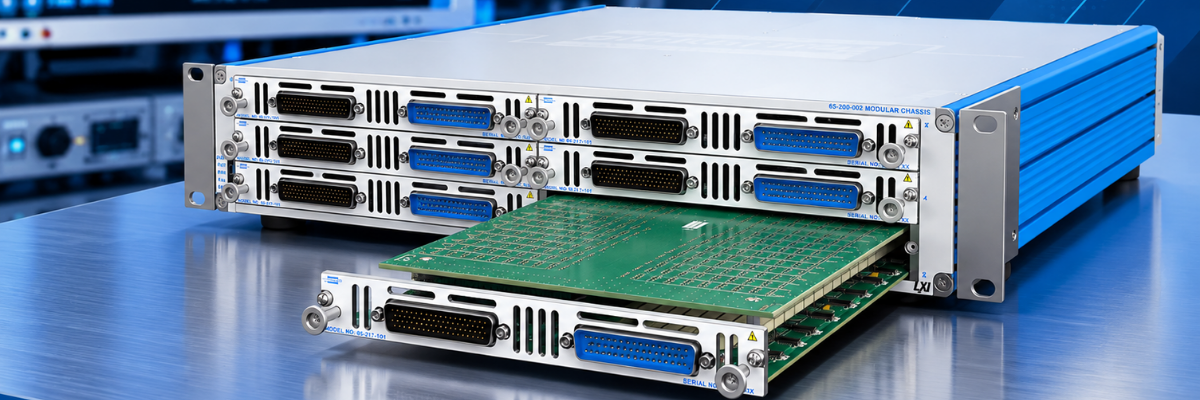
The 65-217 is a plug-in module for Pickering’s 65-200 scalable LXI chassis platform. Each module provides a 64×8, 1-pole matrix. Engineers can install up to six modules in a single 19-inch, 2U chassis, expanding the matrix to a maximum configuration of 384×8.
Rather than treating each 64×8 module as an independent matrix, the system combines installed modules into a single larger matrix. Pickering’s control software accounts for path-identification offsets between modules, allowing the expanded hardware to operate as one switching system.
That approach means an engineer could initially populate a chassis for a smaller test requirement and add modules later without replacing the original switching hardware.
The modules load from the front of the chassis, so adding capacity or replacing a module does not require removing the chassis from the test rack. Versions are available with or without front-panel Y-axis access, while switched Y-axis loop-through connections allow the matrix to expand across multiple chassis.
More Than Additional Test Points
The architecture also provides flexibility in how instruments access the matrix. A dual Y-axis analog bus allows separate external instruments to connect to different sections of the switching system. Engineers can also divide the hardware into two independent matrices when a test setup calls for separate signal paths.
Unused sections of the Y-axis can be disconnected using switched Y-axis points, helping preserve bandwidth rather than leaving unnecessary portions of the switching network connected.
The 65-217 also supports RF crosstalk measurements on unterminated signal paths. This type of testing is useful when engineers need to characterize how signals couple between adjacent paths under conditions where the far end is not terminated, including certain aerospace and automotive test applications.
Each module switches up to 300VDC or 250VAC at 2A, with maximum switching power of 60W or 62.5VA.
Keeping a Growing Test System Running
Expansion is only part of the challenge with large switching matrices. As relay counts increase, identifying worn components and determining when maintenance is needed becomes more important.
The 65-217 includes relay cycle counting so engineers can track switching activity and plan preventive maintenance. Pickering’s integrated Built-In Relay Self-Test (BIRST) can help identify failed or worn relays, with optional external eBIRST tools providing additional self-test capabilities.
Spare relays are also installed directly on each plug-in module. Combined with the front-loading design, this allows individual modules to be serviced without dismantling the larger rack installation.
For automated test systems expected to change over time, the modular approach lets engineers size the switching matrix around current requirements while retaining a path to additional channels later. It also keeps expansion, diagnostics and servicing within the same matrix architecture rather than requiring separate switching systems as test coverage grows.
The Pickering Interfaces 65-217 modular LXI matrix is available for the company’s 65-200 scalable LXI chassis platform and is backed by a three-year warranty and long-term product support.