

The shift toward 48V power distribution is changing more than the voltage delivered through AI servers, robots and industrial equipment. It is also putting more pressure on the converters that step, regulate and distribute that power.
Increasing switching frequency is one way to shrink those converters. Smaller inductors, transformers and other passive components become possible as frequency rises. The tradeoff is switching loss. At hundreds of kilohertz and into the megahertz range, losses associated with turning a power transistor on and off become increasingly important.
Renesas is targeting those higher-frequency power stages with its first 100V enhancement-mode GaN power transistors, extending the company’s GaN portfolio into low-voltage applications.
The new family includes the RTP100E005G1FL, RTP100E2P6G1FL, RTP100E1P8G1FL-DSC and RTP100E1P2G1FL-DSC, with applications ranging from 48V AI data center power architectures to robotics, industrial motor drives and solar microinverters.
Why 100V GaN Matters
GaN is often associated with higher-voltage power conversion, but lower-voltage systems present another opportunity for the technology.
AI infrastructure is increasingly moving toward architectures that combine 800VDC distribution with 48V intermediate buses. The conversion stages around those 48V rails need to move large amounts of current while occupying as little space as possible.
Similar constraints appear in humanoid robots and industrial motor drives, where the power electronics must fit close to motors and actuators without adding excessive weight or heat.
Renesas’ new devices use normally-off E-mode GaN technology and cover RDS(on) values from 5 mΩ down to 1.2 mΩ. Low on-resistance reduces conduction losses, while GaN’s switching characteristics address another major source of loss as operating frequencies rise.
Reducing Energy Lost During Switching
Every switching cycle creates a period where voltage and current overlap across the transistor. Multiply that energy loss by hundreds of thousands or millions of switching events per second and it becomes an important part of the converter’s efficiency and thermal budget.
The new devices are designed with low total gate charge and output charge to reduce those switching losses. They also have zero reverse-recovery charge, eliminating the reverse-recovery losses associated with conventional silicon MOSFET body diodes.
Renesas reports up to 35% lower hard-switching figure of merit and 63% lower soft-switching figure of merit compared with comparable GaN devices.
At the system level, the company says the devices support a 40% to 70% reduction in switching losses and as much as twice the power density, depending on the converter topology and application.
Higher switching frequencies also allow designers to reduce the size of magnetics and other passive components. That gives engineers another route toward smaller power supplies rather than using the efficiency gain solely to reduce energy consumption.
Making the Move From Silicon Easier
Electrical performance is only part of the challenge when replacing silicon MOSFETs with GaN. Package differences and thermal requirements often force changes elsewhere in the design.
Renesas is offering the new transistors in FCLGA and FCLGA-DSC packages with MOSFET-compatible footprints, giving engineers a more direct migration path from existing silicon designs.
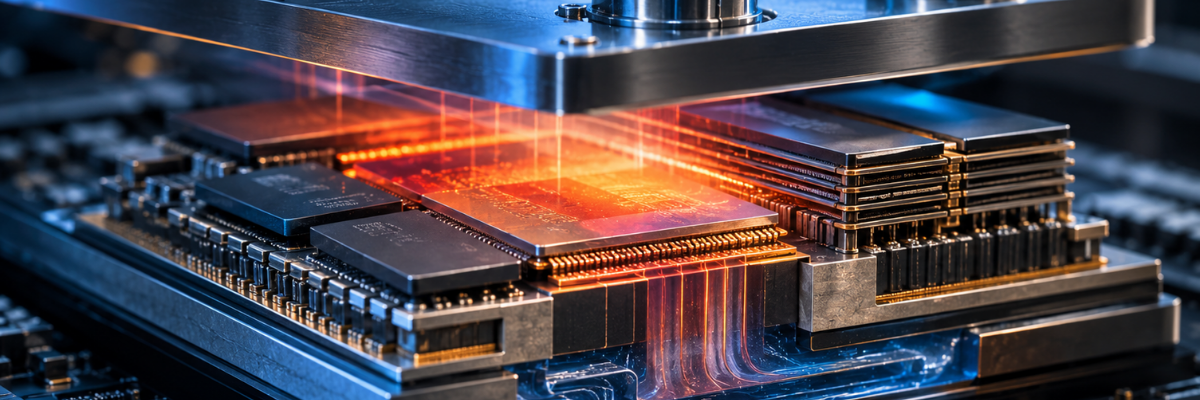
Both bottom-side and dual-side cooling options are available. The dual-side-cooled versions provide an additional thermal path for applications pushing higher power density.
The combination gives designers several ways to use the family across synchronous rectification, multiphase buck converters, motor drives and other low-voltage power stages.
Why It Matters
Moving from silicon to GaN is most useful when engineers take advantage of what faster switching changes elsewhere in the system.
In a 48V AI server power stage, lower switching losses mean less heat that needs to be removed. Higher operating frequencies allow magnetics to shrink. In a robot joint or industrial motor drive, those same characteristics translate into smaller power electronics positioned closer to the load.
Renesas estimates the new GaN devices provide 1% to 3% higher efficiency than silicon-based designs. That might sound incremental at the transistor level, but in systems moving large amounts of power continuously, those losses affect cooling requirements, component size and overall energy consumption.
The new 100V GaN transistors are available now alongside corresponding evaluation boards. Renesas is positioning the family for AI power supplies, 48V DC-DC conversion, robotics, factory automation, motor drives, power tools and renewable-energy systems.