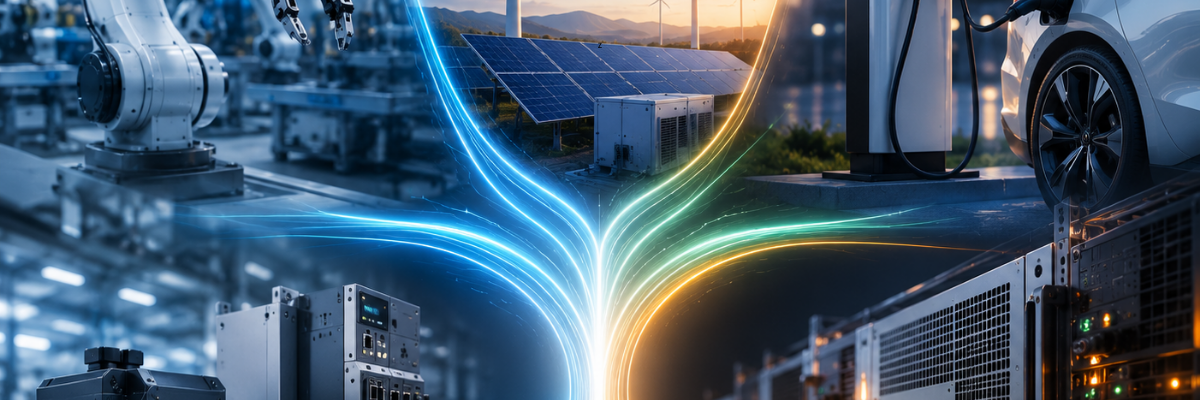
The global push toward electrification is changing the scale of modern power systems.
Battery energy storage installations continue to grow in capacity. Fast-charging infrastructure is delivering increasing amounts of power. Industrial motor drives, renewable energy systems, and power conversion equipment are all being asked to handle larger electrical loads than previous generations.
As current levels rise, however, the challenge is no longer simply moving power. Engineers must also measure it accurately.
Current measurement affects everything from efficiency and power quality to protection systems and control-loop performance. In high-power applications, small measurement errors can translate into significant operational consequences.
Why Current Measurement Matters
Current sensing is often viewed as a supporting function within a power system, but its impact reaches much further.
Power converters rely on current feedback to regulate output and optimize switching behavior. Battery management systems use current measurements to estimate state of charge and monitor system health. Grid-connected equipment depends on accurate measurements to maintain power quality and system stability. Protection systems use current data to identify faults and respond before equipment is damaged.
In each case, the quality of the measurement directly affects the quality of the decision being made.
A small error may not seem significant on paper. In a high-power system operating continuously, however, measurement inaccuracies can influence efficiency, reduce control performance, and affect long-term reliability.
The Rise of Higher-Power Applications
Several industry trends are driving demand for higher-current measurement capabilities.
Utility-scale battery energy storage systems are becoming larger as grids incorporate increasing amounts of renewable energy. Electric vehicle charging infrastructure continues to expand, with higher-power charging stations designed to reduce charging times. Industrial electrification initiatives are replacing fossil-fuel-powered processes with electrically driven alternatives.
These systems often operate at current levels that would have been uncommon in many applications just a decade ago.
Measuring hundreds of amperes accurately is one challenge. Measuring several thousand amperes while maintaining precision across changing operating conditions presents an entirely different set of requirements.
As current levels increase, sensor technologies must maintain accuracy without introducing excessive drift, nonlinearity, or temperature-related errors.
Hall-Effect Sensors Have Long Been the Industry Standard
For many applications, Hall-effect current sensors have provided a practical and effective solution.
Hall-effect devices offer non-contact current measurement and relatively straightforward implementation. They have been widely used in motor drives, power supplies, industrial automation equipment, and energy systems for decades.
Their popularity stems from a combination of performance, cost, and ease of integration.
As power systems continue to evolve, however, some applications are beginning to expose the limitations of traditional Hall-effect approaches. Factors such as offset drift, temperature sensitivity, long-term stability, and measurement linearity become increasingly important as current levels rise and performance expectations increase.
In applications where efficiency targets are aggressive and control systems require highly accurate feedback, even small measurement deviations can become significant.
Why Accuracy Becomes More Challenging at 4,000A
Current measurement accuracy becomes increasingly difficult to maintain as power levels increase.
Large currents generate stronger magnetic fields and often exist within environments containing significant electrical noise. Power conversion systems may experience wide temperature swings, requiring measurement devices to maintain consistent performance across varying operating conditions.
At the same time, designers are being asked to improve efficiency and power quality while reducing losses throughout the system.
This combination of higher current levels and tighter performance requirements is encouraging engineers to revisit sensing technologies that can provide greater accuracy and stability than conventional approaches.
Revisiting Fluxgate Technology
One technology attracting renewed attention is fluxgate-based current sensing.
Unlike Hall-effect sensors, fluxgate current transducers use a closed-loop measurement architecture that actively compensates for the magnetic field generated by the measured current. This approach can provide improved linearity, reduced offset drift, and greater stability across temperature ranges.
Fluxgate technology has long been used in applications where measurement precision is a priority. As high-power systems continue to expand, the technology is becoming increasingly relevant in commercial and industrial applications as well.
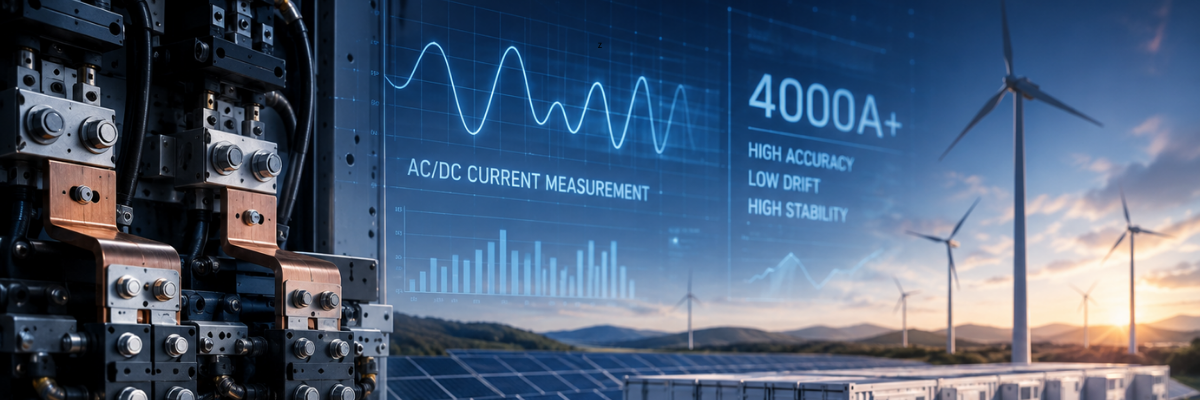
Demand for current measurement solutions capable of accurately monitoring currents of 4,000A and above continues to grow as electrification expands across multiple industries.
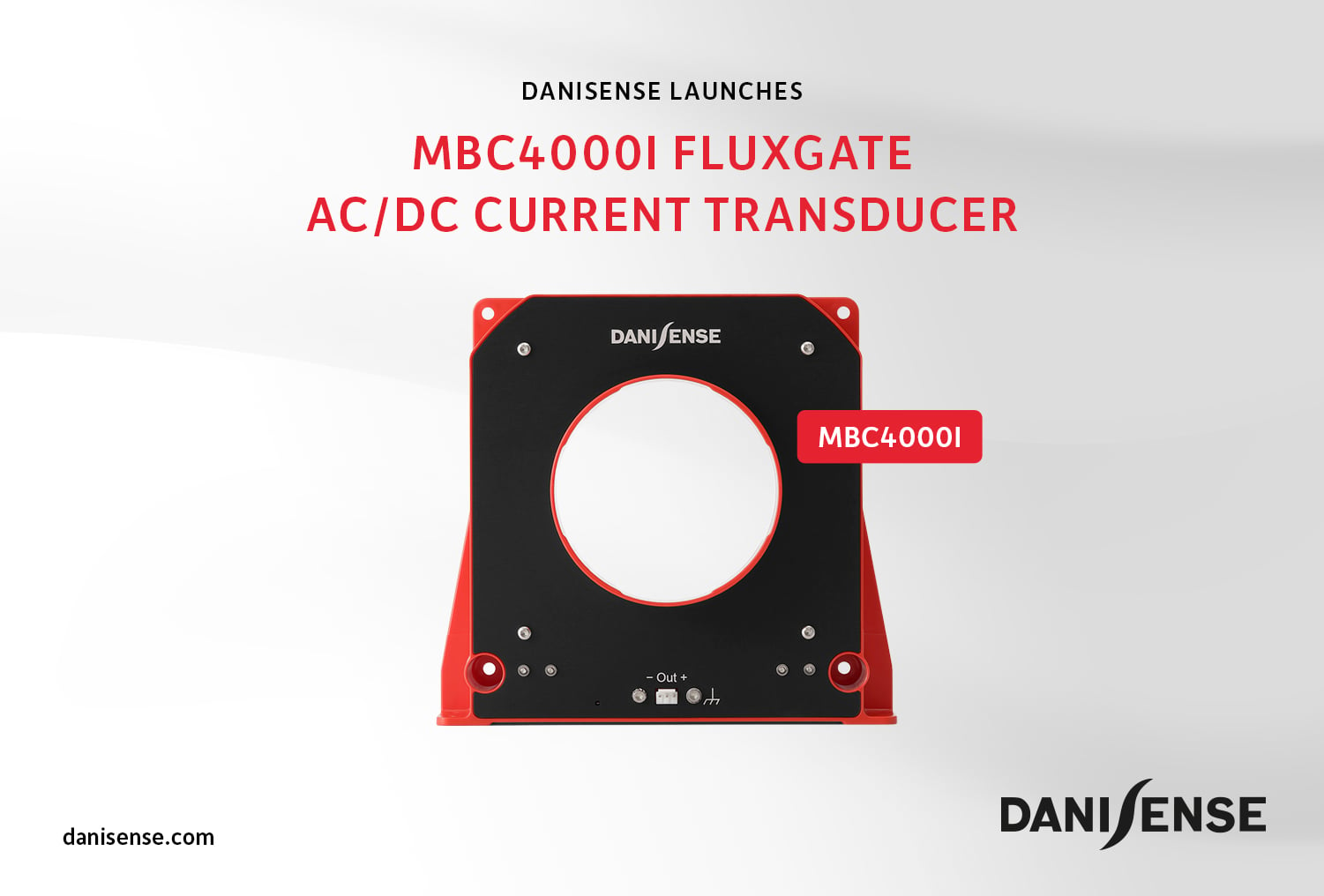
To address these requirements, Danisense recently introduced its MBC4000I fluxgate AC/DC current transducer. Designed for measurements of up to 4,000A and beyond, the device is based on its closed-loop fluxgate technology and targets demanding high-current applications.
The company reports accuracy below 0.05% across a temperature range from -20°C to +85°C while offering ultra-low sensitivity drift and minimal offset variation over temperature. Danisense also states that the transducer can deliver measurement performance levels up to ten times higher than conventional Hall-effect solutions.
The device features a large 121 mm aperture intended for busbar-based installations and a 1:5000 primary-to-secondary ratio designed to support high-current measurement environments.
What Designers Need from Modern Current Sensors
As electrification continues to advance, engineers are placing greater emphasis on measurement technologies that provide more than basic current monitoring.
Accuracy remains a primary requirement, but long-term stability is becoming equally important. Sensors must maintain performance over extended operating lifetimes while remaining resistant to temperature-related drift and environmental influences.
Integration considerations also matter. Modern power systems often operate in space-constrained environments where measurement solutions must accommodate large conductors, busbars, and complex power architectures without adding unnecessary complexity.
The growing use of advanced power electronics, including silicon carbide and gallium nitride technologies, is placing additional pressure on measurement systems to provide accurate feedback that supports increasingly sophisticated control algorithms.
Looking Ahead
Electrification is reshaping power systems across transportation, renewable energy, industrial automation, and energy storage applications. As power levels continue to increase, accurate current measurement is becoming a critical design requirement rather than a supporting function.
Meeting the demands of next-generation power systems will require sensing technologies capable of maintaining accuracy, stability, and reliability at current levels that continue to climb. Whether through improved Hall-effect devices, fluxgate architectures, or other emerging approaches, advances in current measurement technology will play an important role in helping engineers improve efficiency, optimize control performance, and support the continued growth of high-power electrified systems.