


Memory has traditionally belonged to electronics. Magnetic tape stored music. Hard drives stored files. Flash memory stores electrical charge. Materials like adhesive tape were never supposed to join that conversation.
Researchers at Penn State may have complicated that assumption.
The team discovered that ordinary pressure-sensitive adhesive tape can retain a record of previous interactions in a way that behaves surprisingly like memory. The material could store multiple “memories,” strengthen them, retrieve them later, and even erase some of them. The work is not about replacing solid-state storage with office supplies. The more interesting question is whether materials themselves can do more than simply sit inside a system.
For years, engineers have largely separated responsibilities. Materials provide structure. Electronics handle sensing, processing, and memory. Research across smart materials, neuromorphic systems, and adaptive structures has already started blurring those boundaries. This work adds another unexpected example to that growing list.
The researchers did not discover the effect accidentally while pulling tape off a cardboard box.
To study the behavior, the team built an automated system that repeatedly peeled adhesive tape to precise distances, pressed it back onto a surface, and measured the force required to peel it again. Running the process under tightly controlled conditions allowed them to watch how the material changed after each interaction.
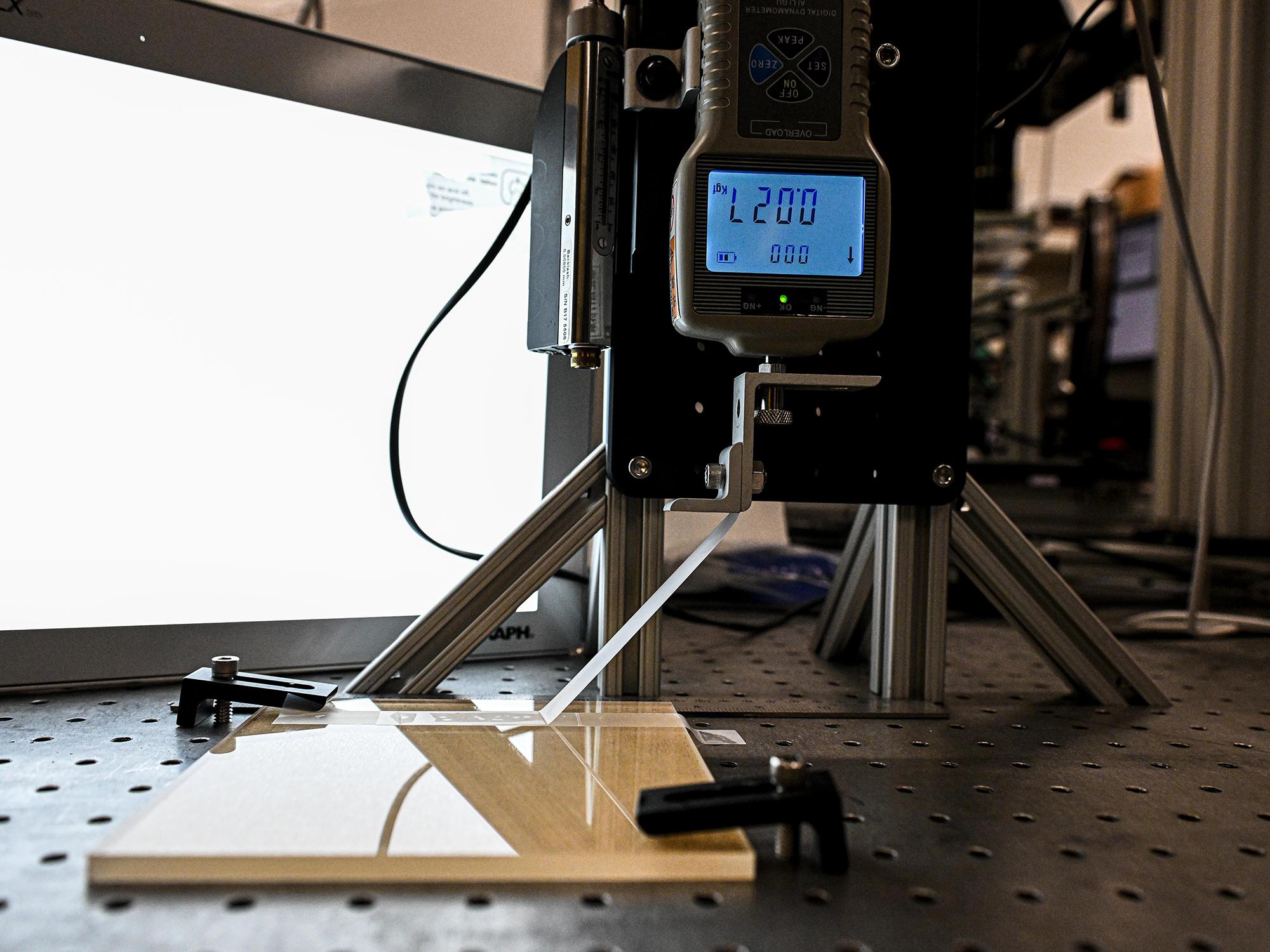
What they found was that stopping the peel at certain points created localized changes in adhesion. Pressing the tape back down effectively left behind a marker inside the material.
Repeating the process created multiple markers.
Later, when the tape was peeled again, those locations announced themselves. As the peel front reached a stored position, the required force increased, creating a measurable signal that revealed where a previous interaction had occurred.
The tape was carrying a record of its own history.
The behavior became even more interesting as the experiments continued.
New memories did not necessarily erase old ones. Researchers found that multiple stored states could exist at the same time. The most recently created memory appeared first during retrieval, creating a last-in-first-out pattern similar to stack structures commonly used in computing.
The memories also were not fixed.
Holding the tape at partially peeled positions for longer periods strengthened the stored state, making later retrieval more pronounced. Peeling beyond certain locations erased previously stored information, effectively resetting portions of the system.
Some memories proved more stubborn than others and remained even after reset attempts.
No one expects future data centers to be built from rolls of tape. That misses the larger point anyway.
The significance of the work may be less about adhesive materials and more about where researchers are looking for computation and information storage. If physical materials can preserve, organize, or process information through their own behavior, future systems may not always require separate structures, sensors, and memory devices.
Sometimes the material itself may already be doing part of the work.
This research suggests that even something as ordinary as tape may have been carrying hidden behaviors all along.
Original Story via Move over cassette tapes, adhesive tape has memory, too | Penn State University