

As embedded systems continue to expand into industrial automation, edge devices, and connected sensing applications, designers are increasingly looking for ways to simplify networking integration while reducing component count. Combining processing and networking resources into a single package can help streamline development, particularly in space-constrained systems or rapid prototyping environments.
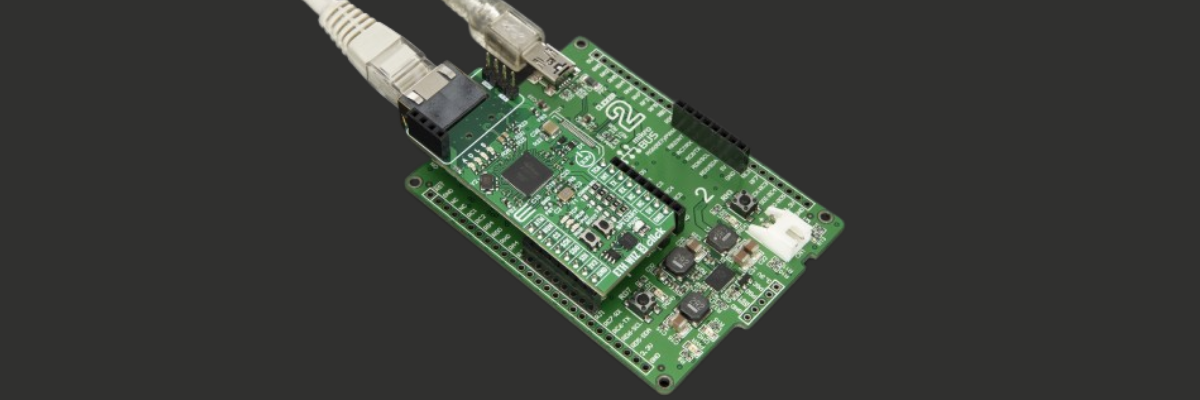
MIKROE recently introduced the ETH WIZ 3 Click board, a compact add-on module designed to provide Ethernet connectivity alongside onboard processing capabilities for embedded applications. The board targets applications such as IoT gateways, network-enabled controllers, industrial systems, and other devices requiring wired network access.
At the center of the design is the W55RP20 System-in-Package (SiP) from WIZnet. The device combines two established components into a single package: the W5500 Ethernet controller and the Raspberry Pi RP2040 microcontroller.
The W5500 has been widely used in embedded networking applications because of its hardwired TCP/IP implementation. Rather than requiring developers to build a full networking stack entirely in software, the controller manages networking protocols directly in hardware. This can reduce processor overhead and simplify software development for applications using protocols such as TCP, UDP, IPv4, ICMP, ARP, IGMP, and PPPoE.
The processing portion of the package relies on the RP2040 microcontroller, featuring dual Arm Cortex-M0+ cores operating at up to 133MHz. Integrating the processor and networking controller within a single package reduces the need for multiple external components while simplifying board design.
Beyond Ethernet support, the board includes several features intended to support development and debugging. Communication options can be configured through selectable SPI or UART interfaces using an onboard COMM SEL jumper. A USB Type-C interface connected through the integrated USB 2.0 controller provides additional connectivity and programming flexibility.
Diagnostic capabilities are also built into the board. Status indicators provide visibility into link activity and TCP communication status, helping developers monitor network behavior during testing and development.
Another notable feature is the exposure of Ethernet magnetics center taps, allowing optional implementation of Power over Ethernet (PoE). For systems deployed in remote or difficult-to-access locations, PoE support can simplify installation by allowing both power and data transmission through a single Ethernet cable.
The board joins MIKROE’s larger ecosystem of mikroBUS-enabled Click boards, which are designed to speed development by allowing modular hardware additions without requiring extensive custom circuitry. The platform also incorporates ClickID functionality, enabling host systems to automatically identify connected boards and simplify configuration.
As Ethernet continues to remain a preferred communication method for many industrial and infrastructure applications due to its reliability and established ecosystem, integrated networking modules such as these may provide designers with a quicker path from concept to prototype while reducing some of the complexity associated with network implementation.
Learn more: https://www.mikroe.com/eth-wiz-3-click