


As wearable devices continue to shrink, charging has become one of the harder design constraints to solve. ROHM is addressing that challenge with a new wireless power chipset built specifically for space-limited form factors like smart rings and compact bands.
The chipset consists of the ML7670 receiver and ML7671 transmitter, designed around NFC-based wireless power at 13.56 MHz. Unlike Qi-based systems, which struggle to scale down due to coil size and alignment requirements, NFC operates at a higher frequency that allows for much smaller antennas. That makes it more practical for devices where board area and enclosure size are tightly constrained.
This tradeoff comes at lower power levels. The ML7670/ML7671 supports up to 250 mW, placing it well below traditional wireless charging systems but in line with the needs of ultra-compact wearables. In these applications, the goal is less about fast charging and more about enabling any practical charging method at all within a limited footprint.
ROHM’s approach focuses on integration and efficiency within that power envelope. The receiver achieves up to 45% power transfer efficiency at low output levels, with optimization across coil matching, rectification, and switching losses. For designers working with very small energy budgets, incremental efficiency gains at this level can directly impact usable battery capacity and charge time.
The chipset also reduces external component count. Switching MOSFETs required for power delivery are integrated into the IC, and the firmware needed for wireless power control is embedded on-chip. That removes the need for a separate MCU to manage charging, which can simplify both layout and development effort.
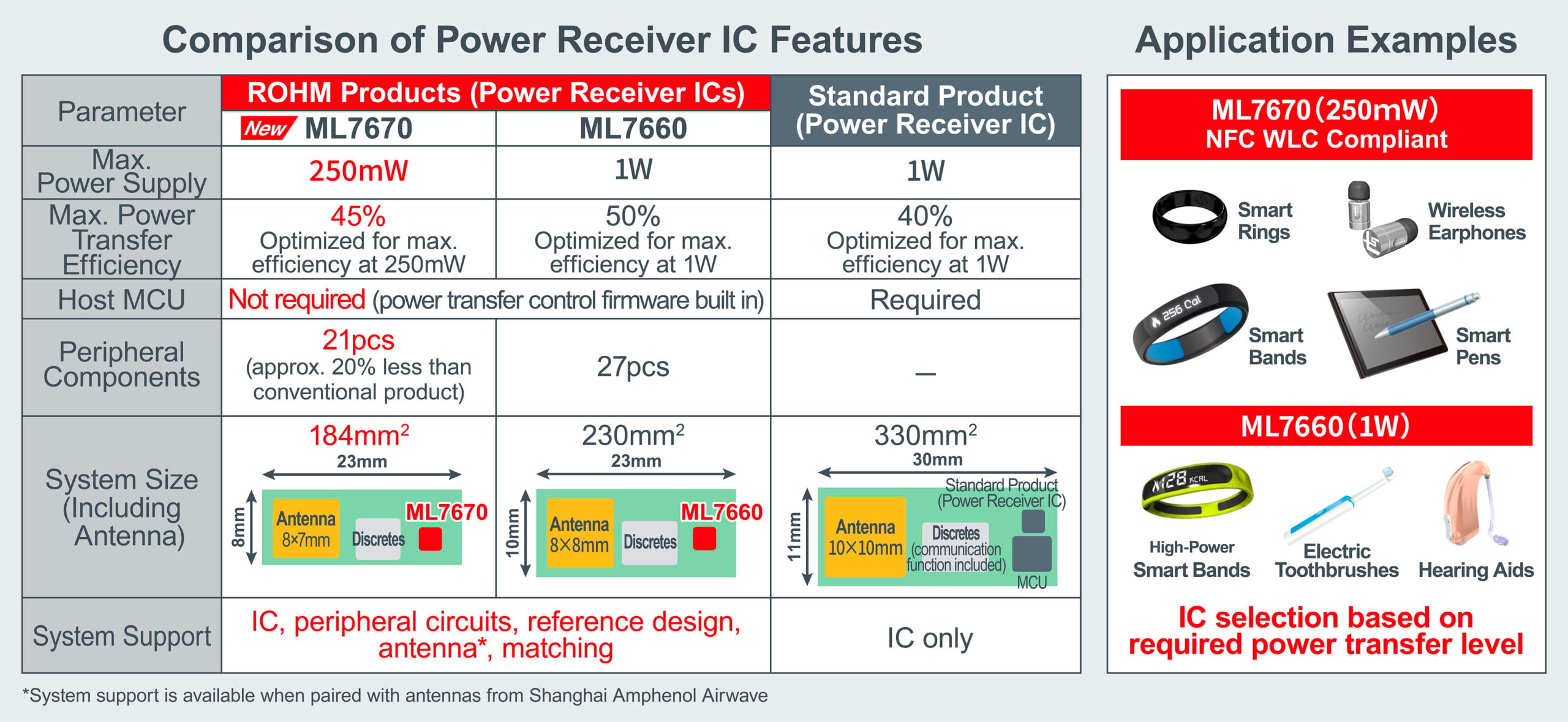
Physically, the receiver comes in a 2.28 × 2.56 × 0.48 mm package, targeting designs where every millimeter of board space is contested. This size reduction, combined with fewer external components, makes the solution more viable for ring-sized devices where traditional wireless charging approaches are difficult to implement.
The chipset complies with NFC Forum Wireless Charging specifications (WLC 2.0), allowing it to operate within the broader NFC ecosystem. That compatibility opens the door to using existing NFC-enabled devices or infrastructure as part of the charging experience, rather than relying on dedicated charging hardware.
ROHM’s earlier ML7660/ML7661 platform established a baseline for 1 W-class NFC charging. This newer generation shifts focus toward smaller devices, where lower power delivery is acceptable if it enables a workable charging method within extreme size constraints.
The chipset is already in mass production and has been designed into the SOXAI Ring 2, a wearable focused on sleep and health monitoring. The device integrates multiple sensors, including optical, temperature, and motion sensing, along with Bluetooth Low Energy and NFC-based charging—illustrating the type of system-level integration these smaller power solutions are meant to support.
As wearable designs continue to push toward smaller, more discreet form factors, power delivery is becoming less about scaling existing standards and more about adapting to physical limits. NFC-based wireless power is one of the approaches gaining traction in that space, particularly where conventional methods no longer fit.
The ML7670/ML7671 chipset is available now, with evaluation boards and reference designs offered to support integration.