


As EV platforms move toward higher bus voltages and wider adoption of GaN and SiC devices, transient protection is becoming harder to implement without adding cost and complexity. Littelfuse is addressing that gap with a new set of high-voltage transient voltage suppression (TVS) diodes designed to handle these conditions with fewer components.
The company’s TPSMC, TPSMD, and TP5.0SMDJ series extends its TP portfolio into higher-voltage automotive applications, including battery disconnect units (BDUs), high-voltage HVAC compressors, and PTC heaters. These subsystems routinely experience load dump events, inductive switching spikes, and other high-energy transients that can stress power devices such as SiC MOSFETs, GaN transistors, and IGBTs.
In many existing designs, engineers rely on multiple lower-voltage TVS diodes connected in series to reach the required standoff voltage. That approach increases PCB area, complicates layout, and adds cost to the bill of materials. It also introduces balancing concerns between devices under transient conditions.
The new Littelfuse devices aim to consolidate that protection into a single component. With standoff voltages up to 400 V, the diodes are intended to eliminate the need for series stacking in many high-voltage circuits.
Beyond voltage capability, the devices are built to handle the energy levels seen in automotive environments. The series supports peak surge currents up to 300 A and peak pulse power ratings ranging from 1.5 kW (TPSMC) to 5 kW (TP5.0SMDJ). Response time is specified at sub-picosecond levels, allowing fast clamping of transient events before they propagate through sensitive power stages.
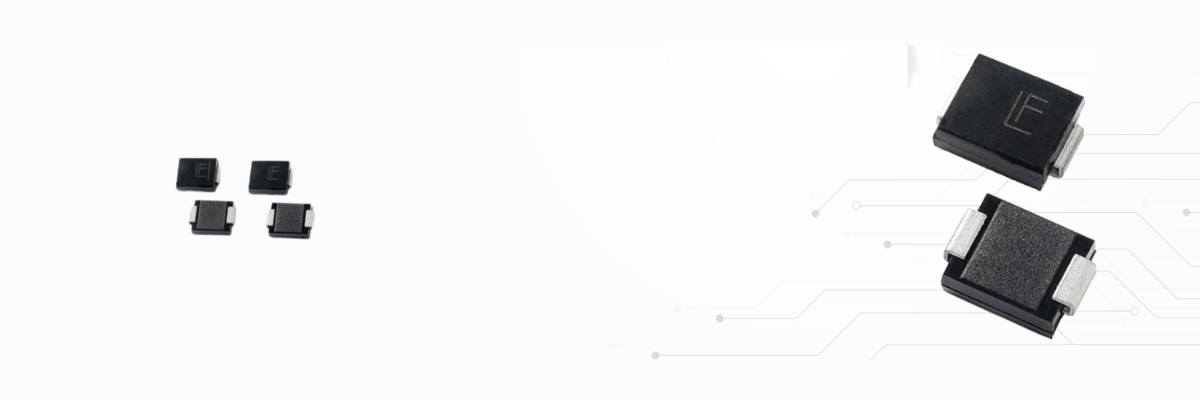
From a layout perspective, the parts use a DO-214AB (SMC) surface-mount package, keeping the footprint relatively compact despite the higher voltage and power ratings. This can simplify routing compared to multi-device protection schemes.
The shift to a single-device solution also has implications beyond protection. By providing higher standoff voltage margin, designers may have more flexibility in selecting lower-rated GaN or SiC switches. That can help reduce conduction losses and improve overall system efficiency, particularly in high-current paths.
All devices in the series are AEC-Q101 qualified and PPAP capable, aligning with automotive reliability requirements. They also meet IEC 61000-4-2 ESD standards, with ratings up to 30 kV for system-level protection.
The TPSMC, TPSMD, and TP5.0SMDJ series is available in both unidirectional and bidirectional configurations, giving designers options depending on the topology and protection strategy.
As high-voltage domains continue to expand across EV architectures, component-level protection is shifting as well. Rather than scaling existing low-voltage approaches, devices like these reflect a move toward purpose-built solutions for higher-energy systems.
The parts are available in tape-and-reel packaging, with sampling offered through Littelfuse distributors.