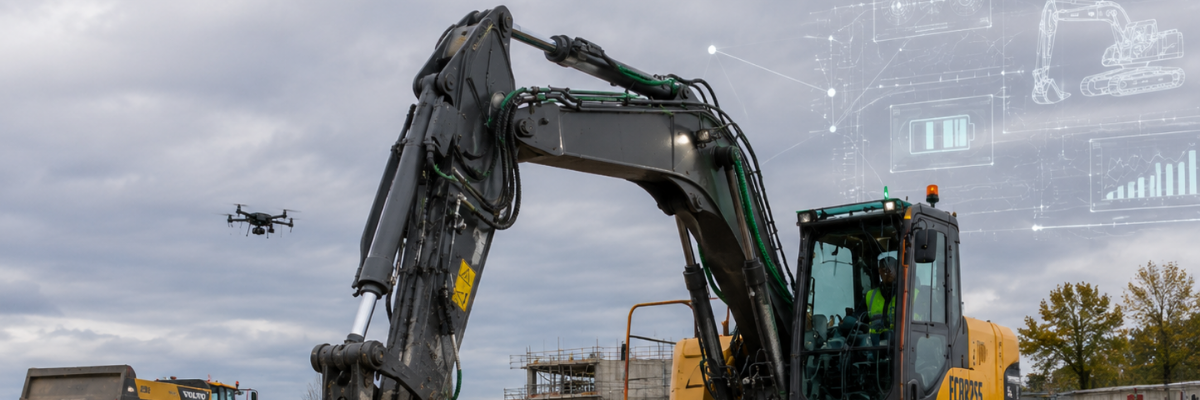
An excavator working in a city has a different set of problems than one digging at a remote mine. Noise and exhaust matter more. There are people, buildings and traffic nearby, and the machine might spend much of its day stopping, starting and repositioning over relatively short distances.
Those conditions have made compact construction equipment an early proving ground for electrification. Volvo Construction Equipment’s ECR25 Electric compact excavator, for example, carries a 20kWh battery and operates for up to four hours, depending on the application. Its sound power level is 84dB, and an off-board charger can bring the battery to 80% in about 50 minutes.[1]
Travel from the city to a mine and the scale changes considerably.
In Australia, Fortescue plans to deploy 360 autonomous battery-electric haul trucks, along with 55 electric excavators and 60 battery-powered dozers supplied through a partnership with Liebherr. The T 264 mining trucks will use a stationary charger capable of delivering up to 6MW and charging the truck in about 30 minutes.[2]
The two examples sit at opposite ends of heavy equipment, but they point to a broader change in how these machines are being designed. Diesel engines and hydraulics are being joined, and in some cases replaced, by batteries, electric drives and power electronics. At the same time, cameras, sensors and increasingly capable electronic controls are taking over tasks once handled entirely by an operator.
That puts much more electrical hardware onto machines built to work in places that are not especially friendly to electronics.
When the Machine Starts Watching Its Surroundings
Automation changes what the electrical system has to do next.
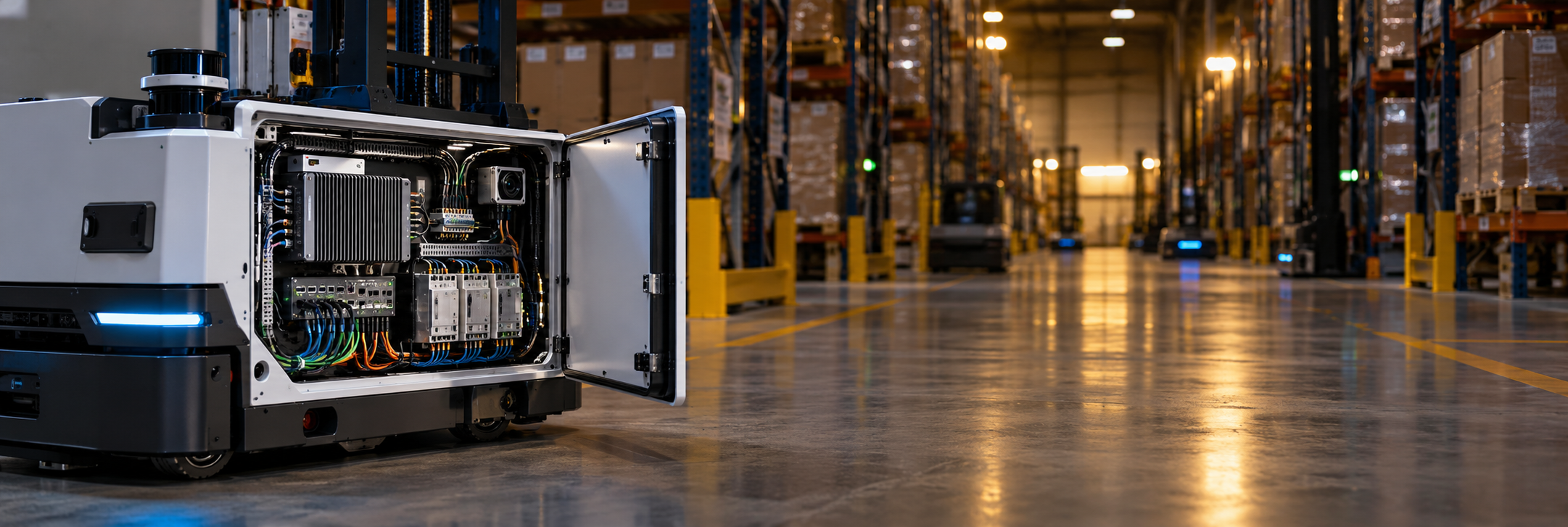
A tractor provides a useful example because driving across a field sounds relatively straightforward until the operator is removed from the cab. The machine still has to know where it is, where it should go and whether something is in its path.
John Deere’s autonomous tillage system uses 16 cameras to provide a 360-degree view around the tractor. Images are sent to a high-speed processor, where a neural network determines whether the area ahead is safe to drive through. Deere says the process takes about 100 milliseconds.[3]
This also shows how quickly one automated function spreads through the rest of the machine.
The cameras need power and a path for their data. The processor needs information from the perception system along with information about the tractor itself. Steering and propulsion have to respond to its decisions. Position and movement have to be monitored continuously.
Mining automation takes place on a larger machine but creates many of the same electrical demands. Liebherr and Fortescue’s autonomous T 264, for example, combines a battery-electric power system with autonomous haulage and an energy-management system responsible for coordinating truck charging.[2]
A haul truck or tractor has therefore become more than a mechanical machine with electronics added around the edges. Electronic systems increasingly participate in how it moves, works and responds to its surroundings.
More Electronics Have to Fit Somewhere
The change is easy to see from the outside. Cameras appear around the machine. Displays replace mechanical gauges. Electric motors take the place of some hydraulic or diesel-powered functions.
Inside, the change produces a less visible problem: wiring.
Electronic control units have to connect to sensors, actuators, motors and other controllers distributed throughout the machine. Automation adds cameras and perception hardware. Electrification adds battery-management electronics, power conversion and additional monitoring. Some of these systems sit close together. Others are separated by the length of a tractor, excavator or haul truck.
The number of electrical connections grows along with them.
Space, however, does not necessarily grow with it. Controllers still have to fit into crowded machine compartments. Wiring has to be routed around moving components and areas exposed to heat. Harnesses also have to remain accessible enough for equipment to be assembled and serviced.
Higher pin-count connectors are one way to bring a larger number of circuits into a controller or subsystem without surrounding it with separate interfaces.
The environment makes the connection itself important.
A tractor spends its working life around dust, dirt, water and agricultural chemicals. An excavator can be covered in mud and later cleaned with high-pressure water. Mining equipment adds long operating hours, heavy vibration and abrasive dust. Connectors mounted on these machines have to maintain electrical contact through those conditions while keeping contaminants away from the contacts.
There is also the repair at the end of it.
Heavy equipment is expected to stay in service for years. When an ECU, harness or other electronic subsystem fails, the ability to disconnect it and replace it in the field has practical value. As the electronics become more distributed, connector placement, sealing, keying and mechanical retention become part of the serviceability of the machine.
Connecting a More Electronic Machine
Amphenol Sine Systems developed its ARC Series rectangular connectors for high-pin-count connections in applications that include heavy equipment, agriculture, construction, transportation and mining.[4]
The series is available with as many as 70 positions in a rectangular thermoplastic housing. When mated, the connectors are rated to IP68 and IP69K, including IP68 protection for immersion in one meter of water for 24 hours. They operate from -55°C to +125°C, with configurations rated for up to 13A and 250V.
The connectors also use a jackscrew and threaded insert to hold the connection together and are available with different mechanical keying options. The latter becomes useful when several similar high-pin-count connectors are located on the same machine because the interfaces can be mechanically differentiated rather than relying only on labels or wire identification.
These are relatively small details compared with a six-megawatt charger or a tractor capable of navigating a field on its own. They are also part of what makes those larger changes possible.
Heavy equipment has always been designed around the work it has to survive. Electrification and automation do not change that requirement. They change what now has to survive along with it.
Sources:
- Volvo Construction Equipment, “ECR25 Electric,” product specifications.
- Liebherr, “Largest order in the company’s history: 475 Liebherr machines to be delivered to Fortescue,” October 5, 2024.
- John Deere, “Autonomous Tractor,” autonomous tillage system overview.
- Amphenol Sine Systems, “ARC Series: Rectangular, Thermoplastic Connectors for Harsh Environment Applications.”