


Small satellites have changed what engineers are willing to put into orbit. The same pressure that has pushed spacecraft toward smaller processors, radios and power systems is also changing how designers approach one of the less visible parts of a satellite: its clock.
Precise timing matters throughout a spacecraft. Communications systems have to stay synchronized. Navigation depends on accurate time measurements. Satellites operating together need a common timing reference, particularly when exchanging data across inter-satellite links.
Atomic clocks provide considerably greater stability than conventional oscillators, but traditionally they have come with tradeoffs in size and power. Those tradeoffs matter when the spacecraft is a CubeSat or another small Low Earth Orbit (LEO) platform with limited room and energy available for its payload.
Chip-scale atomic clocks, or CSACs, are beginning to change that equation.
Why Put an Atomic Clock on a Small Satellite?
Atomic timing and satellite navigation have always been closely connected. GNSS receivers calculate position by measuring the travel time of signals transmitted by satellites, making precise timing fundamental to the system. NIST notes that nanosecond-level timing is typically required to achieve positioning precision on the order of a meter.[1]
But there is another reason to carry a stable clock locally.
A spacecraft normally has access to external timing references such as GNSS. If that reference becomes unavailable, the quality of the satellite’s local oscillator determines how well it maintains timing until the external reference returns.
A sufficiently stable local clock gives the spacecraft more independence from that outside signal. This is useful for assured positioning, navigation and timing (PNT), but also for satellite communications and other systems that need to remain synchronized.
NASA has already explored this approach in nanosatellite navigation. Its Distributed Timing and Localization (DiGiTaL) architecture combines a multi-GNSS receiver, a chip-scale atomic clock and an inter-satellite link to provide precise synchronization and relative navigation between small satellites.[2]
The engineering challenge is getting that timing performance into a package suitable for space.
Moving Atomic Timing Into Smaller Spacecraft
Chip-scale atomic clocks emerged from work at NIST aimed at shrinking atomic-frequency references while dramatically reducing their power requirements. Rather than relying solely on the oscillation of a quartz crystal, an atomic clock uses an atomic transition as its frequency reference.
Miniaturization eventually made it possible to bring this capability into equipment where conventional atomic clocks would have been impractical.
Space introduces another complication: radiation.
Electronic components in orbit accumulate exposure to ionizing radiation, while energetic particles can also produce single-event effects. A timing device intended for a satellite therefore needs more than good stability on the bench.
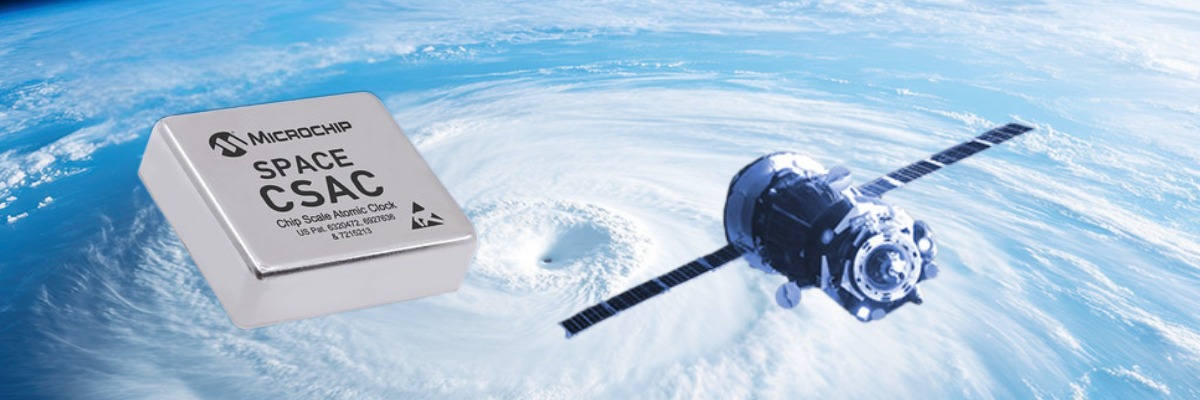
Microchip Technology’s new Space CSAC-SA65 is designed around that problem.
The device is a radiation-tolerant version of the company’s SA65 Chip Scale Atomic Clock and builds on its earlier Space CSAC-SA45. The new version is rated for total ionizing dose (TID) exposure above 30 krad (Si), compared with 20 krad for the earlier SA45.[3]
That increase is significant for designers trying to use smaller commercial-derived components in LEO spacecraft without moving to larger, higher-power timing hardware.
120 mW for an Atomic Clock
The more interesting part of the Space CSAC-SA65 may be how little spacecraft real estate it requires.
The clock measures roughly 41 × 35 × 12 mm, occupies less than 17 cubic centimeters and consumes less than 120 mW during normal operation. Its operating temperature range extends from –40°C to +80°C.[3]
Those numbers put atomic timing into a different category from many traditional space timing devices.
NASA’s 2023 State-of-the-Art Small Spacecraft Technology report illustrates the difference. The previous-generation Space CSAC is listed at 0.12 W, while several other atomic-clock and oscillator technologies in the report range from 0.4 W into multiple watts.[4] Those alternatives do not necessarily provide equivalent performance or target the same missions, but the comparison shows why CSAC technology is interesting for spacecraft where every watt matters.
The SA65 also provides a 10 MHz output along with 1 pulse-per-second (1 PPS) input and output. The 1 PPS input allows the clock to be disciplined against an external reference when one is available. The spacecraft then has a stable local frequency reference to maintain timing between those updates or during periods when the external reference is lost.
That combination could be useful in small-satellite constellations where timing has to be maintained across communications, navigation and cross-link functions.
A Different Approach to Space Hardware
There is another notable aspect of the Space CSAC-SA65. Microchip is manufacturing it as a commercial off-the-shelf product using radiation-tolerant commercial electronic components rather than positioning it as a traditional radiation-hardened space component.
That reflects a larger shift occurring in LEO hardware.
Shorter mission lifetimes and growing commercial constellations have created room between ordinary terrestrial electronics and components developed for long-duration, high-radiation missions. In that space, engineers increasingly have to decide how much radiation tolerance and qualification a particular mission actually requires.
The Space CSAC-SA65 is aimed squarely at that part of the market.
It isn’t a replacement for every space-qualified timing system. Missions with greater radiation exposure, longer lifetimes or different stability requirements will still call for other approaches. But for CubeSats and other SWaP-constrained LEO platforms, the availability of a 30-krad atomic clock consuming roughly a tenth of a watt changes what designers have available to them.
Atomic timing no longer has to be reserved for the largest spacecraft.
Sources
- NIST, Time for a Better Receiver: Chip-Scale Atomic Frequency References
- NASA, Distributed Timing and Localization (DiGiTaL): A Precision GNSS-Navigation System for Nanosatellites
- Microchip Technology, Space CSAC-SA65 Sell Sheet and SA65 Chip Scale Atomic Clock
- NASA, State-of-the-Art Small Spacecraft Technology