

GPS works remarkably well until its signal disappears.
Inside a tunnel, underground or in an area where satellite signals are deliberately jammed, a vehicle has to rely on its own sensors to determine how far it has moved and in which direction. Accelerometers and gyroscopes provide those measurements, but small errors accumulate over time. Without an external position reference to correct them, the calculated position gradually drifts away from the vehicle’s actual location.
Quantum inertial sensors offer a potential way to reduce that drift. Atom interferometers use the behavior of atoms to make extremely precise measurements of acceleration and rotation. In the laboratory, they have demonstrated the sensitivity needed for navigation without continual access to GPS.
That kind of precision is much harder to achieve outside the lab.
Many atom interferometers depend on clouds of ultracold atoms moving through free space while carefully aligned laser pulses interrogate them. Put the same system aboard an aircraft experiencing turbulence or a vehicle bouncing over rough terrain and those controlled conditions become much harder to maintain. A strong vibration or sudden movement can cause the laser beams to lose track of the atoms and interrupt the measurement.
Researchers at Sandia National Laboratories are taking a different approach. Instead of letting the atoms fall freely, they are exploring whether the atoms can be held close to a physical guide and carried along it.
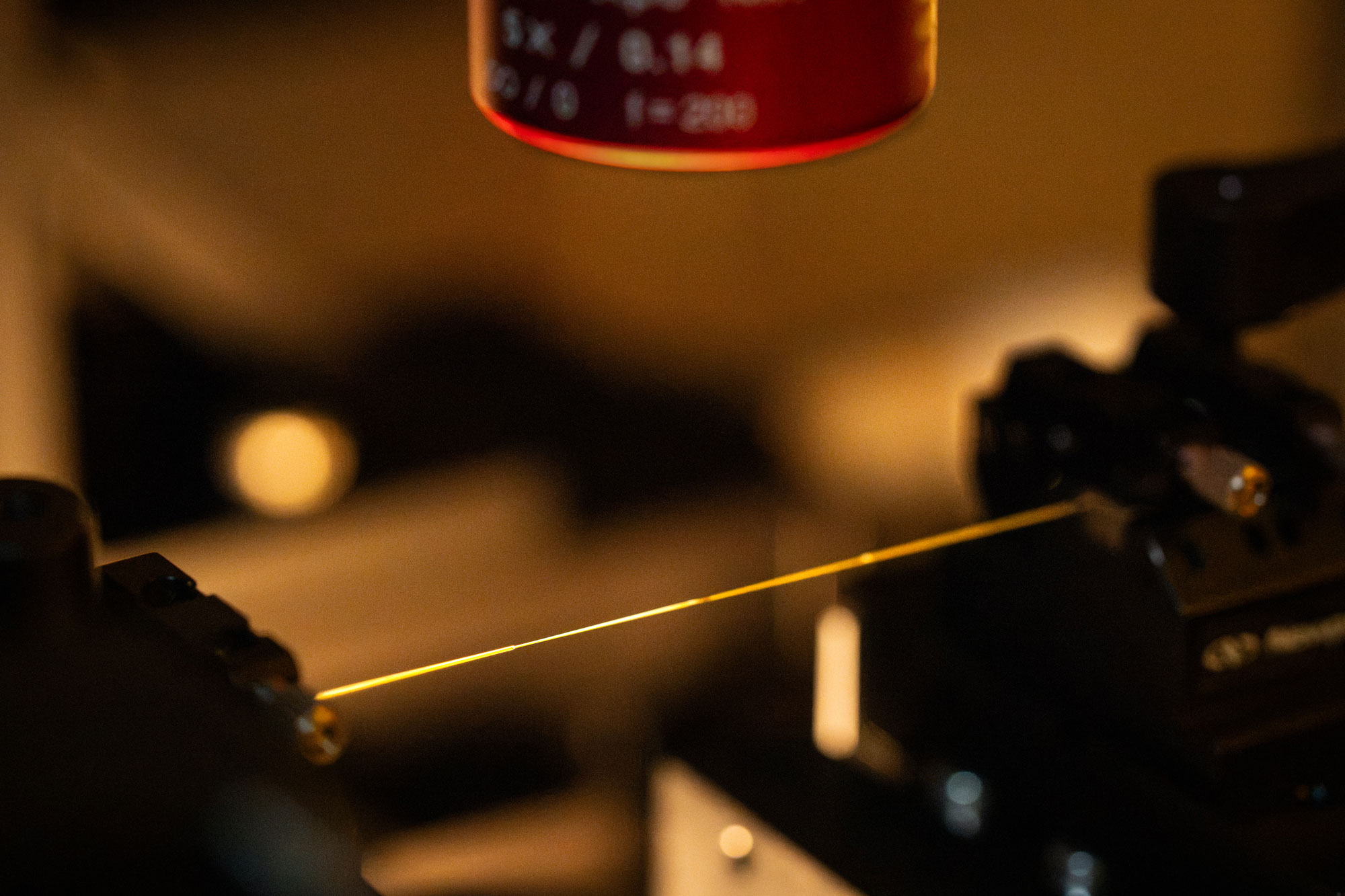
Their latest experiments trapped cesium atoms around an optical fiber only 420 nanometers in diameter using 5 milliwatts of optical power. The researchers also performed measurements related to atom interferometry using only 150 nanowatts. The longer-term goal is to move the technology onto a photonic integrated circuit small and rugged enough for use outside the laboratory.
Putting Quantum Navigation on a Guide
Atom interferometry relies on the wave-like behavior of matter.
In a conventional light-pulse atom interferometer, laser pulses manipulate ultracold atoms, splitting their quantum wave packets along different paths before redirecting and recombining them. Motion changes the phase relationship between those paths. Measuring the resulting interference provides an extremely sensitive way to detect acceleration or rotation.
For navigation, those measurements could help a vehicle calculate its movement without relying continuously on an outside signal. Sandia is developing quantum inertial and gravity sensors specifically for situations where GPS is unavailable or denied.
The challenge is making an instrument based on carefully controlled atoms and lasers behave reliably in a moving vehicle.
Sandia’s guided approach is easier to picture if the atoms are thought of as marbles. In a free-space atom interferometer, the marbles are dropped while lasers track them as they fall. Shake the system hard enough and the lasers can temporarily lose them.
The new approach is more like putting those marbles inside a pipe.
Laser light traveling through Sandia’s extremely thin optical fiber extends slightly beyond its surface, creating what is known as an evanescent field. By controlling those fields, the researchers create a tiny optical trap that holds atoms close to the fiber and guides them along its length.
If the fiber moves, the trapped atoms move with it instead of simply falling away from the interrogation region.
That could give guided atom interferometers an important advantage in aircraft, ground vehicles or other platforms where vibration is unavoidable.
Doing More With Less Laser Power
Reducing vibration sensitivity solves only part of the problem.
A field-ready quantum sensor also needs to become much smaller and consume far less power than laboratory equipment.
In Sandia’s latest experiments, cesium atoms were trapped around the 420-nanometer optical fiber using 5 milliwatts of optical power. Sandia says the trapping technique requires roughly one-sixth to one-fourth the power used by previous approaches.
The team also used fiber-coupled beams with only 150 nanowatts of power to measure atomic coherence in a way that mimics an atom-interferometry measurement.
Reducing optical power becomes particularly important as the researchers try to move the system onto a chip.
Lasers create the optical fields needed to trap and manipulate the atoms, but they also produce heat. In the vacuum environment required for cold-atom sensing, removing that heat is difficult. The problem becomes more significant as optical structures shrink.
A suspended waveguide provides good access for loading atoms around it, but it has little material available to conduct heat away. Mounting the waveguide on a larger solid substrate improves heat dissipation but makes it harder to surround the structure with atoms.
Sandia needed something between the two.
Building a Waveguide That Doesn’t Burn Up
The team’s next-generation design uses a membrane waveguide supported by small silicon pins.
The thin suspended region leaves space around the waveguide for atoms to accumulate. The silicon supports provide a thermal path that carries heat away from the optical structure.
The result is intended to combine the atom-loading advantages of a suspended structure with better heat dissipation.
That seemingly small design detail addresses a problem that has held guided atom interferometry back for years.
“Both heat dissipation and efficient atom loading are really important,” Sandia quantum sensing scientist Jongmin Lee said in the laboratory’s announcement of the research.
The optical nanofiber used in the recent experiments is not itself intended to become the final navigation sensor. Sandia describes it as a testbed that lets researchers study atom trapping and measurement techniques before transferring them to the membrane-waveguide platform.
The goal is eventually to integrate the guide and other optical components into a photonic integrated circuit.
Sandia has already developed several of the pieces needed for compact atom interferometry, including microfabricated atom traps, compact vacuum hardware and silicon-photonic laser systems. The laboratory has also demonstrated a compact cold-atom interferometer with a laser architecture designed to be compatible with photonic integration.
The guided architecture represents another step toward putting more of those functions onto a much smaller platform.
A Quantum Navigation Chip Isn’t Here Yet
The latest work does not demonstrate a complete chip-scale quantum navigation system.
The atom-trapping and measurement experiments were performed using the optical nanofiber testbed rather than the new membrane-waveguide photonic platform. The researchers still need to demonstrate the same capabilities on the integrated device.
Their next steps include trapping and guiding atoms on the membrane waveguide, applying momentum kicks during measurements and integrating additional components needed for a complete sensor.
The comparison with another quantum technology provides some reason for optimism.
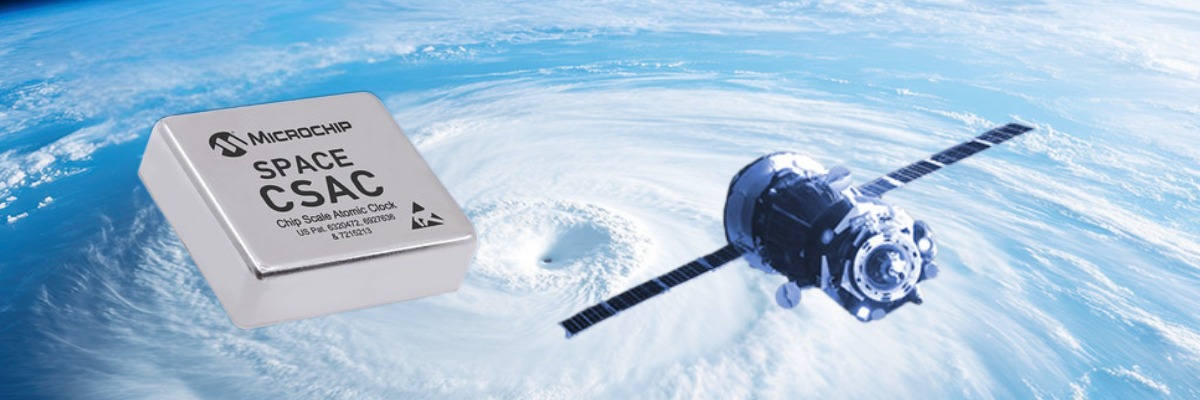
Atomic clocks once occupied laboratory-scale systems too. Work beginning more than two decades ago eventually reduced the technology into chip-scale atomic clocks small and rugged enough for commercial and defense applications. Sandia researchers hope atom interferometers could follow a similar path.
The challenge is greater than simply making the equipment smaller. A navigation sensor has to maintain its precision while the platform carrying it accelerates, vibrates and changes direction.
Guiding the atoms rather than allowing them to fall freely could help address that problem.
The result would not replace GPS where a reliable satellite signal is available. Instead, a sufficiently compact quantum inertial sensor could help a vehicle maintain an accurate estimate of its position when that signal disappears.
For quantum navigation to become useful outside the laboratory, precision alone is not enough. The sensor also has to survive the ride.