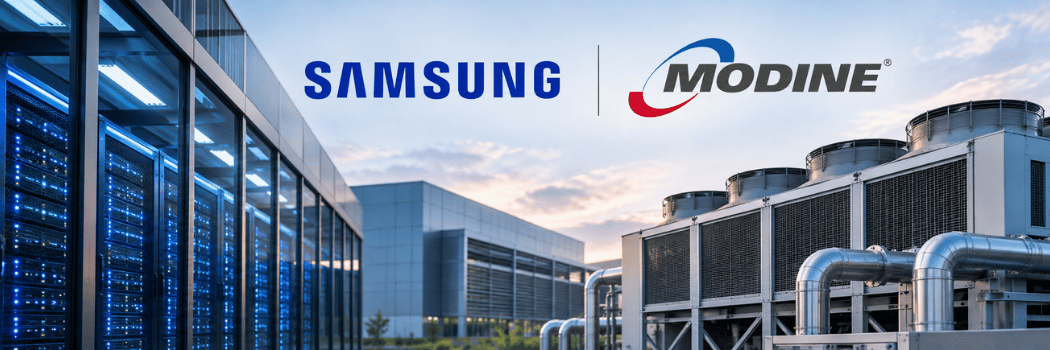

s AI workloads drive up server power densities, Samsung’s potential acquisition of Modine could expand its reach beyond semiconductors and into the thermal infrastructure needed to operate increasingly demanding data centers.
Samsung Electronics is reportedly in talks to acquire U.S.-based cooling systems manufacturer Modine, a potential deal that would give the South Korean technology company a larger presence in the rapidly expanding market for AI data center infrastructure.
According to a November 12 Bloomberg report, the companies have been discussing a transaction that could come together within weeks. The report cited people familiar with the negotiations, although no final decision has been reached and the talks could still fall apart. Reuters subsequently reported that Modine shares jumped approximately 29% in extended trading following the news. Neither company confirmed the discussions.
The possible acquisition comes as the computing demands of artificial intelligence are changing how data centers are designed. Higher-density servers generate substantial heat, placing greater demands on cooling equipment and the systems responsible for removing that heat from the facility.
For Samsung, acquiring Modine would offer an opportunity to participate in another part of the AI infrastructure market. Rather than supplying primarily electronic components and other technology, the company could play a larger role in the equipment that keeps high-performance computing facilities operating.
Why Modine Is an Attractive Acquisition Target
Modine, which changed its corporate name to Modexus Solutions in November, has spent recent years repositioning its business around thermal management, with a particular emphasis on data center cooling.
The company completed the separation of its Performance Technologies business in October 2026, allowing it to concentrate on data center cooling, commercial HVAC and refrigeration. The restructuring has made Modine a more focused supplier at a time when hyperscale cloud providers are investing heavily in new computing capacity.
Its data center business has become a significant growth driver. According to the company’s fiscal 2026 results, data center sales increased 73% to more than $1.1 billion, reflecting demand for cooling equipment used in large-scale computing facilities.
Modine has also been expanding its manufacturing operations to support that demand. On November 11, the company announced the start of commercial production at a new 682,000-square-foot facility in Grand Prairie, Texas. The plant produces Airedale chillers with cooling capacities of 2MW and 3MW for hyperscale and high-density AI data centers.
Those manufacturing capabilities are particularly relevant as data center developers face pressure to bring new facilities online while accommodating greater computing loads.
Modine’s product portfolio also extends beyond conventional air cooling. Through its Airedale brand, the company supplies coolant distribution units (CDUs), dry coolers and intelligent controls. Its CDU range, expanded in 2025, includes standard systems rated from 400kW to 2MW, supporting liquid and hybrid cooling architectures for high-density server installations.
This combination of cooling technologies, manufacturing capacity and established customer relationships could make Modine valuable to a company seeking a broader role in the data center supply chain.
Samsung Has Already Been Expanding Its Cooling Business
A Modine acquisition would build on Samsung’s existing investments in commercial and industrial cooling.
In November 2025, Samsung completed its €1.5 billion acquisition of European HVAC manufacturer FläktGroup. The acquisition expanded Samsung’s portfolio of commercial ventilation, air handling and industrial cooling technologies, giving the company a stronger position in the infrastructure market beyond its established consumer electronics and semiconductor businesses.
Samsung said at the time that it intended to use FläktGroup’s manufacturing and sales operations to strengthen research, product development and its global supply chain.
The company followed that investment with an August 2026 announcement outlining plans to invest approximately $158 million in a new HVAC production line in Gwangju, South Korea. Scheduled to begin operating in 2028, the facility is intended to manufacture FläktGroup cooling equipment, including systems for AI data centers.
Adding Modine could further expand Samsung’s cooling portfolio, particularly in North America, where Modine has established manufacturing facilities and relationships with major data center customers.
The potential combination would also give Samsung access to complementary products and expertise across several thermal management approaches, from facility-wide heat rejection to liquid cooling systems serving high-density server racks.
What the Deal Could Mean for Data Center Design
For data center operators and equipment designers, the implications go beyond another acquisition in the HVAC industry.
As AI accelerators become more powerful, cooling is increasingly influencing decisions about server density, electrical infrastructure and facility architecture. Traditional air cooling remains important, but higher heat loads are driving greater adoption of liquid cooling and hybrid systems that combine multiple methods of heat removal.
Modine has been developing products for this transition. Its Airedale coolant distribution units regulate coolant flow and temperature while separating facility water systems from the cooling loops serving IT equipment. The company has also developed chillers for high-temperature cooling architectures intended to reduce the energy required for mechanical refrigeration.
A larger Samsung cooling business could potentially affect how those technologies are developed and delivered. Combining expertise in electronics, controls and thermal management could create opportunities for more coordinated monitoring and operation of cooling equipment.
However, those benefits would depend on how Samsung integrates the acquired operations, whether the companies pursue common technology platforms and how much independence Modine retains.
The deal could also have implications for equipment sourcing. Large data center developers often depend on specialized suppliers for cooling infrastructure, and an acquisition could give Samsung additional manufacturing capacity and a stronger position in major infrastructure projects. At the same time, customers would need to evaluate how a change in ownership might affect product roadmaps, supplier relationships and long-term service support.
Acquisition Interest Comes Amid Growing Financial Pressure
Despite its expansion into AI infrastructure, Modine has faced challenges scaling its business quickly enough to meet demand.
A November 19 Reuters report said activist investor Jana Partners is urging the company to improve profit margins or consider a sale. According to Reuters, supply chain problems and other growing pains have affected profitability even as customer demand has increased.
Jana managing partner Scott Ostfeld discussed the company’s position at an investor conference on November 18, arguing that Modine should either improve margins or take advantage of acquisition interest in the thermal management sector.
Separately, Modexus announced a $500 million share repurchase program on November 18 and presented new long-term financial targets at its investor day. These developments add another dimension to the reported Samsung discussions, although they do not establish that an acquisition is imminent.
An acquisition could provide Modine access to Samsung’s financial and manufacturing resources, potentially supporting further capacity expansion. But any combination would also have to address the operational pressures that have accompanied Modine’s rapid growth.
Cooling Becomes a Bigger Part of the AI Infrastructure Market
Samsung’s reported interest in Modine reflects a broader change in the business of building and operating data centers.
The value of AI infrastructure increasingly extends beyond the processors and memory devices performing computations. Power delivery, heat removal and facility efficiency all affect how much computing capacity can be installed and operated within a given building.
That makes cooling equipment an increasingly important part of infrastructure planning. Decisions about coolant temperatures, heat exchangers, pumps, flow rates and facility controls can influence operating costs as well as the computing density a site can support.
A Samsung-Modine combination could strengthen competition among established thermal management providers and encourage further investment in integrated cooling technologies. It could also increase pressure on suppliers to demonstrate that their systems can accommodate future generations of high-density computing equipment without requiring extensive facility modifications.
For now, the proposed acquisition remains unconfirmed. But Samsung’s existing investment in FläktGroup, its planned manufacturing expansion and the reported Modine discussions point toward a larger strategic interest in data center thermal management.
As AI computing requirements grow, cooling is becoming an increasingly important factor in data center performance and economics. Whether or not Samsung completes the acquisition, its interest in Modine highlights how important the companies supplying that infrastructure have become.